Scientists using Chinese telesecope capture evolutionary process of mysterious flashes









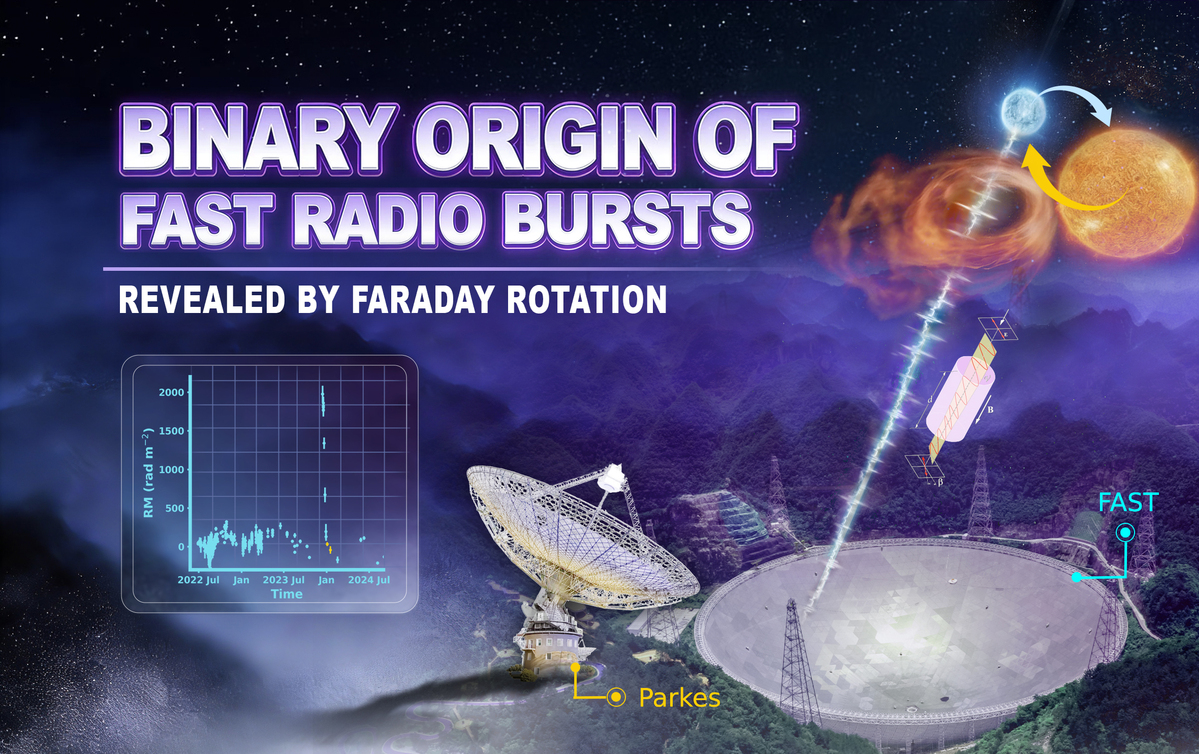
An international research team using China's Five-hundred-meter Aperture Spherical radio Telescope has found some of the strongest evidence yet that at least some fast radio bursts — mysterious flashes of radio energy from deep space — are produced by compact star binaries.
The discovery, published in the journal Science on Friday, comes from in-depth observations of a repeating fast radio burst known as FRB 20220529. This is the first time globally that scientists have captured the evolutionary process of such a burst, aiding in narrowing down the long-debated origins of these brief but powerful cosmic signals.
Like super lightning of the universe, fast radio bursts are extremely bright and transient radio phenomena, lasting only a few thousandths of a second, but releasing as much energy as the sun produces over an entire week.
Since the first fast radio bursts were discovered in 2007, astronomers have detected thousands of them; yet, their exact cause has remained unclear. Many scientists suspect they come from extremely dense stellar remnants such as neutron stars, but how they generate the bursts — and whether they do so alone or with a companion — has been an open question.
The new study, led by astronomers from the Purple Mountain Observatory of the Chinese Academy of Sciences in Nanjing, Jiangsu province, utilized FAST — the world's largest single-dish radio telescope — to monitor FRB 20220529 for more than two years from June 2022 to August 2024.
What caught their attention was a sudden and dramatic change in the environment around the source.
Radio waves can twist as they pass through clouds of charged particles threaded with magnetic fields, an effect known as Faraday rotation. By measuring how much the signal twists, scientists can infer what kind of material the radio waves traveled through.
Scientists found that for most of the observation period, the amount of twisting remained low and relatively stable. Then, in December 2023, it spiked sharply — increasing by about 20 times compared with normal variations — before gradually returning to its usual level over the next two weeks.
"This is the first time we have seen such a clear 'surge and recovery' in the magnetic environment of a fast radio burst," Wu Xuefeng, corresponding author of the study and a researcher at the Purple Mountain Observatory, said.
Wu said the most likely explanation is that a dense cloud of magnetized plasma — hot, charged gas — briefly passed between the burst source and Earth. The team compared the event to a solar coronal mass ejection, when the Sun violently throws out huge clouds of plasma that can disturb space near Earth.
Such a phenomenon is difficult to explain if the burst came from a lone neutron star. Instead, it makes sense, Wu said, if the source is part of a binary system, where a compact object such as a neutron star or magnetar orbits a companion star.
Violent activities from the companion star or the geometry of the orbit itself could send plasma clouds across the line of sight, temporarily altering the radio signal. Notably, intense coronal mass ejections are deemed the most plausible explanation, as supported by model fittings to the observational data.
The study therefore provided the strongest direct evidence so far that some repeating fast radio bursts originate in compact binary systems.
Duncan Lorimer, a professor of physics and astronomy at West Virginia University who first discovered the fast radio bursts in 2007, said, "It is an amazing result, and it's a testament to the power of the FAST in China to make these monitoring observations."
"Taking facilities like FAST, coupling them with survey instruments such as the Canadian Hydrogen Intensity Mapping Experiment, which initially found this particular repeating fast radio burst — we continue to transform our knowledge of these amazing objects," Lorimer said.
FRB 20220529 is a relatively faint source located in a disk-shaped galaxy about 2.9 billion light-years from Earth. While most of its signals are too weak to be detected by other telescopes, FAST's extreme sensitivity, combined with custom data-processing techniques, made it possible to track the changes in detail.
FAST, which began full operations in 2020, has become a major tool for studying pulsars, fast radio bursts, and the structure of the Milky Way. The telescope has produced key results in areas ranging from gravitational wave research to mapping hydrogen gas in space, demonstrating the core strengths of China's independently designed facility, from the independent control of key technologies to leading scientific output.
Sun Jinghai, senior engineer at the National Astronomical Observatories of the Chinese Academy of Sciences, said, "China is now planning a major upgrade to FAST, adding dozens of medium-aperture antennas around the main dish to form the world's only mixed synthetic aperture array centered on a giant single dish radio telescope."
"This upgrade would allow them to pinpoint fast radio burst sources with much greater precision," Sun said, adding that scientists hope that continued observations will eventually solve one of astronomy's biggest puzzles: what exactly produces fast radio bursts and why some of them keep repeating.






- Scientists using Chinese telesecope capture evolutionary process of mysterious flashes
- Man sentenced to 4 yrs for attempted homicide with gas in Henan province
- Changning ranks 2nd in GDP per capita among Shanghai's districts
- Experts: Regulations on AI smartphones needed to protect consumers
- Cold wave expected to sweep across China
- Xi calls for advancing building of China-Canada new strategic partnership