Japan must learn from history and commit to peace










Amid renewed militaristic rhetoric from some right-wing populists in Japan, it is important for the world to remind Japanese Prime Minister Sanae Takaichi and some of Japan's top policy advisers about the painful lessons from World War II, why Japan needs to choose peace over remilitarization, and the need to respect China's internal affairs regarding the Taiwan question.
The recent rhetoric came in the wake of China's celebrations last year marking the 80th anniversary of the victory in the Chinese People's War of Resistance Against Japanese Aggression (1931-45) and the World Anti-Fascist War.
These wars that defined the 20th century were not confined to the battlefields. They were also wars for preserving human civilization, wars for peace, and wars whose lessons shaped the international order that we live in today.
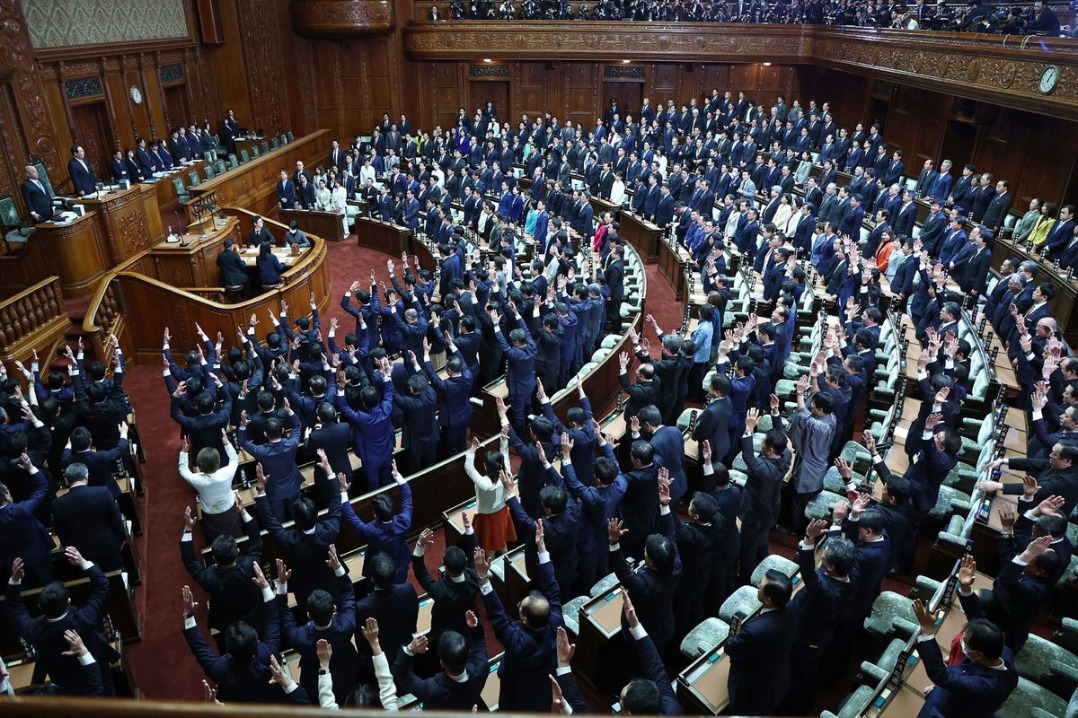
On Nov 7, Takaichi said in parliament that a so-called "Taiwan contingency" could constitute a "survival-threatening situation" for Japan, and she suggested that Japan might respond by intervening militarily. On Dec 18, a senior Japanese official in charge of security and defense at the prime minister's office told reporters that Japan should have nuclear weapons.
First, the correct history reminds us that the World Anti-Fascist War did not begin in 1939, as many Western-centered narratives suggest. It began on Sept 18, 1931, with the September 18th Incident, also known as the Mukden Incident.
The Chinese People's War of Resistance Against Japanese Aggression demonstrated that WWII effectively began in Asia rather than Europe.
This challenges the conventional framing that depicts the outbreak of World War II in 1939 with Germany's invasion of Poland.
As Takaichi and some of the far-right populist leaders in Japan might have forgotten, the 14-year struggle, which made China the main Eastern battlefield of WWII, caused casualties of more than 35 million Chinese nationals, and about 1.5 million Japanese troops, leaving painful scars of war that need to inform Japan's commitment to lasting peace.
Second, countries in the Global South also paid a heavy price during the World Anti-Fascist War. Troops, resources and supplies were mobilized, and millions of lives were lost. Yet from this suffering emerged the awakening of national liberation. The victory in the anti-fascist war accelerated the collapse of colonial empires and ignited independence movements across Asia, Africa and Latin America.
In addition, the postwar wave of decolonization led to the establishment of new states, reshaping the global political landscape and laying the foundations of today's multipolar world, from which Japan has also benefited immensely. After the war, countries embarked on a path to rebuild and experience true modernization. Currently, Global South countries are striving to build high-quality infrastructure, and any conflict, especially one directed toward China, would destabilize the global community and prevent the attainment of the global public goods offered by China-proposed programs, such as the Belt and Road Initiative. Thus it is imperative for Japan to advocate peaceful development over aggression to ensure that countries in the Global South — and specifically those in the Asia-Pacific region — can enjoy lasting stability.
Third, the postwar settlement was equally consequential. Taiwan's restoration to China was explicitly established in the Cairo Declaration of 1943 and reaffirmed in the Potsdam Declaration of 1945. Thus the Taiwan question, being an internal sovereign matter, does not threaten Japan's survival, raising questions about Takaichi's motives in framing it as a Japanese security concern.
Takaichi's remarks also counter the principles and spirit of the four China-Japan political documents — the 1972 Sino-Japanese Joint Statement, the 1978 Treaty of Peace and Friendship, the 1998 Joint Declaration and the 2008 Joint Statement — which together established principles of peace, mutual respect and cooperation, particularly regarding the one-China principle. These post-WWII lessons need to inform Japan to embrace peace and not remilitarize, especially knowing the true impact of the tragedy of the atomic bombings of Hiroshima and Nagasaki.
Yet geopolitical tensions are rising and the 2025 Global Peace Index shows a continuing decline in global peacefulness. Factors that often precede major conflicts — including provocative statements such as those by Takaichi and other populist leaders in Japan — are higher than at any time since the end of World War II. Such factors have led to conflicts that resulted in the loss of hundreds of thousands of lives over the years. Any provocative rhetoric from any leader on plans for remilitarization or war should be condemned by the global community.
History is a mirror, and only by drawing lessons from history can the world avoid repeating past calamities. The international community must, therefore, urge Japan's right-wing leaders to embrace peace over remilitarization. The devastation and atrocities of WWII, fears of a resurgence of imperialist tendencies and the potential for regional destabilization underscore the urgency of this call.
Therefore, Japan must uphold the principles of the United Nations Charter including peaceful dispute resolution, avoid remilitarization, and reject provocative statements from leaders who detest peace as proclaimed in Article 9 of Japan's Constitution.
The author is executive director of the China-Africa Center at the Africa Policy Institute in Nairobi, Kenya.
The views do not necessarily reflect those of China Daily.