China eager to invest in United States: diplomat
Updated: 2011-10-25 09:38
By Cheng Guangjin (China Daily)
|
|||||||||||


|
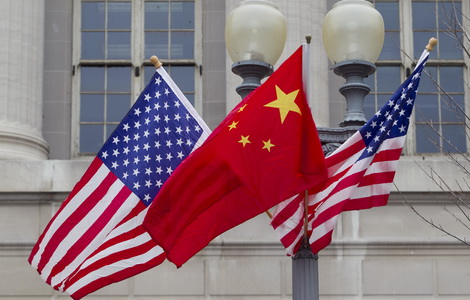 Flags of the United States and China in Washington DC. To help spur exports to China and boost domestic employment, six US governors visited China to explore trade opportunities last week. [Photo/Bloomberg] |
Ambassador stresses cooperation as key to peaceful bilateral relationship
COLLEGE STATION, Texas - China hopes to increase investments in the United States, which will boost the country's economy and create jobs, said China's top diplomat to the US on Sunday.
Speaking at the fifth China-US Relations Conference, Zhang Yesui, the Chinese ambassador to the US, said that potential sectors for investment include clean energy, environmental protection and infrastructure.
The biannual conference aims to promote, strengthen and expand academic and business collaborations between the two countries.
Zhang reiterated in his opening remarks that politicizing the China-US trade imbalance through legislation will only lead to a "trade war".
He called for a friendlier investment environment in the US for Chinese investors. Chinese investment in the US currently accounts for only a small portion in China's overall foreign direct investments.
"I am confident that there will be more Chinese investments in the US, which is not only good for investors, but also helps your economy and creates jobs in this country. This is very, very important," Zhang said.
Responding to a question on the US trade deficit with China, he said the trade imbalance is a combination of complicated factors and that China "does not believe that legislation is the appropriate mechanism", referring to a bill approved by the US Senate on Oct 11, which threatens to punish China for allegedly undervaluing its currency with retaliatory tariffs on imports from China.
According to Zhang, causes for the imbalance between the two countries include differences in structural trade and investment, saving and consumption behavior, and the international division of labor.
"Many of the manufacturing products the US imports from China are no longer produced in the US. If the US decided to stop importing from China, it has to import from somewhere else. Maybe for ordinary consumers, they have to pay more for the same quality of products," Zhang said.
He said if China and the US continue to look at each other with a Cold War mind-set, the two countries will be drawn into confrontation and conflict. However, "if we work together as partners, we would both emerge as winners", Zhang said.
He added that China and the US are undertaking massive efforts to restructure their economies, which will provide opportunities for increasing trade and investments, and expand cooperation in areas including clean energy and conservation, environmental protection, and infrastructure.
Zhang also highlighted the potential for collaboration at the local level.
To help spur exports to China and boost domestic employment, six US governors visited China to explore trade opportunities last week. Their visit follows the attendance of four Chinese provincial leaders at the US-China Governors Forum in Utah's Salt Lake City in July.
Zhang also called for the two countries to improve strategic mutual trust. "It is imperative to have an accurate understanding of each other's strategic intention and policy objectives," he said.
China and the US have launched many dialogue mechanisms, including the Strategic and Economic Dialogue, Strategic Security Dialogue and Asia-Pacific Affairs Consultation.
President Hu Jintao and US President Barack Obama have met nine times since the US president's first visit to China in 2009, with three more meetings ahead - the November G20 summit in France, the APEC summit in Hawaii, and the East Asia Summit in Indonesia.
"We should take advantage of the dialogue mechanisms we have put in place and use them fully and wisely in order to communicate in a prompt way and minimize the chances of conflicts and strategic surprises," Zhang said.
In the 40 years, bilateral relationships have been smooth and stable when both sides take into account the other party's core interests and rocky and strained when they do not, the Chinese diplomat said.
"How we finally choose to manage, shape and grow this relationship will determine its course in the next 40 years," Zhang said.
"A successful China can make our country more prosperous, not less," US Vice-President Joe Biden wrote in The New York Times after his visit to China in August.