Comments
  Print
Print  Mail
Mail  Large Medium Small
|
 Hankook Tire Group has invested $954 million in the Sino-Korean Industrial Park in Chongqing Liangjiang New Area. The company now has a production capacity of 2,400 truck tires a day and is expected to produce another 16,000 car tires a day in early 2015. [Photo / China Daily]
|
In Nov 1945, when Kim Gu, president of the provisional government of the Republic of Korea, finished six years of exile in Chongqing and left for home, he expressed his gratitude to the Chinese government in an open letter for its "generous" financial support, especially when China itself was also experiencing extreme hardship.
That wartime friendship has not been forgotten by South Koreans, in that many still choose to pay a visit to the site of their exiled government when they visit China.
Now, as Chongqing, the largest city in China by population, opens itself to the world in pursuit of economic progress, memories of those dark days are frequently cited as an important emotional link between the two East Asian countries, which have a tradition of building business ties on personal relationships.
South Koreans are not only guided by old alliances, but are also lured by the exciting business opportunities in western China, which is still relatively underdeveloped compared with the eastern coastal region.
In September 2011, the two governments signed an agreement to launch the Sino-Korean Industrial Park in Chongqing Liangjiang (Two Rivers) New Area, the third national development area approved directly by the State Council after Shanghai's Pudong New Area and the Binhai New Area in Tianjin. It is also the third industrial park jointly built with a foreign country, after ones in Suzhou and Tianjin, both in collaboration with the Singapore government. This gave South Korea a foothold in a strategically important growth engine in China.
"In the 1980s, watch Shenzhen; in the 1990s, watch Pudong; in the 2000s, watch Binhai; in this new decade, watch Liangjiang." The catchphrase repeatedly propounded here, crystallizes a feeling of pride and expectation that, for too long, the inland mega city, a temporary capital during World War II, had been resting on former glories and envying the prosperity of once lesser-known cities, such as Shenzhen and Suzhou, brought about by their proximity to the international market. Now, finally, it is Chongqing's time.
In the past decade, the "go west" campaign launched by the central government changed the landscape of the less-developed western provinces - highways, railways, bridges and airports have been built on a massive scale; GDP growth has been faster than their eastern counterparts for the past six years; and people's incomes have grown considerably.
Chongqing has more reasons to be optimistic. In 2010, a 1,200 square kilometer area across from the north bank of the city's central Yuzhong peninsula was pinpointed as a "New Area", a national-level pilot zone to test new policies, introduce foreign investment and drive future growth.
As China opens up more, expanding from the east coast to areas along major rivers and borders, Chongqing is well positioned as the largest city on the upper stretch of the Yangtze River, China's golden waterway.
It is also the starting point of a strategic inter-continental railway line, crossing north through the Xinjiang Uygur autonomous region, Kazakhstan and Russia to Duisburg in Germany. After the route opened, Chongqing suddenly found itself at the forefront of opening-up to the European market.
"We do not regard ourselves as an inland city. We consider Chongqing as a yanbian (along the border) city," says Hao Ming, deputy director-general of the administrative committee of Liangjiang New Area, which houses the Sino-Korean Industrial Park.
"Foreign companies do not regard the western area only as a production base. Rather, they deem it as the gateway to a 300-million population market."
Hao's views are shared by many Korean businessmen working in Chongqing, attracted by what they see as a huge and largely untapped market.
"It is definitely the center of the western region," says Chang Maeng-Keun, factory director and vice-president of Hankook Tire Group, which is investing $954 million in the Sino-Korean Industrial Park.
Completed this June, the first phase of the project has a production capacity of 2,400 truck tires a day. When the second phase is finished in early 2015, the company expects to produce another 16,000 car tires a day.
Hao says the fact the investment was made before there was a whole-car production factory in the city underlines Hankook's eagerness to access the market. Although Chongqing is an auto parts and motorcycle manufacturing hub, less than 30 percent of Hankook's tires are sold in western China.
Because most of Hankook's products are either transported by trucks or ships to other markets, sound infrastructure was another reason why Hankook settled on Chongqing, Chang says.
The Chongqing plant is Hankook's third in China, after Huai'an in Jiangsu province and Jiaxing in Zhejiang. Chang has overseen both these factories for more than 10 years. He says Chongqing's electricity and gas prices are 30 percent cheaper than for the eastern plants. He claims that although the company pays the same wages for Chongqing workers, they are more diligent and efficient.
However, it isn't all smooth going. When Hankook decided to open the factory in Chongqing, China's GDP growth was still above 10 percent. This year it has dropped to less than 8 percent and tire sales are currently lower than expected. China's labor costs have also risen significantly since the factory was built, which forced the company to increase investment in automatic equipment.
 Buick Riviera concept car at 2013 Auto Guangzhou
 FAW-VW all-new Golf at Guangzhou auto show
 VW donates more than 5k child safety seats
 Honda models at 2013 Guangzhou auto show
 Honda Jade at the 2013 Guangzhou auto show
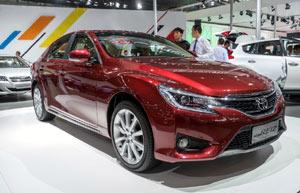 Toyota's new Reiz debuts at 2013 Auto Guangzhou
 Jimmy Lin Zhiying, models at Toyota pavilion
 Volvo all-new S60L world premiere at Guangzhou auto show

Copyright 1995 - . All rights reserved. The content (including but not limited to text, photo, multimedia information, etc) published in this site belongs to China Daily Information Co (CDIC). Without written authorization from CDIC, such content shall not be republished or used in any form. Note: Browsers with 1024*768 or higher resolution are suggested for this site.
License for publishing multimedia online 0108263 Registration Number: 20100000002731