Technological innovation, industrial upgrades and balanced economy can help maintain momentum
Most economists think China's economic growth had to slow down. As one notes, economies that were once the world's fastest growing such as Japan and South Korea maintained 8 to 10 percent growth for 20 years, then slowed to 7 percent or less.
China has maintained rapid growth for 33 years, averaging close to 10 percent a year for most of that time, so how is it possible to continue to sustain that?
Other economists have found that when a country's per capita GDP reaches $11,000 in terms of purchasing power parity, economic growth slows down to 7 percent or less. China hit $11,904 last year, the World Bank says.
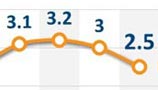
Starting with the first quarter of 2010, the growth of China's economy has steadily declined. In 2013, growth dropped to 7.5 percent in the second quarter. After the government introduced policies to encourage growth, it rebounded to 7.8 percent. But in the fourth quarter, it was down to 7.7 percent.
The government's goal for this year is 7.5 percent. The rate was 7.5 percent in the second quarter after falling to 7.4 percent in the first quarter.
But that does not mean the Chinese economy is going down the chute. India in 2010 grew by 10.5 percent; in 2011 it was 7 percent; 5.3 percent in 2012; and 4.9 percent in 2013. In Brazil in 2010, the growth was 7.5 percent, and in 2011 and 2012 it was only 2.7 percent and 0.9 percent, respectively. Compared with those cases, the performance of the Chinese economy is still relatively good.
To understand this situation, one must understand the nature of economic growth and high growth determinants. The essence of economic growth is the increase in per capita GDP. Rapid economic growth is a phenomenon that appeared only in modern society.
Before the 18th century, the average annual growth of per capita GDP was only 0.05 percent in Europe. From the 18th century until the mid-19th century, GDP per capita rose 20-fold, reaching an average of 1 percent per year. From the mid-19th century to the present, the growth of GDP per capita has doubled, reaching an average annual 2 percent.
These huge changes in growth are all due to technological innovation that has driven a continuous improvement in labor productivity. Also, as high value-added industries emerge, labor and resources are transferred from low to high value-added industries.
Continuous technological innovation and industrial upgrades are determinants of high economic growth, and they apply to both developed and developing countries. Since the Industrial Revolution (1760-1850), developed countries have been at the forefront of technology and industry around the world.
Innovations and upgrades relied on their own research and development, with R&D costs huge and risks high. The technology used in developing countries mimics and introduces elements from the developed countries, so the costs and risks of R&D are much lower. This is called the later advantage.
According to research led by Nobel laureate Michael Spence, after World War II, 13 economies used this later advantage to achieve annual GDP growth of 7 percent or higher, and maintain it for 25 years or longer, while the average annual growth of GDP per capita was 2 percent in developed countries. Coupled with population growth, their average annual GDP growth was 2.5 to 3 percent. The growth of these 13 economies was twice that of developed countries.
After reforms that began in 1979, China became one of these 13 economies. Since the rapid economic growth of the past 30 years relies on the later advantage, the most important factor in determining whether China still has the potential for rapid growth is to find out how much of the later advantage the country has left.
The average per capita GDP level reflects the status of a country's labor force, as well as that of its overall technology and industry. In terms of purchasing power parity, in 2008 China's per capita GDP reached 6,725 yuan (about $986 at 2008 rates), 21 percent of that of the United States that year. That was similar to Japan's situation in 1951, Singapore's in 1967, and South Korea's in 1977, according to the late British economist Angus Maddison.
That gap with the US allowed Japan to maintain 9.2 percent average annual growth for 20 years. Singapore's was 8.6 percent, and South Korea's 7.6 percent. These economies all used the later advantage to achieve average annual growth of 7 percent or higher for 25 years or more.
Of course, continuous technological innovation and industrial upgrades are prerequisites for making full use of the later advantage. On the one hand, China needs to make sure companies receive the correct signals. On the other, the government should play a prominent role in overcoming market failures, external difficulties and coordination problems during the upgrade process.
China needs a two-track system, with a market economy as the engine while the government assists in the economy's healthy development. That should help resolve problems like unequal distribution of income, development of monopolies and corruption in favor of social harmony and stability.
Building the best type of government-led development model is conducive to China's economic comparative advantage. Besides, it will also help the government deal effectively with problems like reduction of the demographic dividend as society ages and weakness in the international economy, so China can move closer to its potential GDP growth of 8 percent.
The author is vice-chairman of the All-China Federation of Industry and Commerce and honorary dean and professor with National School of Development of Peking University.
|
 |
 |
| SAP sees China business up in the cloud | The history of cloud computing |

Copyright 1995 - . All rights reserved. The content (including but not limited to text, photo, multimedia information, etc) published in this site belongs to China Daily Information Co (CDIC). Without written authorization from CDIC, such content shall not be republished or used in any form. Note: Browsers with 1024*768 or higher resolution are suggested for this site.
License for publishing multimedia online 0108263 Registration Number: 20100000002731