BEIJING - Overseas experts say that the Chinese economy is making major strides in the right direction, as the country is undergoing an upgrade of its development pattern from an investment- and export-driven model to one driven by innovation and consumption.
Great changes
Over the past few decades, particularly since the adoption of the policy of reform and opening up in 1978, great changes have taken place in economic development in China, and the people's livelihood has significantly improved as a result, in sharp contrast to what used to be in the past.
For centuries, China continued to disappoint foreign businessmen, "not least because many ordinary people have been too poor to buy anything." But great changes have taken place in the Chinese economy over recent years, which is being driven by new engines such as e-commerce, said a report published on The Economist in September.
Official data showed that the scale of China's e-commerce financial market reached 6 billion yuan ($937 million) in 2013 and online trade exceeded 15 billion yuan ($2.34 billion) in 2014. With a growth rate estimated to reach 94 percent in the next three years, the whole e-commerce market is expected to exceed 100 billion yuan ($15.62 billion) in 2017.
New sectors of the Chinese economy have seen such rapid growth thanks to the optimization and upgrade of its structure.
In the eyes of Stephen Roach, senior fellow of Yale University's Jackson Institute of Global Affairs, China has two models of economy: the old one driven by fixed investment and exports, and the new one boosted by private consumption.
The old model, which fueled China's economy growth in the past three decades, is decelerating, while the new model is still in its incipient stage, he said at a seminar held in China Institute of Global Affairs in November.
Services activity grew 8.4 percent year on year in the first half of 2015, far outstripping the 6.1-percent growth in manufacturing and construction, according to an article written by Roach recently.
In 2014, the service sector contributed 48.2 percent to China's Gross Domestic Product (GDP), exceeding the combined 42.6 percent share of manufacturing and construction, according to the article.
The shift toward a services-based new model lifted the downside pressures in the manufacturing-based old model, he said.
Roach predicated that the service sector could account for 65 percent to 70 percent of China's economy in next 20 years.
"The key understanding of China is not the number of GDP, but the mix of economy," said Roach.
Market still attractive
In the eyes of some entrepreneurs, the Chinese market, despite the slowdown, is still attractive as it is being reinvigorated by the Chinese government's reform and the new model of the Chinese economy will generate great opportunities.
"China's economy is headed for a rough year or two, but the longer-term outlook for business remains positive. Our members are staying here and investing in China's future growth," another report of The Economist quoted Jorg Wuttke, president of the EU Chamber of Commerce in China, as saying.
John Rice, vice chairman of General Electric Co, agrees that the easy gains in China have been made, but reckons that "many firms haven't tried hard enough."
With a population of 1.4 billion, China packs such a punch that even niche markets like online dining and nail salons can amount to more than the entire car industry in a smaller country, the report cited Rice as saying.
Many of China's people are getting richer all the time, the report said.
McKingsey, a consultancy, estimates that by 2020 the proportion of urban households with annual incomes of 15,000-33,000 US dollars (a rough definition of the country's middle class) will be 59 percent, against only 8 percent in 2010, according to the report.
"Chinese consumers are fast becoming the world's most discriminating and knowledgeable. They are also quite brand licentious. The choice of top global brands there is much wider than in America, Europe or Japan. This has resulted in fierce competition, pushing firms to come up with ever more inventive offerings," the report said.
Clear-headed leadership
Roach, the US expert on China, said an economic rebalance highlighting services and consumption does not mean that Beijing has ignored traditional sources for growth.
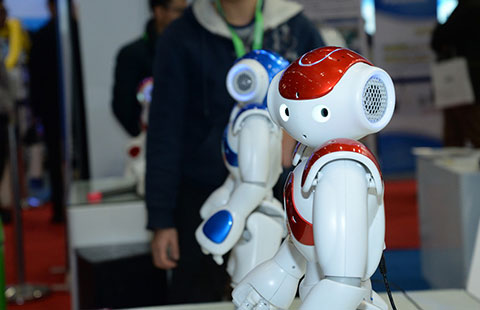
The Chinese government has unveiled the "Made in China 2025" plan, the first 10-year action plan designed to transform China from a manufacturing giant into a world manufacturing power, and "Internet Plus" action plan that aims to integrate the Internet with traditional industries and fuel economic growth.
The move is in accordance with the innovation strategy highlighted by the Chinese leadership, which they think is the key to avoid falling into the middle income trap, a theorized economic development situation where a country which attains a certain income will get stuck at that level, Roach said.
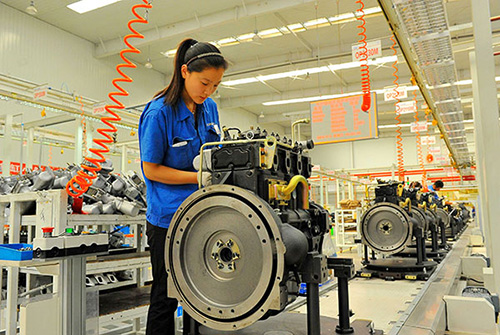
McKinsey also said that China's manufacturing industry is not declining. Instead, it is benefiting from the investment on labor productivity, automation and regional network of supply, while the underdeveloped service industry will produce great opportunities.
Louis Kuijs of the Royal Bank of Scotland pointed out that China's income per person at market exchange rates in 2013 was only 13 percent of that of the United States, so there is plenty of scope for catch-up growth, particularly if the government adopts reforms that free up the private sector, according to the Economist report.
"China can look back on 2015 and be well satisfied with its economic performance," said Professor James Laurenceson, deputy director of Australia-China Relations Institute, University of Technology Sydney.
"I'm reassured that China's leaders appear clear-headed about what needs to be done. Reform and challenging vested interests is never easy in any country but on the basis of what we've seen this year, there is greater cause for optimism than pessimism," Laurenceson said.
Besides, Beijing's measures to encourage the development of renewable energy and green industry that helps reduce contamination, protect the environment and change China's current energy structure, have "broad prospects for development," Sun Qingyun, associate director of the US-China Clean Energy Research Center at West Virginia University, told Xinhua.
Both Chinese enterprises and households have potential in reducing energy consumption. Upgrading some energy-consuming and outdated equipment and improving energy efficiency will create new opportunities for investment and become a new approach for driving economic growth, Sun said.

Copyright 1995 - . All rights reserved. The content (including but not limited to text, photo, multimedia information, etc) published in this site belongs to China Daily Information Co (CDIC). Without written authorization from CDIC, such content shall not be republished or used in any form. Note: Browsers with 1024*768 or higher resolution are suggested for this site.
License for publishing multimedia online 0108263 Registration Number: 130349