Li Wei, president of the Development Research Center of the State Council.[Photo/Xinhua]
Editor's note: Li Wei, president of the Development Research Center of the State Council, shared his insights on the current economic challenges China faces and the strategies to overcome them with China Daily reporter Zheng Yangpeng.

Although China's economic growth has slowed, its growth rate is still high compared with the rest of the world. In 2015, the Chinese economy expanded by 6.9 percent, or more than $700 billion, equivalent to the total GDP of Turkey the world's 18th-largest economy.
According to the National Bureau of Statistics, China's growth contributed 25.8 percent of the world's economic growth last year, 1.1 percentage points higher than that of the United States. India's economy grew faster than China, but its contribution to the world economy is less than one-ninth that of China. Meanwhile, China's imports of commodities are still growing. Imports of crude oil, for example, grew by 27 million metric tons, the exchange rate of the renminbi remained stable, and foreign direct investment and Chinese outbound direct investment grew steadily.
China undoubtedly remains a major driver of the global economy.
So why is China blamed for other countries' woes? Facing the sluggish growth of the global economy, many countries have pinned their hopes of recovery on China. The larger their hopes are, the more concerns they have about the Chinese economy. This is natural. Of course it is possible that some countries hope we will repeat the actions of 2009, rolling out massive stimulus measures so they can benefit from it. Whatever the motives for their blaming China for their woes, the most effective solution is to strengthen communication and guide people in other countries to look closer and longer at China so they can better understand it. We should share with them our confidence in China's economic fundamentals and our ability to manage the economy.
Many observers think that to ensure growth of between 6.5 and 7 percent over the next five years, China will have to resort to stimulus, which could intensify the imbalances in the economy. How do you evaluate the growth range set by the government?
China has the conditions to achieve an average growth rate of 6.5 percent over the next five years. Its level of savings is relatively high, it still has plenty of room to catch up in technology, and, although the working-age population is declining, the quality of the workforce is improving due to the expansion of tertiary education.
Whether we can transform that potential into reality depends on our ability to macro-manage. If we get the direction, the intensity and the pace of our macro-management policy right, and if it is well coordinated with other policies, such as industrial policy and structural reform, we can reduce the high corporate leverage and achieve a new equilibrium.
The central government's push for supply-side reform has been widely lauded, but it has also faced some doubts. Some economists think the biggest challenge at present is weak aggregate demand, and they have called for more emphasis on demand-side management. What do you think?
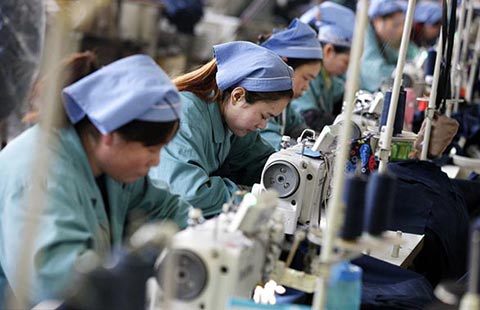
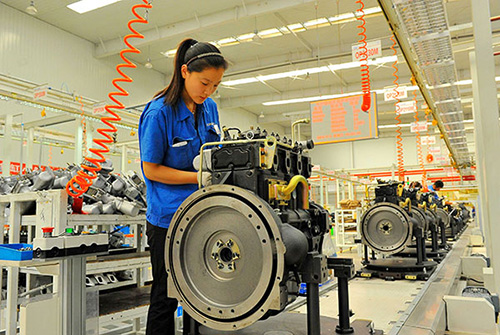
The largest problem now is not the weak aggregate demand, but that supply doesn't match the changing demand. On the one hand, there is overcapacity in the traditional industries, especially the heavy industries, and the pace of reducing the overcapacity is slow. On the other hand, consumer demand is becoming increasingly diverse and services-oriented. There is rapidly growing demand in areas such as healthcare, senior care, leisure and culture. Chinese consumers spent more than $200 billion overseas last year, which illustrates that our supply can't meet the demand.
Of course, we'll keep the demand-side modestly expansionary in order to create an accommodative environment for supply-side reform.
Is it possible to reduce the tax burden on businesses and reduce the fees they pay? Tax cuts will reduce government revenues, how will the conflict between the reduced income for governments and their bigger spending responsibilities be reconciled? How do you view the international warning line of a 3 percent fiscal-to-GDP ratio?
China has the room to cut the taxes and fees for businesses. China's tax system is dominated by indirect taxes, which enterprises can transfer to consumers. If the tax burden on enterprises is modestly lowered, they will have more room for new investments and the taxable base will be enlarged. There is also a lot of room to cut the administrative fees charged companies, which are even higher than taxes in some localities. We could also reduce enterprises' social security payments.
That said, businesses cannot rely on cuts in the taxes and fees they pay. The deciding factor remains their individual innovation.
The 3 percent red line was proposed by the European Union in 1991 and has been credited with maintaining a country's fiscal prudence. But in practice there should be some flexibility. In recent years, not many Western nations have adhered to the line. For China, 2016 is the first year of its 13th Five-Year Plan (2016-20) and greater fiscal policy support is required. An appropriate increase in the deficit ratio is both conducive to the plan and necessary. But we could not rely on this for too long.
Some local officials complain that there are too many directives from Beijing that they don't have enough time to implement them fully. There also seems to be too much talk about reforms and not enough implementation. How can Beijing give local officials more room and more incentives to advance reforms?
These opinions are not completely true. Actually many reforms are on track. However, many have yet to be completed and the public have yet to feel their effects. But when implementing reforms, we should be alert to local officials' anxieties and exhaustion. Reforms need to be practical and an oversight mechanism for their implementation needs to be established.
The central government should grant more authorization to local governments to encourage them to innovate, and an evaluation mechanism needs to be established that tolerates mistakes and failures.

Copyright 1995 - . All rights reserved. The content (including but not limited to text, photo, multimedia information, etc) published in this site belongs to China Daily Information Co (CDIC). Without written authorization from CDIC, such content shall not be republished or used in any form. Note: Browsers with 1024*768 or higher resolution are suggested for this site.
License for publishing multimedia online 0108263 Registration Number: 130349