|
|
A local potential buyer test-drives a Beijing Automotive Industry Holding Co's truck model under the guidance of Guo Lei, general manager of Foton East Africa Ltd, a subsidiary of BAIC, in Nairobi, Kenya.CHINA DAILY |
BAIC is set to complete three manufacturing bases in order to target five regions for growth
Foreign carmakers injecting billions into China to ride the country's fast-growing market is passe. Over the past few years, the two-decade-old cliche has been making way for a new theme as Chinese auto companies such as Beijing Automotive Industry Holding Co decided to go global with their easily serviceable and inexpensive products.
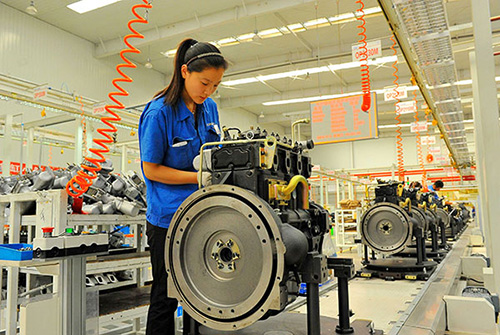
BAIC is one of China's largest automakers in terms of sales. It will complete building three global manufacturing bases in South Africa, Mexico and Ruili of Yunnan province by the end of 2017. This will likely help it to compete with established global rivals such as Toyota Motor Corp and Ford Motor Co.
BAIC will build more than 100 after-sales service centers in five major regional markets: North Africa, North America, Southeast Asia, Central Asia and Eastern Europe. That will help brighten its brand image and bolster its sales networks.
Xu Heyi, chairman of BAIC, said Chinese vehicle manufacturers who used to rely on gaining easy money through joint venture brands, are shifting focus to global markets as growth in the domestic markets has more or less bottomed out.
The company has set for itself a sales target of 300,000 units globally by 2020 through exports and overseas factories and different assembly lines. It will also deploy more resources in markets that are part of the Belt and Road Initiative.
The initiative, proposed by the Chinese government in 2013, envisages a Silk Road Economic Belt and a 21st Century Maritime Silk Road covering about 4.4 billion people in more than 60 countries and regions in Asia, Africa and Europe.
China's 15 major automakers, including Chongqing Lifan Group and Great Wall Motors Group, have established 61 overseas plants. They produced more than 270,000 vehicles in different regional markets in 2015, data from the Ministry of Commerce show.
They have also created a $19.7-billion export market for auto parts from China.
BAIC, which has subsidiary joint-venture companies including BAIC Hyundai Motor Co Ltd and Beijing Benz Automotive Co Ltd, had adopted the original equipment manufacturer or OEM business model for its Mexico factory initially. The idea was to limit its investment to a certain level in order to pre-empt large losses due to possible political uncertainty.
With an investment of 5 billion yuan ($773 million) in South Africa, BAIC plans to produce up to 100,000 units per year at its new manufacturing base in Port Elizabeth from 2018.
Construction will begin next month and production in November 2017. The Port Elizabeth factory is expected to entail the largest one-time investment in South Africa and even Africa.
It will be operated as a joint venture with the involvement of South Africa's Industrial Development Corporation, which is a financial company providing capital support for the country's enterprises and investment projects.
The new manufacturing base will produce passenger vehicles, sport utility vehicles, minivans and vans. It will create 2,500 jobs directly, and over 10,500 jobs for upstream and downstream industries indirectly.
"Continued foreign and domestic investments in infrastructure development, such as roads and town expansion, will be key factors for sustained economic growth in our five major regional markets, especially in Africa and Southeast Asia during the next decade," said Xu.
Buoyed by the surging demand for new vehicles in Africa, BAIC established a minibus assembly plant that employs more than 500 people in Springs, a South African town in 2013.
Xu said the company will increase its investment in its South Africa production base and the assembly plant in Nairobi, Kenya, to produce pickups and light trucks.
As China and other partners are accelerating the pace of the ongoing negotiations to upgrade the China-ASEAN Free Trade Agreement, Xu said the company will add more products and part-fund warehouses in its manufacturing base in Ruili of Yunnan province by the end of 2017, to compete with foreign brands in the markets of Southeast Asia.
The Chinese company has already built a number of plants, research and development centers in India, Pakistan, Russia, Italy, the Netherlands and the United States. It had managed to sell 40,000 vehicles in global markets through its 24 overseas plants and 124 sales branches in 37 countries and regions by the end of 2015.
Cai Jianjun, vice-president of BAIC, said that as is the case in most African countries, where new cars are beyond the reach of most people, used vehicles command a large share of the market, with the proportion being 70 percent in most Sub-Sahara African countries such as South Africa, Ghana, Ethiopia, Angola and Kenya.
The disadvantage of such a big used car market is that the brand life of some cars can be as long as 20 years, and anyone with one of the old models can face problems in obtaining spare parts.
"Consumer trends there indicate that buyers go for vehicles they know they can buy spare parts for in the nearest town," said Cai.
Cai said this is a new growth opportunity for BAIC because the company can provide spare parts in sufficient quantities and technical services on time through locally built warehouses, established logistics and service networks.
"The auto market is usually seen as a barometer of the macroeconomy, since it reflects the scale of GDP, consumption power, regional trade and the developing level of industrialization, as well as infrastructure development," said Zhao Ying, a researcher at the Institute of Industrial Economics under the management of the Chinese Academy of Social Sciences in Beijing.


Copyright 1995 - . All rights reserved. The content (including but not limited to text, photo, multimedia information, etc) published in this site belongs to China Daily Information Co (CDIC). Without written authorization from CDIC, such content shall not be republished or used in any form. Note: Browsers with 1024*768 or higher resolution are suggested for this site.
License for publishing multimedia online 0108263 Registration Number: 130349