Opinion
Building up economic confidence
(China Daily)
Updated: 2010-09-27 11:46
 |
Large Medium Small |
Financial considerations will dominate policies next year because of a lack of credit, say academics
PHILADELPHIA, Pennsylvania - The present global economic and financial crisis is not merely the most severe episode of economic downturn and financial distress since the Great Depression.
It represents a stark reminder that the global economy is undergoing important transformations. Financial systems, policymaking by governments and central banks, the relative weight of emerging economies, and the global financial architecture are all in flux.
Defining scenarios for 2011 requires a careful consideration of how each of these moving parts will affect the overall structure and performance of the global economy.
Financial matters will continue to dominate policymaking debates during 2011 for several reasons.
The main one is that the economic recovery, especially in the richest countries, is being delayed and undermined by the persistent problems with credit flows. Within the financial system, the continuing lack of confidence among financial intermediaries, especially banks, has diminished the expected positive effects of low interest rates and quantitative easing by central banks.
In addition, trust between financial institutions and non-financial firms has not yet been rebuilt. The amount of credit flowing around the economy is not enough to sustain the incipient recovery.
The stress tests conducted in Europe during the spring of 2010 were meant to restore confidence in financial institutions and to help return the financial system to a state approaching normality. Still, liquidity is not moving easily around the economy, even with the additional efforts being undertaken by central bankers.
Emerging economies
While the richest economies cope with slow growth, persistently high unemployment and financial volatility, the emerging economies are surging ahead, increasing their share of global production, savings, and consumption. Growth rates in Asia, Latin America, the Middle East, and Africa are poised to exceed those in Europe, the United States and Japan in 2011 and beyond. Perhaps the most surprising case is that of the economies of Latin America. This is the first major global financial crisis since the collapse of the Bretton Woods system in the 1970s during which the economies of the region have not been near the epicenter of the financial turbulence.
Latin America will grow in 2010 by more than 5 percent and in the vicinity of 4 percent in 2011, a slowdown caused by weak demand from two of its major customers, the US and Europe. It is also important to note that this growth scenario in Latin America is free from the historically severe macroeconomic imbalances afflicting the region. Brazil has consolidated its position as one of the most relevant actors on the global financial and economic scene. Brazil's outstanding economic policies in recent years, which will help the economy grow this year by just over 7 percent and about 4 percent in 2011, will remain a benchmark for many other emerging economies. Moreover, Brazil is not only exporting raw materials or semi-processed goods, but also such high-tech items as regional jets, automotive components, and sugarcane ethanol.
|
 |
|
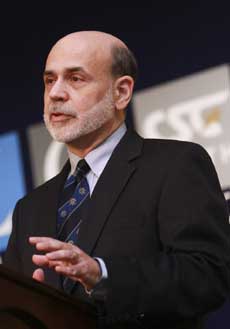
Ben S. Bernanke, chairman of the US Federal Reserve, speaking in Charleston, South Carolina. Mauro F. Guilln, a professor at The Wharton School, and Emilio Ontiveros, an academic at Universidad Autnoma de Madrid and Analistas Financieros Internacionales, said in a jointly-written article that the global economic recovery, especially in the richest countries, was being delayed and undermined by persistent problems with credit flows. Mahmood Fazal / Bloomberg |
Emerging economies are increasing their exports to other emerging economies, a sign that their economic bonanza may become self-sustaining. In addition, domestic consumption is growing as both the government and households spend on goods and services. For instance, retail sales in the emerging economy have grown by nearly 60 percent since the beginning of 2007, compared with almost no growth in the advanced economies. The rise of a large middle-class of consumers and savers in countries such as China, India and Brazil will be felt around the world. It goes without saying that companies all over the world will need to adjust their product designs, production locations, and marketing and distribution strategies to this important new development.
The year 2011 will be tough for the majority of Organization for Economic and Co-operation Development economies, and especially the US, Japan, and the European Union, as foreshadowed by growing risk aversion among investors in these countries. Growth rates will likely continue to be below these economies' long-term potential. Economic policies will enjoy even less room for maneuver and continue to be in uncharted territory. During 2011 the new regulations on banking will be implemented in many advanced countries. More strict risk management systems and less de-leveraging will be two of the main consequences that will result from the new regulations. Stronger financial regulations, we have to recall, mean higher costs for the non-financial sector of the economy. In this case, it will mean also a closer monitoring of corporate borrowers and a smaller propensity to provide financing for the growth projects of non-financial companies.
In the United States the recovery is softening more than expected. Household indebtedness and the absence of job growth are inhibiting consumer demand, the key element in the expected recovery. The government and the Federal Reserve (Fed) will need to cope with persistently high unemployment and a housing market that may take years to recover. These two variables will continue to create problems for the financial system. The process of de-leveraging by US households during 2011 in the absence of robust economic growth will put even more pressure on the government and the Fed to engage in another round of economic stimulus. The debate on the future of US macroeconomic policy is wide open, and it will exert a great influence not only on academic literature but also on the direction of policymaking in other advanced economies.
In Japan the economic and financial signals are not good either. The country faces a demographic problem, accentuated by years of economic underperformance, a pusillanimous financial sector still reeling from the real estate problems of a generation ago, and an export sector whose superior performance cannot compensate for the problems in other parts of the economy. The recovery is equally fragile in the US, and is presently being threatened by the appreciation of the yen, which the central bank is attempting to arrest. The pursuit of different policies by different countries in an attempt to address specific national problems does not facilitate a global management of the crisis.
Challenges in 2011
In spite of Germany's excellent growth record in 2010, driven in part by its dismal performance in 2009 and, of course, by increasing demand from China, European countries will face in 2011 a number of challenges. Budget deficits will be hard to erase in the absence of growth. Tax increases and cuts in public spending will likely depress growth even further. Policymakers in most European Union countries will face a hard balancing act between laying the foundations for sustainable growth in the medium to long term and addressing the difficult economic and employment outlook in the short run and the growing rate of structural unemployment. Members of the eurozone face the additional hurdle that their companies rely on bank credit (as opposed to capital markets) to a greater extent than in the US. Thus, the slow, gradual normalization of credit flows continues to place a limit on the pace of recovery in the real economy and in employment. Paradoxically, the European Central Bank may be the world's monetary authority most willing to remove the exceptional support to the banking systems under its jurisdiction that it has established since the beginning of the crisis. In 2011, the combined GDP growth of the eurozone is not likely to exceed 1 percent by much, about the same as in 2010. Under this growth scenario, unemployment will not decrease.
| |||||||


Calls for the reduction of global economic and financial imbalances will be made during 2011 and for as long as economic growth, trade balances, financial reserves and economic well-being continue to be as unevenly distributed globally as they presently are. These problems cannot be fully resolved within a short period of time, such as one year. But the most important points of disagreement, including exchange rates and restrictions to financial investment, need to be part of the global policy conversation and agenda, so that the present imbalances do not bring about another round of economic and financial instability and crisis. Given the limited scope of conventional macroeconomic policies, international coordination has become an essential pillar sustaining the confidence of economic agents worldwide. Confidence is one of the most important factors to underpin a strong recovery.
Mauro F. Guilln is a professor at The Wharton School. Emilio Ontiveros is an academic at Universidad Autnoma de Madrid and Analistas Financieros Internacionales.