Questions remain over safety of bottled water
Updated: 2011-08-16 09:24
By Wu Wencong (China Daily)
|
|||||||||||


|
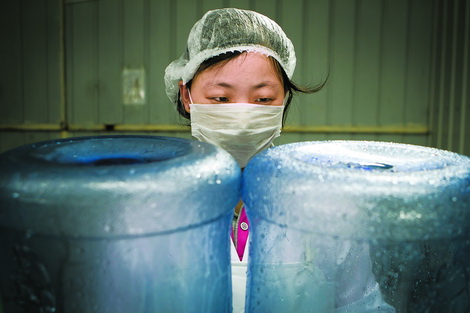 A worker, wearing a hygiene mask and hair covering, examines containers at a bottled water plant in Beijing's Chaoyang district on Monday.[Photo/China Daily]
|
|
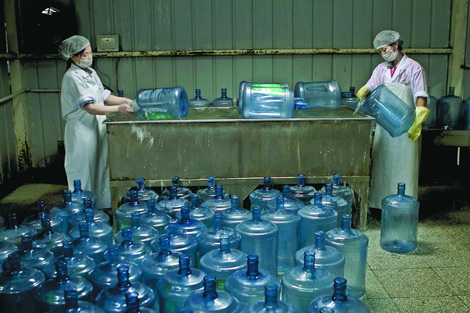 Workers clean empty bottles before filling them with purified water at Beijing Kangtai Gaoke Co. Experts suggest choosing a relatively reliable brand to lower the risk of drinking contaminated water.[Photo/China Daily]
|
Brand reliability provides buyer with no guarantee of product's purity, reports Wu Wencong in Beijing.
The era of drinking water from the tap has been over for years, says Li Fuxing, director of the Beijing Institute of Public Health and Drinking Water. But there are no guarantees that the water you take from a dispenser is safe, either.
There are too many opportunities for contamination, in every step of the process, from water source to the 18.9-liter container that is delivered to your home or office.
Choosing a relatively reliable brand can lower the risk. But before that a thorough understanding of drinking water and the dispensing industry is more effective than buying by price or brand name.
"In China, people's level of knowledge about drinking water is unbelievably low," said Li, who has been conducting research in water and health for almost 20 years.
They don't know, for example, that they should drink eight to 10 glasses of water a day.
He reached that conclusion based on an online survey, released in March, that drew about 70,000 responses - 80 percent of which showed ignorance of the basics of water and health. Still, Li said, the proliferation of choices in drinking water shows that consumers want to do the healthy thing.
First, they know that many sources of drinking water are fouled by industrial waste or other sources of pollution. On Sunday, for example, water experts arrived in Qujing, Yunnan province, to investigate after highly toxic waste was dumped at a water source - not a rare occurrence.
Second, Li has said previously that the delivery of treated water often means traveling through pipes that could be 60 years old and risks from byproducts of disinfectant chlorine.
So 10 million people subscribe to water dispenser services, spending more than 30 billion yuan ($4.7 billion) annually, Li said. Asia tops the world in the growing pace of the industry, and China leads the way with a rate of roughly 20 percent a year.
In some cities, Li said, more than 60 percent of households get their drinking water delivered in the big bottles, sometimes called barrels. Yet on July 6, the capital's industry and commerce administration reported that 31 water brands had failed regular safety checks. All exceeded the allowable count of aerobic bacteria; one brand, Liquan, was 9,000 times over the limit.
In an interview with China Daily, Li broke down the hidden dangers in the production and distribution processes for water that comes in "barrels".
The source
He started, logically, at the water source. Most of the water, especially mineral water, comes from the aquifer deep underground. When pollution occurs in nearby, contaminants can easily sink into the groundwater.
"I saw it with my own eyes in Jiangxi province, where local people raise ducks and do their washing up near a water source," Li said.
In addition to sources of ordinary water, about 3,000 sources for mineral water in China are considered qualified, meaning they meet certain standards for the level of minerals in the water, or did at the time they were certified.
After that, he said, few follow-up checks are conducted. "Authorities pay most attention to the finished products."
The water is then pumped into the production line, which is supposed to precipitate the sediment and purify the water. However, Li said, "Pipelines and the filtration system need backwashing and cleaning on a regular basis. Otherwise the disinfection process itself will become a contamination process."
Beyond regular spot-checks by authorities, the drinking water industry relies heavily on checks by the factories themselves. This usually occurs after the water has been bottled and before it is shipped, Li said.
"No companies, big or small, can guarantee that all of their products meet quality standards. That's why the self-check mechanism is a must," he said. "If it exists only in name, as in many cases I know about, there will be higher possibilities for substandard products to reach customers."
Related Stories
China arrests 2,000 suspects in food safety overhaul 2011-08-04 09:51
'Monitor food safety at the source' 2011-06-30 13:10
The dos and don’ts for food safety 2011-06-17 16:30
China beefs up food safety control in rural areas 2011-06-15 14:06
- Questions remain over safety of bottled water
- Local govt debt risk 'is under control': Ministry
- Haier sees sharp rise in H1 profit
- HTC to increase mainland outlets
- Tax watchdog says govt document forged
- Relativity, Huaxia form film partnership
- Home buy limit drives rent to soar in Beijing
- Hong Kong stocks end over 3% higher--Aug 15