For now, all that glitters is only gold
Updated: 2011-09-20 13:36
By Julian Jessop (China Daily)
|
|||||||||||


|
Pang Li / China Daily |
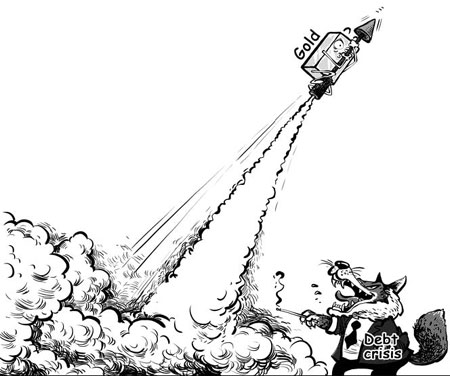
Gold's spectacular rise over the past decade has seen its price climb from $256 per ounce in 2001 to more than $1,900 at its recent peak before sliding a little. In the early stages the main driver was the boom in emerging economies. Rapidly rising incomes increased the demand for gold as a status symbol and store of wealth at a time when the supply of newly mined gold was struggling to keep up.
But since the global economic crisis began in 2008, gold has also become a mainstream financial asset, increasing in demand as insurance against the risk of a surge in inflation and as a safe haven from other shocks.
Confidence in "paper" currencies, notably the US dollar, has been declining, and very low interest rates in the major economies have reduced the opportunity cost of holding an asset such as gold that does not pay any income. Finally, the surge in gold prices has encouraged the development of new products that have allowed more people to participate in the market. Even the central banks of many countries have switched from being net sellers of gold to net buyers.
After such a long bull market, people are inevitably starting to ask whether gold prices are now forming a bubble. This is a difficult question to answer, because it is hard to determine a fair price for an asset that has no income stream. But there are two approaches that we can take.
The first is to compare the current price of gold to that of other assets and to its own history. Gold has been much more expensive in the past relative to equities and other commodities such as oil. What's more, after adjusting for inflation, the current price of gold is still well below the record of around $2,500 in real terms that was reached in 1980. On this basis, gold prices are not forming a bubble.
The second approach is to look at the factors that have recently driven gold higher and ask whether these are likely to continue or instead go into reverse. One downside risk to gold prices is that global inflation fears are likely to fade as economies slow down and other commodity prices, notably oil and key agricultural products, drop back. Headline inflation already appears to be close to a peak in most major economies, including China. This will reduce demand for gold as an inflation hedge.
Another downside risk is that the cycle of monetary easing by the major central banks, led by the US Federal Reserve, is now largely complete. The worst scenario for gold prices would include a strong economic recovery that reduces safe haven demand as well as allows the Fed to return interest rates to more normal levels. This scenario is unlikely in the foreseeable future.
But the Fed seems to be losing its appetite for further quantitative easing (QE), in part because of the risk that it would drive commodity prices higher again. Any further action from the Fed this year is therefore likely to be limited to lengthening the maturity of its existing holdings of US Treasury securities ("Operation Twist") rather than a third round of outright purchases (or QE3) that would have done more to boost gold.
A final downside risk is that the dollar is coming back into favor as a safe haven. The currency and bond markets have shrugged off the downgrade of the US sovereign credit rating by Standard & Poor's and the dollar has begun to recover against the euro. This would reduce demand for gold as an alternative to the dollar, which at least for now remains the world's dominant currency.
All of these potential negatives, however, could be more than offset by continued strong demand for gold as a refuge from other shocks. Gold is the ultimate safe haven because its value is not dependent on the creditworthiness of any government or financial institution, nor can its stock be increased in the same way that monetary authorities can create money.
In my view, the financial crisis in the West that began with the banks was only temporarily eased by transferring the problems to governments in the form of massive budget deficits. The worsening debt crisis in the eurozone is the most extreme demonstration of this and is likely to provide continued strong support for gold. If, or when, fears that the eurozone is about to break up become widespread, gold price would probably rise significantly further.
Uncertainty about the economic and financial implications could trigger a run on European banks and a collapse in confidence in the creditworthiness even of the German government. At the very least gold price could then be expected to return to the previous record in real terms or even rise further.
The author is chief global economist at Capital Economics, a London-based independent macroeconomic research consultancy.