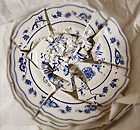
Art market sees a different picture
Updated: 2011-12-19 15:03
By Zhang Yuchen (China Daily)
|
|||||||||||


|
An artifact which was once stored in a Qing-dynasty (1644-1911) palace is displayed in Suzhou, Jiangsu province. After several years of huge profits, the country's art market experienced a bleaker picture this winter. [Photo/China Daily] |

Falling sales after boom paint a new scene for dealers and galleries, Zhang Yuchen reports from Beijing.
The temperature remained below freezing even at noon, and the wind howled. Even so, a few people stood outside their shops in Panjiayuan just to have something to do.
The people trying to pass the time were gallery owners or assistants and this should be by tradition, despite the weather, a hot time of year for antiques and art.
"People used to flock into the shop at this time of year to select and buy jade objects for their collections or as presents for their friends," a shop assistant said. "But now I may sit here for a whole day without selling a single item."
The art market cooled this fall after several boom years. Both collectors and investors are buying less in retail stores and at auctions.
While some observers think the art bubble is about to burst, many experts consider it a normal correction to the market.
The autumn auction season brought in 40 billion yuan ($6.3 billion) to the 219 auction companies tracked by Beijing-based Art Market Monitor of Artron. That's a drop of 6.6 percent from the spring season's 42.84 billion yuan. However, some auction companies reported their business volume was down 30 percent.
Artron's general manager, Guan Yu, wasn't surprised, given the government's tightening of monetary policy. "We surveyed the market after the spring auction season finished and forecast that the market would shrink this fall."
Experts also figured that the spring results were pushed to new heights by big profits flowing from the real estate and stock markets, and that the autumn results reflect the slower economy.
Some auction companies acted to keep their business steady by holding back items they thought would not sell at the anticipated price. Then, on Dec 5, Poly Auction in Beijing sold a Xu Beihong (1893-1953) masterpiece, Cultivation on the Peaceful Land, for 266.8 million yuan ($42 million). That set a world record for works by the father of modern Chinese painting.
"Rationality is what I saw in this autumn's auction results," said Wu Yishen, a collector from Shanghai who also is the great-grandson of Wu Hufan (1894-1968), an important 20th century painter in China. "In the circumstances this fall, buyers still carefully chose some particularly good objects to invest in heavily, through which we can see the support for China's arts market."
A bigger circle
Public trading of art has a relatively short history in China. The first auction house, China Guardian Auctions Co. Ltd, was established in 1993 with government assistance.
"Before that, collectors and art lovers only traded privately. Art collection was an issue within a small circle," Kou Qin, director and vice president of China Guardian, said at a summit hosted by Zhilan Yaji, an art collectors and dealers club, on Dec 8 in Beijing. Soon the small circle expanded.
In 2005, China's leadership encouraged people to "increase their property income instead of their labor revenue," and people took the opportunity to manage and increase their money through investments, said Liu Shuangzhou, a professor in the law school at Central University of Finance and Economics.
With the economy booming, art joined stocks and real estate as a financial tool. Its market closely followed the capital markets starting in 2006.
In 2009, the prices paid for several art items opened what art auction people call the Era of a Hundred Million Yuan. Stockbroker Liu Yiqian bought a piece of Song Dynasty (960-1279) calligraphy for more than 170 million yuan, which approached the world record for Chinese painting and calligraphy at the time.
Last year, China became the No 1 arts market with one-third of the world market share, according to Artprice.com, a market monitor and analyst since 2000. The United States had held that rank.
Seeing, setting value
Dong Guoqiang, president of Beijing Council International Auction Co, explained how the market has changed: "Now we are facing not only the traditional collector, who sees the value of items in terms of art and culture, but also the investors with a huge amount of capital who have taken to art as a way of increasing their fortunes."
Chinese calligraphy or a painting worth more than 100 million yuan today might not have fetched 10 million just 10 years ago, said Hu Yanyan, director of the painting and calligraphy department at China Guardian Auction, but now the public recognizes its value.
"Though this year the whole market is not as good as expected, we are still impressed by the consumption capacity of our new customers," said Jiang Wei.
"They paid quickly for the collection items and inquire little about the investment value in the future."
Jiang works at Beijing A&F International Auction. He said these customers have huge buying power and the next step the auctioneers should take is to find ways to cultivate them in a new area, art as an investment. Maybe only 1 percent will come to truly appreciate the art, he said, but "what we really want is those who can truly consume the arts right now."
Individuals are not the only investors capable of boosting the market. Nearly 30 arts funds companies on China's mainland entered the market controlling a total of 5.8 billion yuan, according to a recent report on a one-year survey by Money Journal magazine and Xinhua Holdings. These funds buy art strictly as an investment, using pooled money, and usually do so anonymously.
Risky business
Big capital participation in the market means bigger potential for peril, too.
In the era before such large sums were invested, "we assessed the value of an art or antique item according to its quality, its historical price, its scarcity, etc," said Gong Jisui, an arts administration professor at Central Academy of Fine Arts. But now, he said, valuers have to anticipate how all that capital will influence an item's future price. "That is risky."
So is the possibility that a painting or other artwork may not immediately turn into cash. The transaction channels remain comparatively narrow.
Wu Yishen, the collector in Shanghai, mentioned a "long-term troubling problem - whether an art item or antique is genuine or fake."
The central government also has shown concern about artwork exchanges, which trade art similarly to stocks. It has limited some agents in their pooling of money.
No worries?
"I never hold the thought that we are facing a falling market," said Zhao Xu, executive director of Poly Auction in Beijing. "China's art market experienced several rounds of ups and downs as it was influenced by financial crisis or equilibrium in power between buyers and collectors. They are not at all big deals, since professionals ensure the market won't fall."
Wang Jie, managing director of Tiancheng International Auctioneer, sees the cooling down as a sign that the market is maturing and buyers are becoming rational. This means they will be more selective, she said, paying the highest prices only for art of the highest quality.
Wang, who joined the Shanghai office of Sotheby's in 1994, noted that sales in China's art market in 1999 totaled $199,000. Last year, they were $150 million.
"So it is just a transition period," she said. "We can make the most of it by doing some education work to cultivate a new generation of collectors."
Write to zhangyuchen@chinadaily.com.cn
|
The last night of the fall Poly Auction on Dec 9 in Beijing, which ended with a total hammer price of 4.95 billion yuan. [Photo/China Daily] |

|
Top: A visitor studies work by Zhang Daqian (Chang Dai-chien), a master of Chinese painting, during a preview to Sotheby's auction on May 31 in Hong Kong. Children Playing Under a Pomegranate Tree (left), painted in 1948, sold for US$9.56 million. Lotus and Mandarin Ducks (right), 1947, set an auction record for the artist at $24.5 million. [Photo/Xinhua] |


Related Stories
Art market picks up pace 2010-09-15 09:42
Spring comes to art market 2009-04-13 07:45
Asian art market sizzles 2011-04-04 10:25
Art scene slumps in dry market 2009-12-24 10:36
- Art market sees a different picture
- Tax adjustments point to environmental protection
- Yuan funds for forex drop for 2nd month
- Centrally administered SOEs profits rise 3.6%
- Beijing reaches annual 'blue sky days' target
- Calls for more taxis as congestion mounts
- Company still has eyes on Iceland and US
- Tmall recruits buyers in anti-fake campaign