Culture is new growth source
Updated: 2012-01-10 09:35
By Chen Keyu (China Daily)
|
|||||||||


Sector helps to promote other industries and increasingly adds to gross domestic product
BEIJING - As the global financial downturn worsens, China is looking to its cultural industry for stimulus to shore up its slowing growth and to sustain its economic restructuring.
|
 |
|
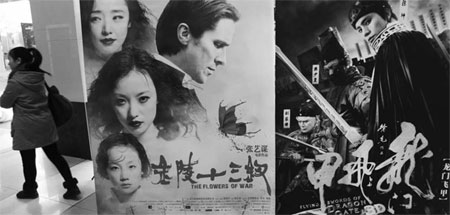
Two well-known Chinese films - The Flowers of War and Flying Swords of Dragon Gate - advertised on a billboard in a cinema in Nantong, Jiangsu province. Despite the rapid development of the culture industry, it currently contributes less than 3 percent to the country's gross domestic product, according to the National Bureau of Statistics. [Photo/China Daily] |
|
 |
A statement released at the conclusion of a plenary session of the 17th Communist Party Central Committee in October last year said that China should spur the development of its cultural industry, making it a "pillar" of its national economy.
Added value from China's cultural industry rose 25.8 percent year-on-year to 1.1 trillion yuan ($172 billion) in 2010, making up only a 2.75 percent share of the gross domestic product (GDP), according to data from the National Bureau of Statistics (NBS).
China is ambitious to double it in the coming five years.
A report released in November by Huabao Securities Co Ltd predicted that the added value from the cultural industry would reach 2.79 trillion yuan by then.
Cai Wu, minister of Culture, also expects the cultural added value to contribute 5 percent to GDP by 2016.
The cultural industry has already seen a prospering trend in recent years, with its added value growing 24.2 percent on average every year from 2008 to 2010, compared with 23.3 percent between 2004 and 2008, according to NBS data.
Liang Da, an expert with the statistics authority, attributed the development of the cultural sector to China's economic boom, government's favorable policies and its combination with scientific innovation attracting investment. But he said the cultural sector still had "huge potential" to grow due to its growing market demand and important role in spurring employment and growth in related sectors. Liang estimated the sector was worth about 5 trillion yuan in potential demand.
"Development in culture, an emerging sector, would foster new economic growth engines, promoting industrial upgrades and growth in the service industry," said Liang.
He said the cultural sector, "environmentally friendly and driven by innovation and technological investment, was unique in its sustainability", adding that the highly value-added sector could produce high returns.
"Cultural products, if accepted by consumers, will produce a multiplied effect in economic returns," he said, citing publications, films, cartoons, games and stage shows as such products.
In 2010, box office revenues from cinemas amounted to 10.2 billion yuan nationwide, with 313 cinemas and 6,256 film screens added, according to a report by Beijing-based Business Value. The revenue was expected to reach 13 billion yuan in 2011, according to the State Administration of Radio, Film and Television (SARFT).
The SARFT granted permission for 14,685 episodes of TV series in 2010, with data showing that 84 percent of the produced series could be sold.
The cartoon sector earned 20.8 billion yuan, with 74 percent reaped from the market for related cartoon products.
"The creative design in the cultural sector is closely related with the agricultural, industrial and service sectors," Liang said, seeing an integrating trend between culture and the wider economy. "It plays an irreplaceable role in promoting the inner quality of traditional sectors," Liang said.
Financial institutions have sensed the opportunity, speeding up investment in the emerging sector.
Su Wenli, manager of the product management department with the Industrial and Commercial Bank of China, was quoted by Dongfang Daily as saying banks were willing to invest in the cultural industry because of its huge potential.
In December, Bank of China (BOC) announced a 3 billion yuan loan to Hengdian Chinese Film Industrial Park, a leading filmmaking base in eastern Zhejiang province, over three years.
The move, an extension of BOC's 2010 credit program with the film park, is seen as an important step by financial institutions in support of China's cultural industry.
On Dec 20, Chen Yuan, chairman of the China Development Bank, pledged 200 billion yuan in financing capital to support the cultural sector over the next five years.
By the end of November, the bank's outstanding loans to the sector stood at 118.2 billion yuan. Since the beginning of last year, 15 investment funds for the cultural sector have been established, with combined capital of 38.15 billion yuan. Culture-related companies also seek to be listed in stock exchange markets.
Huabao Securities Co Ltd's report showed more than 180 cultural companies planned to be listed, among which were 54 from the printing sector and 52 from the cartoon and film sector. The report forecast that 20 to 30 companies would be listed each year over the next five years.
Beijing has 44 listed cultural and creative enterprises, accounting for 22.9 percent of the total number nationwide, with initially financed capital of 34.07 billion yuan, according to Zhu Yuanguang, deputy director of Beijing Municipal Bureau of Financial Work.
Zhu added that more than 120 such companies in Beijing met the financial standards to be listed.
Liang also saw some problems hindering development in the culture industry.
"The culture industry is still only a small part of GDP and most of the companies are small," Liang said, adding that the government needed to invest more in the sector.
Furthermore, lower per capita disposable income and consumption also challenge China's cultural ambitions, said Liang.
Although urban residents' per capita spending on cultural entertainment activities rose 127.4 percent to 559 yuan in 2010 from 431.6 in 2005 - an average annual growth rate of 17.9 percent, according to the NBS - it formed only a 12.1 percent share in urban residents' total consumption, compared with 35.7 percent spent on food.
For rural residents, cultural entertainment took a 7.4 percent share in their consumption in 2010, while food took 41.1 percent, according to the China Statistical Yearbook 2010.