|
|
|
 |
|
|
|||||||||
Chinese firms going abroad try to contribute to local development
As Chinese companies expand globally, they are not merely buying up raw materials and tapping new markets.
They are also adding local jobs, establishing universities and research institutions and building up community schools and hospitals in an attempt to improve their reputations and establish better relations with local communities.
Chinese companies have added significant numbers of local employees, according to a report that was conducted by the World Economic Forum and Boston Consulting Group and was released on Tuesday.
The report was compiled using reviews of 95 Chinese companies with large overseas operations and interviews with 130 senior executives, researchers and corporate citizenship experts.
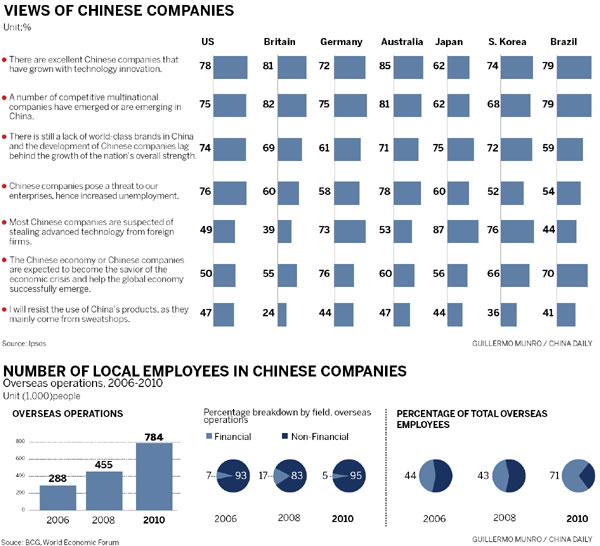
The report said Chinese companies hired 784,000 people overseas in 2010, almost triple the 288,000 hired in 2006. Of those, 71 percent were local residents, compared with only 44 percent in 2006.
Companies in the mining, construction and transport industries contributed the most to overseas employment, according to the report. For example, the China Railway Construction Corp hired 26,000 local employees in 2010 and China Petroleum and Chemical Corp, or Sinopec, hired 14,000.
Although financial companies in general contributed little to overseas employment, the Bank of China outperformed other companies in that regard, hiring 28,000 people.
Chinese companies also helped train local residents. For example, ZTE Corp, a telecommunications equipment and network solutions company, has worked with various institutes in Indonesia to train local residents. The Industrial and Commercial Bank of China regularly recruits employees from developing countries and sends them to its headquarters in China for training.
"As for local employees, we started from having none in countries such as Algeria and Angola", to having them make up one-third of the company's workforce in such places, said Ma Chuanfu, vice-president of CITIC Construction Co Ltd. "We are training local residents. We expect the proportion of local workers on our staff could finally reach 50 percent."
Ma said various obstacles have impeded the plans to hire local workers; many people in Angola, for instance, have received scant training, he said.
As a result, Chinese construction companies tend to prefer using Chinese workers.
"In Europe and America, certain local employment requirements have to be met," Ma said. "But in most African countries, that's not the case. We have given their government a choice: Should we use local workers and expand construction time or use more Chinese workers and finish the work within a shorter time? Most of them prefer the latter."
Hu Houkun, deputy chairman of Huawei Technologies Co Ltd, a leading information and communications-technology company, said Huawei's ability to make profits in Europe has not increased quickly in recent years. The biggest reason for that, he said, is that the company has invested heavily in local research and development centers.
"Huawei didn't see this as a problem because we think about it in the longer term," Hu said. "We see the strategic value of these investments."
Huawei has also found alternative ways to exhibit corporate responsibility while still making profits. In the rain forests of Bangladesh, people are often too poor to afford monthly phone services. They want to use mobile phones only when they need to seek help for the sick and elderly or when they want to speak to children who have moved away.
Inspired by locals' consumer behavior, Huawei managed to set up what is known as a "phone lady" arrangement.
Huawei decided to divide the cost of its phone service into very small amounts. It has also asked unemployed rural women to be "phone ladies" and act as de facto distributors of its fragmented product.
"This project has become very popular," Hu said. "Local women have gained employment opportunities, remote villagers have got service and we have entered a difficult market."
He said the case is typical and shows that corporate citizenship is mainly about matching companies' advantages with local demand in order to deliver a mutually beneficial result.
"Chinese companies should try to understand corporate responsibility and global citizenship in much deeper ways," Hu said. "They are not all about donations."
zhengyangpeng@chinadaily.com.cn
 |