|
|
|
 |
|
|
|||||||||
Scandals, delistings, and decreases in earnings estimates hit investors hard
Profit warnings, auditor disputes and delistings involving Chinese mainland companies trading on foreign exchanges are fueling investor distrust, wiping out valuations and poisoning the market for new listings.
The 180 Chinese mainland companies that have gone public in New York, Hong Kong and on other global exchanges since the start of 2010 are trading on average 21 percent below their offer prices, according to data compiled by Bloomberg.
At least six disputes have broken out this year between auditors and Chinese mainland companies listed in Hong Kong. More than a quarter of Chinese mainland companies that went public on the city's main board in 2010, a record year for volume, have lowered forecasts since they started trading, compared with less than 10 percent of non-Chinese mainland companies that had IPOs there that year.
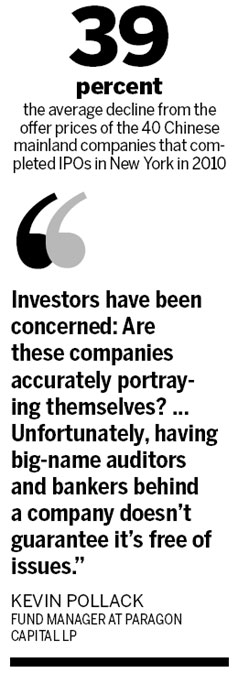
"Investors have been concerned: Are these companies accurately portraying themselves?" said Kevin Pollack, a fund manager at Paragon Capital LP in New York. "There has absolutely been collateral damage. Unfortunately, having big-name auditors and bankers behind a company doesn't guarantee it's free of issues."
Due diligence quality
|
 |
Investor enthusiasm that allowed a record number of Chinese mainland companies to go public abroad in 2010 has evaporated as the accuracy of financial reporting and the quality of due diligence by IPO underwriters has been called into question. That contributed to making the first quarter for global first-time offerings the weakest since the depths of the financial crisis.
Confidence in the stocks of overseas-listed Chinese mainland companies had already been undermined by scandals involving companies that went public in the US through so-called reverse mergers. Now, investors are shunning firms based in the world's fastest-growing major economy: Of the 57 IPOs in the US this year, only one came from the Chinese mainland, compared with seven in the first quarter of 2011.
Four Hong Kong-listed Chinese mainland companies, including Boshiwa International Holding Ltd, a Shanghai-based Harry Potter apparel licensee, said their auditors resigned this year because of disputes over financial data or other key information. That's four times the number in the same period last year and in the first quarter of 2010. Two other companies reported that their auditors needed more time to verify earnings.
Boshiwa, whose shares fell 66 percent from their September 2010 listing price, was suspended from trading on March 15 after the accounting firm Deloitte Touche Tohmatsu resigned.
Hong Kong warnings
The disclosures caused Hong Kong's Financial Reporting Council to announce on April 11 that it had identified 13 Chinese mainland companies in need of close monitoring. The agency, which investigates the auditing and reporting irregularities of publicly traded companies, declined to name them.
Chinese mainland companies listing on global exchanges in 2010 set a record: 110 IPOs, up from 67 in 2009 and almost twice the number last year. That prompted Hong Kong regulators to warn at least eight times since early 2011 about inadequate due diligence on the part of investment bankers who underwrote the IPOs of companies that applied for listings in 2010.
Overseas IPOs by Chinese mainland companies in 2010 accounted for 16 percent of the $199 billion in global IPO proceeds, excluding Chinese mainland deals, the data show. In the first quarter of this year, foreign offerings of Chinese mainland companies fell to 5.7 percent of the $11 billion raised worldwide.
Revenue declines
More than a quarter of the 56 Chinese mainland companies that raised a combined $32 billion in Hong Kong in 2010, including the cellulose producer Sateri Holdings Ltd and manganese-mining company Citic Dameng Holdings Ltd, have lowered their expectations, saying they expected "significant" or "substantial" declines in revenue.
Sateri has fallen 66 percent since its December 2010 debut, and Citic Dameng has dropped 61 percent since listing in November that year. Both companies, headquartered in Hong Kong, get more than 70 percent of their revenue from the Chinese mainland, according to Bloomberg data.
The 56 companies have declined an average of 27 percent from their IPO prices, the data show, while the benchmark Hang Seng Index is down 3 percent from its 2010 average.
"There's a lack of confidence in some of the issuers," Renato de Guzman, chief executive officer of the Bank of Singapore, the wealth-management unit of Oversea-Chinese Banking Corp, said in an interview on March 30. "That fear creates a lot of undervalued shares."
Stocks of Chinese mainland companies listed in New York have fared worse. The 40 companies that completed IPOs in 2010 are down an average 39 percent from their offer prices compared with a 22 percent gain for the S&P 500 Index from its 2010 average, the data show.
In Singapore, the third-biggest market for such listings after Hong Kong and New York, eight Chinese mainland companies that went public in 2010 have declined an average of 47 percent from their offer prices, the data show. That compares with a drop of 15 percent for the 23 non-Chinese mainland companies that had IPOs in 2010.
In March, Vipshop Holdings Ltd, the first Chinese mainland company to have an IPO in New York since August, raised 39 percent less than targeted. Shares of the Guangzhou-based online discount store are trading 9.2 percent lower than its offering price. The number of Chinese mainland companies completing IPOs in the US last year fell to 15 from 41 in 2010.
Chinese mainland enterprises that completed foreign IPOs in the early 2000s have done better. The 91 companies that sold shares overseas from 2001 through 2004 and are still trading have gained an average of 289 percent from their offer prices, according to data compiled by Bloomberg.
The disclosures of financial irregularities or auditor resignations last year by Chinese mainland businesses that went public in the US through reverse mergers resulted in "significant negative sentiment" toward companies based in the Chinese mainland, Paragon Capital's Pollack said.
Bloomberg News in New York and Hong Kong