I. Current Energy Development
Since the reform and opening-up policy was introduced, China's energy industry has witnessed rapid growth, achieving comprehensive development of coal, electricity, petroleum, natural gas, and new and renewable energy resources, making important contributions to the long-term, steady and rapid growth of the national economy and the sustained improvement of living standards.
-- Remarkable enhancement of energy supply capability and security. In 2011, the output of primary energy equaled 3.18 billion tons of standard coal, ranking first in the world. Of this, raw coal reached 3.52 billion tons; crude oil, 200 million tons; and refined oil products, 270 million tons. The output of natural gas ballooned to 103.1 billion cu m. The installed electricity generating capacity reached 1.06 billion kw, and the annual output of electricity was 4.7 trillion kwh. A comprehensive energy transportation system has developed rapidly. The length of oil pipelines totaled more than 70,000 km, and the natural gas trunk lines exceeded 40,000 km. Electric power grids were linked up throughout the country, and electricity transmission lines of 330 kv or more totaled 179,000 km. The first phase of the national petroleum reserve project was completed, and the country's emergency energy-supply capability keeps improving.
-- Conspicuous achievements in energy conservation. China vigorously promotes energy conservation. During the 1981-2011 period, China's energy consumption increased by 5.82 percent annually, underpinning the 10 percent annual growth of the national economy. From 2006 to 2011, the energy consumption for every 10,000 yuan of GDP dropped by 20.7 percent, saving energy equivalent to 710 million tons of standard coal. The state implemented a series of energy-saving renovations, such as of boilers, electrical machinery, buildings and installation of green lighting products. The gap between the overall energy consumption of China's high energy-consuming products and the advanced international level is narrowing. The energy utilization efficiency of new projects in the heavy and chemical industries, such as non-ferrous metals, building materials and petrochemicals, is up to the world's advanced level. The country has eliminated small thermal power units with a total generating capacity of 80 million kw, saving more than 60 million tons of raw coal annually. In 2011, coal consumption of thermal power supply per kwh was 37 grams of standard coal lower than in 2006, a decrease of 10 percent.
-- Rapid development in non-fossil energy. China has made energetic efforts in developing new and renewable energy resources. In 2011, the installed generating capacity of hydropower reached 230 million kw, ranking first in the world. Fifteen nuclear power generating units were put into operation, with a total installed capacity of 12.54 million kw. Another 26 units, still under construction, were designed with a total installed capacity of 29.24 million kw, leading the world. The installed generating capacity of wind power connected with the country's power grids reached 47 million kw, ranking top in the world. Photovoltaic power generation also reported speedy growth, with a total installed capacity of 3 million kw. Solar water heating covered a total area of 200 million sq m. The state also expedites the use of biogas, geothermal energy, tidal energy and other renewable energy resources. Non-fossil energy accounted for 8 percent of the total primary energy consumption, which means an annual reduction of more than 600 million tons of carbon dioxide (CO2) emission.
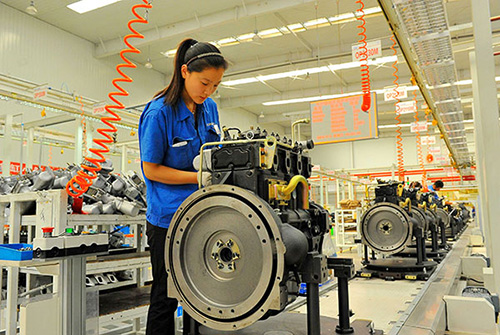
-- Quick advance in science and technology. A fairly complete system of exploration and development technologies has taken shape in the petroleum and natural gas industry, with prospecting and development techniques in geologically complicated regions and the recovery ratio of oilfields leading the world. Oil drilling rigs that are capable of operating at a maximum water depth of 3,000 m have been built. China is now able to independently design and build oil refinery equipment, each set of which boasts an annual output of 10 million tons, and ethylene production plants, each of which has an annual output of one million tons. The country's direct coal liquefaction and coal-to-olefins technologies, for which it owns independent intellectual property rights, have reached the world's advanced level and achieved new breakthroughs in technology. In addition, 60 percent of the country's coal mines have been mechanized, and mechanized underground mining equipment with an annual output of six million tons is installed nationwide. Electric power generating units featuring a large capacity and high parameters, including ultra-supercritical and air-cooled generators each with an installed capacity of one million kw, have been installed widely. The designing and manufacturing of 700,000-kw hydraulic turbine generators have reached the world's advanced level. China is now able to independently design and build one-million-kw pressurized water reactor nuclear power plants, and has made outstanding breakthroughs in the R&D of high-temperature gas-cooled reactors and fast reactors. Also, 3,000-kw wind power generators have been mass-produced and 6,000 kw wind power generators have come off the production line. The solar photovoltaic industry has formed a sound manufacturing chain, with an annual output of solar panels accounting for more than 40 percent of the world's total. China leads the world in extra-high-voltage DC/AC power transmission technology and manufacturing.
-- Marked improvement in civil energy use conditions. The state actively promotes civil energy projects and works to enhance the overall level of energy service. Compared with 2006, the per-capita primary energy consumption in 2011 equaled 2.6 tons of standard coal, a 31 percent increase; the per-capita natural gas consumption reached 89.6 cu m, an increase of 110 percent; and the per-capita electricity consumption was 3,493 kw, a 60 percent increase. The first and second west-east gas pipelines have been completed, and more than 180 million people across the country have access to natural gas. The government has invested more than 550 billion yuan in power grid upgrading projects for rural areas, fundamentally improving access to electricity for rural residents. The Qinghai-Tibet electricity network project has been completed, connecting the power grid of the Tibetan plateau with those of the other parts of China. The state is accelerating the construction of electric power facilities in areas that as yet do not have electricity, and has so far ensured that more than 30 million people have access to electricity. Combined heat and power projects with a total installed capacity of 70 million kw have been built in high-altitude and frigid areas in northern China that provide more than 40 million urban residents access to heating.


Copyright 1995 - . All rights reserved. The content (including but not limited to text, photo, multimedia information, etc) published in this site belongs to China Daily Information Co (CDIC). Without written authorization from CDIC, such content shall not be republished or used in any form. Note: Browsers with 1024*768 or higher resolution are suggested for this site.
License for publishing multimedia online 0108263 Registration Number: 130349