Comments
  Print
Print  Mail
Mail  Large Medium Small
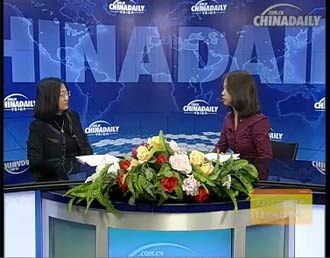
Exclusive | Xu Dingbo
As the world continues to hear a lot these days about China's economic slowdown, where does the country's best way out of its current difficulties lie?
It's not in using the government to shore up the market with its fiscal power and with offers of incentives, argued Xu Dingbo, deputy dean of the China Europe International Business School's Beijing division.
And it's also not in flooding the market with cheap bank loans.
Rather, the best way is to help investors and citizens maintain their confidence in the economy's capacity to fulfill its potential, he said.
Xu, whose academic background is in macroeconomics, said leaders in Beijing should find better ways to boost confidence in the country's businesses and make industry and services more prosperous.
The government, in fact, has no shortage of fiscal and material resources to fight economic setbacks, Xu noted.
"China is well-prepared" and has been "preparing itself through the years" since the outbreak of the global financial crisis in 2008.
The professor made his remarks ahead of the 18th National Congress of the Communist Party of China. The congress, which will elect a new group of top leaders, is scheduled to convene on Nov 8.
Xu said some of the precautions that the central government has taken may have been "overdone", citing cuts to investment projects and the adoption of various price caps since mid-2011.
He said the country's fiscal policy has been "extremely tight". He noted that China's tax revenue had increased twice as fast as its gross domestic product by the end of last year, indicating that the government is taking a larger share of the country's newly produced wealth.
At the same time, the government has imposed a "dramatic cut" on its spending projects.
The increase in revenue and decrease in expenditures have given the government unprecedented financial power, Xu said.
China's fiscal deficit in 2011 was 650 billion yuan ($103 billion), which was just 1.38 percent of the country's GDP that year, and was smaller than that of many large countries. What's more, all of China's deficit may have been incurred by local governments.
"If you look at both the central government and local governments, there is a deficit," said Xu, a specialist in accounting. "But if you look at the central government alone, there is surplus."
He said governments have adopted the general practice of keeping their fiscal policy tight when the economy is good and loosening it to stimulate demand when things take a turn for the worse.
So it is "very surprising", he said, that China has maintained a tight fiscal policy in the economy's downward cycle.
On the monetary front, Xu said, the reserve requirement ratio, which the central bank uses to control the amount of money banks must keep in reserve, has been set "too high", even though interest rates have been generally low. That has hindered banks' ability to provide credit.
To prevent inflation from continuing to rise, the central bank increased the reserve requirement ratio 12 times in 2011 and 2012, pushing it to a historic high of 21.5 percent for large financial institutions, and did not reduce it again until May. The high reserve requirement ratio has greatly affected the real economy and the state of many enterprises.
Xu attributed the government's excessive caution, which he called "contra-cyclical", to concerns that the global economy may further deteriorate.
When preparations for an impending economic emergency are overdone, prophesies of approaching disaster may become self-fulfilling, he said.
"Speak of the devil and he appears."
He noted the pressure that continues to bear down on the Chinese stock markets. With a price-to-earnings ratio of 9.8, Chinese stocks are significantly cheaper than US stocks, whose general price-to-earnings ratio is 15, even though China's economy has not been outperformed by the US'.
"Why are stocks so cheap and yet nobody wants to buy them?" Xu said. "Because the government keeps saying that the worst times are yet to come.
"So, don't ask me whether the slowdown will bottom out in the third quarter or the fourth quarter Even if growth continues to slow down in the fourth quarter, so what? My question is: How can we keep our growth up and lead in global growth in the next five to 10 years?"
But can China do that?
"Yes, we can, provided we help investors and citizens regain their confidence in the economy," Xu said. "And to make that happen, we need to do three things right."
One priority, he argued, should be making reforms to State-owned enterprises, or SOEs.
"What the public sees and hears is usually about SOEs' large size or their profits. What people don't see and hear is the enormous opportunity cost they incur in their daily management."
SOEs should adopt management reforms to ensure they can be run efficiently, he said.
At the same time, a large number of private enterprises also need to increase their productivity. The rapid increases in wages that have been seen across China's more industrial east coast cannot be offset without increased productivity.
A third priority should be on ensuring the government can adapt to changes in the population's characteristics and accommodate the increasingly diverse expectations of the younger generation - especially in an age of widespread information and mobile social networks.
Effective reforms will inspire confidence in both entrepreneurs and the public, Xu said. And confidence, inevitably, will result in a commitment to the country's long-term growth.
"China has had enough weapons to resist a financial crisis," Xu said. "About that I have no doubt. But it is in these matters that it still has to prove its prowess."
 Infographic: Highlights of China Q1 economic data
 Top 10 luxury cars at Beijing auto show
 Highlights of smart hardware on display at 2016 GMIC Beijing
 Two students return from abroad to open beer factory
 Man aims to provide freshest ice cream possible
 Top 6 domestic new-energy vehicles at Beijing auto show
 Hanover Fair opens with Sino-German alliance launch
 Five Chinese companies with exclusive broadcasting rights to sports event

Copyright 1995 - . All rights reserved. The content (including but not limited to text, photo, multimedia information, etc) published in this site belongs to China Daily Information Co (CDIC). Without written authorization from CDIC, such content shall not be republished or used in any form. Note: Browsers with 1024*768 or higher resolution are suggested for this site.
License for publishing multimedia online 0108263 Registration Number: 20100000002731