Comments
  Print
Print  Mail
Mail  Large Medium Small
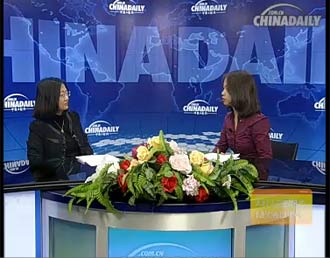
Another important issue expected to be addressed at the third plenum is China's wealth gap. So how urgent is the need for reforms in this area ? And what impact has the wealth gap had on the country's have-nots? To answer these questions, my colleague Jin Yingqiao joins us now in the studio.
Q1, So tell us just how serious the income disparity is in China?
A1, Well Zou Yue, to measure the seriousness of the problem, we use what's called the "Gini coefficient". For the first time since the year 2000, China's national bureau of statistics released data earlier this year. Now keep in mind a ZERO means complete equality, and a ONE means absolute inequality. The number reached 0.49 in 2008. It dropped slightly to 0.48 in 2010, and again to around 0.47 in 2011 and 2012. But all the figures are higher than the "warning level" of 0.4 set by the United Nations. According to Forbes, China has 112 billionaires, the second-biggest number in the world. But 13 percent of people in China live on less than $1.25 a day.
Q2, Indeed some very alarming numbers. So what has caused this?
A2, Well one big reason is the sheer size of China's rural population: 39 percent of Chinese worked in the agricultural sector in 2008... a number much higher than in developed economies. And remember that a big part of that sector is under-industrialized. The average NET income per person in rural areas in 2012 was only about 8,000 yuan, that's just one third of the average disposable income of urban residents. Income disparity can also be drawn according to geographic lines, between coastal and inland provinces. In 2012, the average annual income for a Shanghai family was over 29,000 yuan, while the average in Gansu Province in northwest China, was just over 11,000 yuan. Finally, the income gap is visible within cities, with the average income of migrant workers equivalent to just a third of that of local residents.
 |
|
A woman pulls a handcart full of waste paper in this 2012 file photo taken in Daqing, Heilongjiang province.[Photo/icpress.cn] |
Copyright 1995 - . All rights reserved. The content (including but not limited to text, photo, multimedia information, etc) published in this site belongs to China Daily Information Co (CDIC). Without written authorization from CDIC, such content shall not be republished or used in any form. Note: Browsers with 1024*768 or higher resolution are suggested for this site.
License for publishing multimedia online 0108263 Registration Number: 20100000002731