BEIJING - Economists and insiders are calling for more effective government supervision as a year of wild swings in China's stock market is coming to an end.
China fought an unprecedented and costly war in 2015 to contain wide stock market fluctuations, but the rout served as a harsh test of its ability to deal with new economic challenges.
The market plunge, which erased huge wealth, especially for small and new investors, sounded the alarm for policymakers that piecemeal fixes or stopgap measures are far from enough to keep the stock market sound.
It remains to be seen whether China will learn a lesson and improve supervision over the stock market, which the government is counting on to lower company leverage ratios and fund startups amid an innovation and entrepreneurship campaign.
"The market volatility revealed that the government's current supervision system failed to adapt to the latest financial developments," said President Xi Jinping at a high-level policy meeting in October.
"China will reform and improve the supervision system for its financial market in the next five years," said a communique released after the Fifth Plenum of the 18th Communist Party of China Central Committee.
Fever and fall
This round of bullish performance started in August last year as many central banks, including the People's Bank of China (PBOC), adopted easy monetary policy to buoy a faltering economy.
By the time of the sudden collapse in mid-June, the benchmark Shanghai Composite Index had risen over 150 percent and the NASDAQ-style ChiNext Board Index had more than doubled since August 2014.
Total market value on the Shanghai and Shenzhen exchanges reached nearly 78.4 trillion yuan ($12.3 trillion) on June 12.
In the previous week, a record 1.6 million new investors flocked to the stock market in search of quick wealth as the public widely anticipated the Shanghai Composite Index would exceed the all-time high of 6,124.04 set in 2007.
The Shanghai Composite Index touched 5,178.19 points on June 15, but then started to nosedive steeply and repeatedly, shocking senior market observers and veteran investors.
After several rounds of roller-coaster fluctuations, the index plummeted by 43.5 percent from the June peak to 2,927.29 points on August 26, the lowest level during the market rout.
At the height of the disaster, many stocks dipped to the 10-percent daily limit during call auction before the market opened.
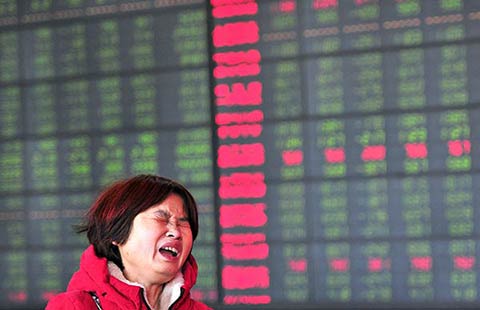
Due to a lack of buyers, rattled investors could not dump their shares to stop losses, but were forced instead to hold and watch their wealth quickly shrink.
In July, more than 1,400 public companies, or about half of the total listed on the Shanghai and Shenzhen exchanges, applied to suspend stock trading to reduce losses.
On the eve of the market crash, the price/earning ratios of many shares unreasonably soared to more than 1,000, indicating that inflated share prices were not backed by solid profitability.
"Globally, abundant liquidity is conducive to asset price bubbles," said an article written by economists Guan Tao and Deng Haiqing published in Caijing Magazine.
As bank bad loans rose and property investment declined, huge capital flowed to the stock market through unconventional and unchecked channels, contributing to price bubbles, according to the two economists.
"Risky margin trading, poor supervision and new transaction techniques caused the market rout," said Wu Xiaoqiu, a senior finance researcher with the Renmin University of China.
Recovery and remedy
On June 27, the PBOC lowered both benchmark interest rates and the reserve requirement ratio, raising the curtain for months of government actions, including liquidity injections and a police crackdown on insider trading and price manipulation.
State-owned enterprises were prohibited from selling shares and the government bought a huge amount of heavyweight shares through major brokerages to stabilize stock prices.
Police launched an investigation and questioned several fund managers and executives of brokerages, including Cheng Boming, general manager of CITIC Securities.
Market sentiment started to improve in late August with mildly rebounding indices and rising turnover.
Driven by the rally in autumn and winter, the Shanghai Composite Index grew about 6.6 percent in 2015 despite the summer crash, outpacing many other global metrics, including a year-to-date gain of around 0.1 percent in the S&P 500 in the United States.
The China Securities Regulatory Commission (CSRC) resumed IPOs in November after it halted new share issuance in July.
"Chinese shares have basically gone through a liquidity crisis and investor mood is recovering," said Shi Jianxun, a senior finance researcher at Tongji University.
"But the market is still very sensitive. Policymakers should reflect on the causes of the stock rout and measures to combat it," he said.
Major stakeholders will be free to sell their shares as a sales ban expires next month.
Stock supply will likely increase substantially as the government pushes ahead with registration-based IPO reform.
These new situations, along with persistent downward pressure on the broader economy, will add uncertainty to the 2016 stock market.
The government should establish a high-level mechanism to coordinate different market regulators so that they can work together more efficiently, according to the article by Guan and Deng.
They called for a centralized platform to pool and analyze data collected from the PBOC, the CSRC, the China Banking Regulatory Commission and the China Insurance Regulatory Commission.
It is critical for the government to have an emergency response plan as belated and panicked actions are usually less effective, according to them.
The two economists also urged better information disclosure, intensified crackdown on insider trading and a shift from the current "T+1" restriction to a "T+0" rule to allow investors to sell shares the day they buy them.
"The purpose of government supervision is to create a sound environment, rather than stabilize or prop up stock indices," said Guan Qingyou, a senior researcher with Minsheng Securities.

Copyright 1995 - . All rights reserved. The content (including but not limited to text, photo, multimedia information, etc) published in this site belongs to China Daily Information Co (CDIC). Without written authorization from CDIC, such content shall not be republished or used in any form. Note: Browsers with 1024*768 or higher resolution are suggested for this site.
License for publishing multimedia online 0108263 Registration Number: 130349