|
|
A man tries out a virtual reality headset at the 2016 CES Asia in Shanghai. There were more than 200 exhibitors at this year's show. [Photo provided to China Daily] |
LOS ANGELES - Kyle Stirling could feel that change was even in the air during his recent visit to China.
"Last year everyone was elbowing their way in to make stock trades and watch their portfolios rise," the Silicon Valley startup mentor said.
However, within 12 months, "it is a very different time here now and a change is afoot," he told Xinhua after coming back from China recently.
Stirling, a mentor in the US National Science Foundation Innovation Corps for technology commercialization by graduate students and elite teams of scientists, noticed that some of the most powerful forces in China are seeking innovation this year.
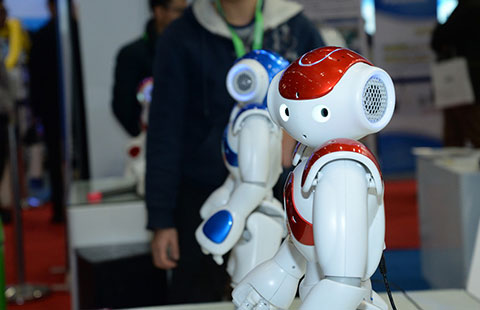
During his packed one-day stay on May 30 in China, Stirling first went to Domo Lab, a tiny startup in Shanghai with a focus on building new robotics courses to promote Science, Technology, Engineering and Mathematics (STEM) courses among high school students.
Those entrepreneurs were talking about "passion" and "changing the world" and asked the consultant for some advices on designing innovation programs.
During the afternoon tea time, Stirling also met a Chinese mom who seemed very worried. But she was not worried so much about the traditional education problems of her 10-year-old boy, like a focus on test scores, he said.
What made her so concerned about was how to incorporate innovation into the current Chinese education system and she was betting on innovation through DIY, Art and STEM programs, he recalled.
During a conference that evening, some local industry leaders and global experts including Stirling talked about building "smart cities" and discussed how China could have a supportive infrastructure that let people interact in new ways.
According to the Chinese industry leaders, innovation is not the same as productivity. "In productivity you optimize for value, could be quality, price or speed, you know in advance what you are doing. With innovation you are bringing together a bunch of experiments and see which one takes root, you want variation the opposite of mass production."
"They are all committed to doing something about bringing innovation to the people of China," Stirling said.
One example is that Internet plus and data-driven design had made their way into the vocabularies of many Chinese entrepreneurs, Stirling observed. "Last year this was not a part of anyone's vocabularies," the Silion Valley data science specialist said.
On May 30, Beijing hosted three top-level science and innovation conferences that would boost China to become a leading global power in science and technology.
When asked about what is the best environment for creativity, Stirling believes that it is an environment that can bring together people with different background and experiences to focus on a problem.
Stirling is not the only one who was impressed with China's innovation environment.
After a visit to an innovation hub in Beijing, Silicon Valley angel investor and entrepreneur Cyriac Roeding was surprised by Chinese entrepreneurs' spirit, their dedication, and friendliness. He said that in 10 years Beijing may become the next center of global innovation.
Roeding said in an article that he sat down with billionaire startup executives as well as entrepreneurs while in Beijing in a recent trip and was astounded by the pragmatism, motivation and innovative thinking in the Chinese tech industry.
Chinese companies usually ran a 9/9/6 schedule, meaning their staff work from 9 am to 9 pm, six days a week, while founders and top executives often ran a 9/11/6.5 schedule, higher than the average of their U.S. counterparts.
"We pride ourselves on being fast in Silicon Valley, but Chinese startups are faster ... Meetings are anytime ... A wave of innovation is coming from China."
According to Stirling, China might enter a phase where it finally "copies" the successful approach of other countries by actually "not copying" and instead goes full steam for an "innovative culture within the framework and context of China's unique history."
The reason why he said this is because the three most powerful forces in China -- Government, Business and Chinese Moms -- give a push for innovation.
"The next ten years will be surprising to see how this plays out," he said.


Copyright 1995 - . All rights reserved. The content (including but not limited to text, photo, multimedia information, etc) published in this site belongs to China Daily Information Co (CDIC). Without written authorization from CDIC, such content shall not be republished or used in any form. Note: Browsers with 1024*768 or higher resolution are suggested for this site.
License for publishing multimedia online 0108263 Registration Number: 130349