CHINA> National

|
CHINA> National
|
|
Migrant workers bear brunt of crisis
By Wu Jiao (China Daily)
Updated: 2008-11-21 07:23 To go home, or not to go home: that is the question for Huang Bingnan. The 31-year-old and his wife lost their jobs in a machinery factory in Dongguan last month. Plants in the city in Guangdong province were running day and night till a few months ago. But shrinking orders from overseas has forced many manufacturers to close shop or cut their staff strength. "It's very difficult to find another job (in the city) during these difficult times," Huang said Thursday.
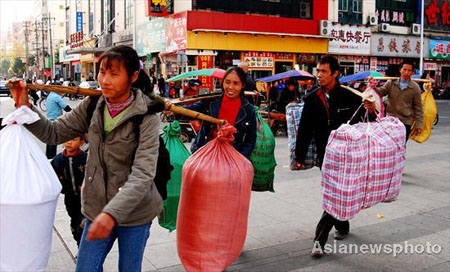
It is people like Huang that the Ministry of Human Resources and Social Security is for the first time trying to register as unemployed, so that they get the help and benefit to start life afresh. The government till now has followed an urban registered unemployment rate to reflect its job market. The Huang couple face another problem if they decide to stick around in Dongguan to test the waters: they have to pay 500 yuan a month for the 9-sq-m shanty they have called their home for three years. "We have to go home probably. But that would be our last choice," Huang said. Their reluctance to return to their native Anhui province is understandable. They want to earn enough to build a two-story house in their village. But unlike the Huang couple, a lot of laid-off migrant workers have already returned home. And an increasing number of labor disputes have been reported in the past few months. Migrant workers are the worst-affected group by the global economic downturn, Minister of Human Resources and Social Security Yin Weimin told a press conference Thursday. For instance, about 300,000 of the 6.8 million migrant workers from Jiangxi had returned home by mid-November. The situation is similar in Hubei province, where about 300,000 of its 7 million migrants have returned from cities. China's rapid growth has been fuelled, at least in part, by about 230 million farmers-turned-workers. But these very people are being laid off in increasing numbers as the global financial crisis starts hurting the export-oriented small- and medium-sized enterprises (SMEs).
The ministry is trying to include migrant workers in its unemployment registration network, making it mandatory for those who lose their jobs after having worked for more than six months in a city to be registered by local labor authorities. The possibility of introducing services such as recommending new jobs and paying unemployment insurance to such workers is also being studied, Yin said. The ministry is also considering providing unemployment-insurance subsidy for industrial units so that workers are not retrenched. It has asked large State-owned enterprises (SOEs) to shoulder their social responsibility and avoid laying off workers if possible. The ministry has asked local labor and social security authorities to monitor struggling enterprises' operations, and ensure that firms don't lay off workers unnecessarily or excessively. The authorities will also have to ensure that workers get easy access to labor dispute arbitration to prevent mass incidents. The ministry said migrant workers who lose their jobs after having worked for a company for six consecutive months must get a one-time subsistence benefit and government-funded vocational training. It also said arrear salary cases should be handled at the priority level to protect the interest of migrant laborers and maintain social stability. In Hubei province, the influx of 300,000 people from cities has prompted some firms to seek the administration's approval to cut jobs to stabilize the job market. Under an emergency program to deal with rising unemployment, large SOEs in Hubei were required to cut staff salaries this month before thinking of dismissing them. Large SOEs and SMEs need to secure the administration's approval to cut 50 or more people's jobs. About 200,000 workers who have returned home from cities were re-employed in their hometowns in Hubei within two months. Xinhua contributed to the story |
|||||
主站蜘蛛池模板: 免费无码肉片在线观看| 欧美精品在线观看| 粉嫩在线一区二区三区视频| 日韩人妻系列无码专区| 四虎精品国产AV二区| 动漫AV纯肉无码AV电影网| 视频一区二区无码制服师生 | 国产精品视频亚洲二区| 无码日韩做暖暖大全免费不卡| 精品国产中文字幕第一页| 少妇和邻居做不戴套视频| av综合亚洲一区二区| 久久亚洲精品日本波多野结衣| 国产人妻人伦精品婷婷| 日韩不卡1卡2卡三卡网站| 欧美日韩中文亚洲另类春色| 巨胸美乳无码人妻视频漫画| 爱情岛亚洲论坛成人网站| 四虎永久播放地址免费| 久久精品这里只有国产中文精品| 国产熟女激情一区二区三区| 亚洲中文字幕人妻系列| 美女内射福利大全在线看| 激情自拍校园春色中文| 婷婷六月天在线| 九九九精品成人免费视频小说 | 欧美亚洲另类制服卡通动漫| 色一乱一伦一图一区二区精品| 老司机精品福利在线资源| 国偷自产一区二区三区在线视频| 边做边爱完整版免费视频播放 | 亚洲精品久久久久久下一站| 色二av手机版在线| 亚洲国产精品嫩草影院久久| 无码综合天天久久综合网| 亚洲卡1卡2卡新区网站| 夜夜高潮夜夜爽夜夜爱爱| 亚洲一区中文字幕人妻| WWW夜插内射视频网站| 少妇人妻偷人精品免费| 韩国一级永久免费观看网址|