CHINA> National

|
CHINA> National
|
|
GDP growth slows to 6.8% in Q4 of 2008
By Dong Zhixin (chinadaily.com.cn)
Updated: 2009-01-22 10:11
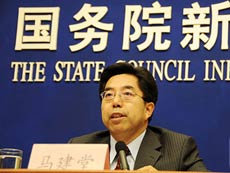
The country's GDP, the most widely watched measure of its economic strength, grew 6.8 percent from a year earlier in the fourth quarter of 2008, said Ma Jiantang, Commissioner of the National Bureau of Statistics (NBS), on Thursday at a press conference in Beijing. For the whole of 2008, the economy expanded 9 percent to 30.07 trillion yuan (US$4.4 trillion), marking the first year of single-digit growth since 2003 and well below the average rate of 9.8 percent in the past 30 years. The latest reading consolidated China's position as the world's third-largest economy after the United States and Japan. The NBS last week revised the country's GDP in 2007 up to $3.38 trillion, making it surpass Germany’s $3.32 trillion. The European country’s economy expanded one percent in 2008.
While some developed countries may be looking at China's growth with envy, Beijing is feeling the heat from the current economic slump. Conventional wisdom has it that China’s economy has to grow over eight percent to create sufficient jobs for the country's labor force. Millions of migrant workers have been knocked out of jobs, as a raft of export-oriented firms closed down due to a dry-up of external orders. The country’s exports fell for the first time in seven years in November, dropping 2.2 percent, in a sharp turn for the worse from a 19.2-percent-rise in the previous month. China faced huge challenges, Ma admitted, as "the international financial crisis is deepening and spreading, with continuing negative impacts on domestic economy." However, he remained confident about the country's economy in 2009 and beyond. "China is sure to keep its growth rate above eight percent," Ma told reporters after the press conference. Professor Guo Tianyong of the Central University of Finance and Economics (CUFE) shared Ma's optimism. "We should have no problem attaining a growth of eight percent," he told chinadaily.com.cn, citing huge State investment in the pipeline. Chinese government has annouced a US$586 billion stimulus package, as well as other measures to boost consumption and investment. The State Council decided Wednesday to spend 850 billion yuan ($124.26 billion) in the next three years on healthcare. Signs of Recovery Ma said his confidence was well-founded. "There have been some positive developments in December," he explained, pointing to industrial output, retail, bank lending and money supply. The industrial output rose 5.7 percent in December from a year earlier, up from November's 5.4 percent. "That is a small, but important change," Ma noted, while Professor Guo of CUFE called that a trend for the better. Private consumption, which the government is counting on to jack up the economy, also picked up. After striping out inflation, retail increased 17.4 percent in December year-on-year, up 0.8 percentage points from the previous month. Bank lending and money supply jumped more than economists estimated in December. The country's lenders granted a whopping 740 billion in yuan loans last month, marking the biggest monthly increase in 11 months and a jump of 55 percent from the previous month. The broad measure of money supply increased 17.8 percent in December year-on-year, snapping up six straight months of declines. "All that shows the moderately loose monetary policy has started to take effect," according to Ma. Whether these positive developments constitute long-term trends remains to be seen, but they are very likely to be "the rays of morning sunshine before the dawn," the top statistician noted. Professor Guo agreed. "The economy may have bottomed," but may need one or two more quarters to get out of the doldrums, he said. "The downward pressure is still big." Inflation vs. Deflation What is also good news for the economy is that inflation continued to ease in December, giving the central bank more room to cut interest rates, the tool of choice in times of economic downturn. The Consumer Price Index (CPI), a barometer of inflation, rose 1.2 percent year-on-year in December, after rising 2.4 percent in November. That was a far cry from a peak rate of 8.7 percent in February 2008 after eight months of steady decline, thanks to falling prices of food and commodities. However, the bad news is that inflation is falling too fast, giving rise to increasing worries of deflation, a sustained decrease of prices across the board. The Producer Price Index (PPI), another indicator of inflation, fell 1.1 percent in December from a year earlier, the first month of negative growth in six years. The gauge, which measures factory gate prices, went into a free fall after peaking in August at 10.1 percent. Prices are widely expected to fall further in the coming months due to continued drops in food and commodities prices, as well as decreases in aggregate demand. The CPI will drop 1.1 percent, while the PPI may decline 3.5 percent in 2009 from 2008, said the Galaxy Securities in a report last week. To avert deflation, the central bank may cut interest rates again on top of five reductions since September, 2008, experts said. "The central bank may cut interest rates by 27-54 basis points after the Spring Festival," Professor Guo said. The Spring Festival is the most important festival in China and falls on January 26 this year. The benchmark one-year saving rate now stands at 2.25 percent, while the lending rate for the same duration is 5.31 percent. |
主站蜘蛛池模板: 亚洲人成人无码www| 琪琪777午夜理论片在线观看播放| 狠狠躁天天躁中文字幕无码 | 99精品这里只有精品高清视频| 妺妺窝人体色www聚色窝仙踪| 日本一区二区三区后入式| 99在线无码精品秘 人口| 亚洲AⅤ波多系列中文字幕| 99精品国产一区二区电影| 亚洲人妻一区二区精品| 国产又色又刺激高潮视频| 国产欧美日韩高清在线不卡| 国产三区二区| 国产成年码av片在线观看 | 中文文字幕文字幕亚洲色| 欧美老熟妇欲乱高清视频| 在线播放亚洲成人av| 99热这里只有成人精品国产| 中国毛片网| 女人高潮被爽到呻吟在线观看 | 午夜福利片1000无码免费| 亚洲精品综合网二三区| 亚洲第一二三区日韩国产| 无码精品人妻一区二区三区中| 久久精品国产6699国产精 | 另类 专区 欧美 制服| 日韩在线一区二区不卡视频| 亚洲αⅴ无码乱码在线观看性色 | 免费看视频的网站| 成年女人看片免费视频| 欧美精品一区二区三区中文字幕 | 精品人妻二区中文字幕| 国产高清精品自在线看| 国产日产精品系列| 又湿又紧又大又爽A视频男| 狠狠人妻久久久久久综合九色| 99视频精品国产免费观看| 国产老熟女国语免费视频| 国产激情精品一区二区三区| 日产精品99久久久久久| 手机在线看永久AV片免费|