Docking is giant step for future manned missions
Updated: 2011-11-04 08:25
By Xin Dingding (China Daily)
|
|||||||||||


|
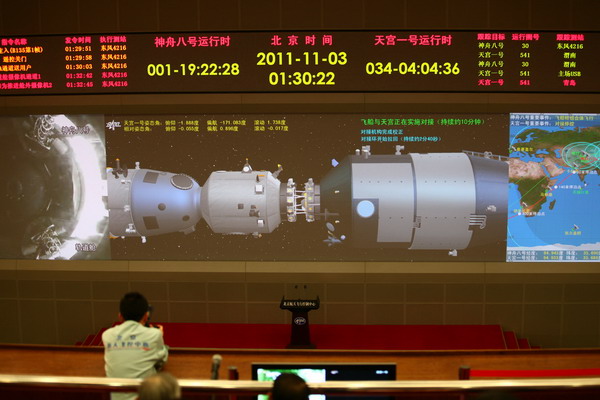 A screen in the Beijing Aerospace Control Center displays a simulation of the Shenzhou VIII spacecraft docking with Tiangong-1 space module on Thursday. [Photo by Wang Yongzhuo/Xinhua]
|
BEIJING - China successfully accomplished its first space-docking mission on Thursday, marking a milestone for its long-term manned space program.
Nearly two days after it was launched, the Shenzhou VIII spacecraft docked with the Tiangong-1, or "Heavenly Palace", space module at 1:36 am, some 343 kilometers above the Earth, Wu Ping, spokeswoman for China's manned space program told a news conference in Beijing.
But Wu stressed this is just an "initial" success, as the spacecraft still have to prove they can complete a 12-day flight under Tiangong-1's control and then separate smoothly.
Zhou Jianping, chief designer of the manned space program, however, was over the moon at the success of the first docking procedure.
"This will make it possible for China to carry out space exploration on a larger scale," Zhou said, adding that more than 20 manned space flights are planned from 2012 to 2020 and China now has the basic technology and capacity to construct a space station.
According to the control center, telemetry sensors on the Shenzhou VIII spacecraft took over from ground control at 11:08 pm on Wednesday and guided it to the tail of the Tiangong-1 module, which was launched on Sept 29.
After two hours and 20 minutes, the Shenzhou VIII was within centimeters of Tiangong-1. In the following eight minutes, the docking mechanisms on the vessels completed the procedure of capturing, buffering and locking.
Spokeswoman Wu said the two vessels will try a second docking after separating on Nov 14, in order to find out whether repeated docking might affect the docking mechanism's performance.
The second docking will be carried out in sunlight, unlike the first one, which was done in the shadow of the sun to avoid sunlight interfering with the telemetry devices, she said.
All of the components in the docking mechanism, as well as 600 onboard instruments, were designed and manufactured by Chinese firms, mostly State-owned enterprises, said Wu.
Pang Zhihao, deputy editor-in-chief of Space International, said the flight control of a docked assembly and undocking are not as simple as they might sound.
"Before docking, Tiangong-1 was orbiting without a burden. Now it carries an 8-ton spacecraft and is controlling the spacecraft's 13 sub-systems such as its attitude, temperature and energy," he said.
The Mir space station, operated from 1986 to 2001, at first by the Soviet Union and then by Russia, once had problems with its attitude control, and had to continuously adjust the attitude to stay in orbit, he said.
The undocking procedure is also risky, and spacecraft designers have prepared contingency plans, including using explosive devices to blow off the hooks if they fail to unlock, he said.
With Thursday's successful docking, China became the third country to master the technique independently, but Pang warned that mastering the technology is not the same as having mature technology.
China plans to conduct two similar docking exercises in 2012, with at least one expected to carry astronauts, in preparation for the proposed launch of a space lab by 2016 and the building of a space station by 2020.
REPORTER'S LOG AN BAIJIE
Breathtaking "kiss" in space
The excitement and tension are becoming palpable in the Beijing Aerospace Control Center on Wednesday night as the Shenzhou VIII spacecraft and Tiangong-1 space lab module come together to complete their "kiss".
The control center, which is located in Beijing's suburban Changping district, is heavily guarded. When I arrived, my car was stopped in front of the center's gate by a People's Liberation Army (PLA) guard and I was asked to present my permission for admittance. PLA soldiers are deployed along the roads to the command building.
On entering the command building my bag is put through an X-ray scanner and I am given a thorough body check, just like the security procedures at an airport. After the security check I am told to put on a pair of plastic shoe covers.
There are three different color passes for the control center. People with red passes have top priority and at most times they can enter the command hall. My pass is green, which means I must stay at the news center, a room with two televisions broadcasting CCTV live reports and a large LED screen showing a real-time image of the command hall.
Fortunately, I can hear the sound from the command hall through the loudspeakers installed in the news center and I can sense the growing excitement.
On the LED screen showing the command hall, I can see interior and exterior images of the Shenzhou VIII spacecraft.
A traditional Chinese decorative knot is swinging slightly inside the spacecraft, which seems to ease the tension in the command hall to some extent.
Instructions from the loudspeakers become more frequent on Thursday morning just after 1 am, when the Shenzhou VIII deploys its docking device. The operators in the command hall become more concentrated as the countdown draws near, and their voices become more exited as the Shenzhou VIII and Tiangong-1 close to less than 30 meters. Everyone else has their eyes glued to the screen and is holding their breath.
Then everyone starts applauding when the Shenzhou VIII and Tiangong-1 have "physical contact" at about 1.28 am.
At 1:43 am, Chang Wanquan, chief commander of China's manned space program, announces the country's first space dock between the Shenzhou VIII spacecraft and Tiangong-1 space lab module was successful.
In the news center, newspaper reporters are beating frantic tattoos on the keyboards of their laptops, and radio reporters are busy making phone calls in low voices for live broadcast.
"It's just like a couple of lovers walking hand in hand in space," a radio reporter broadcasts.
- Hu urges efforts to promote financial stability
- More grassroots delegates for CPC
- Concerns over social security scheme
- China urges support for Afghanistan
- Greek PM under pressure to quit
- China to build manned space station around 2020
- Hu attends G20 summit in Cannes
- China's imports, exports exceed $3t



Hot Topics
Libya conflict, Gaddafi, Oil spill, Palace Museum scandal, Inflation, Japan's new PM, Trapped miners, Mooncake tax, Weekly photos, Hurricane Irene
Editor's Picks

|

|

|

|

|

|