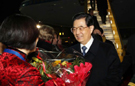
Premier calls for closer regional ties
Updated: 2011-11-08 07:00
By Qin Jize (China Daily)
|
|||||||||||


ST. PETERSBURG, Russia - Premier Wen Jiabao proposed greater cooperation on Monday with Shanghai Cooperation Organization (SCO) members and said China will continue to offer funding for key projects.
Addressing SCO prime ministers, Wen said that China hoped to help boost cooperation in trade, finance, transport, agriculture and health. Youth exchange programs will also be strengthened.
China is willing to share its experience to help members establish economic zones, he added. Wen also urged the quick establishment of a development bank for the SCO and a special fund to finance key projects was discussed.
Wen's proposals showed China's determination to boost SCO cooperation for regional growth, analysts said.
"The call for closer economic cooperation and integration within the SCO comes at an important time when the world economy faces the risk of double dip," said Li Xin, director of the Center for Russia and Central Asia Studies with the Shanghai Institutes for International Studies.
Wen's proposals, especially financial and infrastructure cooperation, are vital areas for further regional integration, he said.
Wen also said that China welcomes the development of clean energy and will continue to provide capital and technology for regional power grids.
Jiang Yi, an expert on Russian studies with the Chinese Academy of Social Sciences, said that regional countries are seeking a post-crisis development model.
The prime ministers of the six member countries adopted a joint declaration on the economic situation, both globally and in the SCO. They also signed several agreements, including a mid-term development strategy of SCO Union Pay.
Jin Canrong, deputy dean of the School of International Studies at Renmin University of China, said that after a decade of development the SCO has hit a bottleneck.
"One factor is Moscow's attitude," Jin said, referring to Russia's foreign policy of prioritizing links with former Soviet republics.
Besides, Jin said, relations between some Central Asian nations have deteriorated, while "the United States is using various methods to restrict the development of the SCO".
Xu Xiaojie, a researcher at the Center for the World Economy and Politics with the Chinese Academy of Social Sciences, agreed, saying that political instability may endanger economic development of the bloc, as some states face a power transition in the coming years.
But Beijing has consistently been a source of stability for the SCO, Jin said. "It has a strong capability in that regard, both financially and in practical terms, such as engineering."
China's trade with the SCO has rocketed from $12.1 billion to some $90 billion during the past 10 years, a faster rate of increase than for any other bloc or country, Xinhua quoted Vice-Foreign Minister Cheng Guoping as saying.
The SCO, originally set up in the post-Cold War period to define borders, groups China, Russia and the Central Asian countries of Kazakhstan, Kyrgyzstan, Tajikistan and Uzbekistan.
In the past decade, the SCO has evolved from focusing solely on regional security to economic development.
An article in the New York Times three weeks ago said China has made great efforts to make that transformation happen.
This policy was formed in the knowledge that a stable and prosperous Central Asia would have a positive effect on China's underdeveloped Xinjiang Uygur autonomous region and benefits both China and the region. But China has gone beyond hard-nosed economics, it also proposed to enhance people-to-people exchanges.
Wen said at the meeting that as the rotating chair of the SCO, China is planning to invite 100 youths from the SCO to visit next year.
It is reported that China has established Confucius Institutes to teach Chinese in all the Central Asian states, except for Turkmenistan, and has also helped develop an SCO university that brings together some 60 universities across China and Eurasia.
Wen also held bilateral talks on Monday with his counterparts from Russia, Pakistan, Kazakhstan and Tajikistan.
Li Xiaokun and Zheng Yangpeng contributed to this story.




Hot Topics
Libya conflict, Gaddafi, Oil spill, Palace Museum scandal, Inflation, Japan's new PM, Trapped miners, Mooncake tax, Weekly photos, Hurricane Irene
Editor's Picks

|

|

|

|
|
|