The dawn of Chinawood
Updated:2011-11-15 20:23
By Rong Xiandong, Xu Pingting and Yan Weijue (chinadaily.com.cn)
|
 |
|
The development of China's culture industry is likely to enjoy a boom in the years to come after the plan was elevated to an unprecedented height at a recent plenary session of the Communist Party of China (CPC). At the meeting, a guideline was adopted to promote the development of the culture industry. It is the first time in the past 15 years that the Party has attached such great importance to boosting the country's culture development. China's film industry has become the world's third largest in terms of production after India and the US as the Chinese economic boom fueled enormous demand for movies, screenplays and animation. Hengdian used to be a small rural village in East China's Zhejiang province well-known for its private businesses, but today it has evolved into the largest film base in Asia known as "Chinawood". In this special coverage, we aim to shed light on how China’s Hollywood became a success and what is planned in the future for arts in China now the government has resolved to boost the culture sector. |
|
Focus on China's Hollywood |
|
 |
 |
 |
|
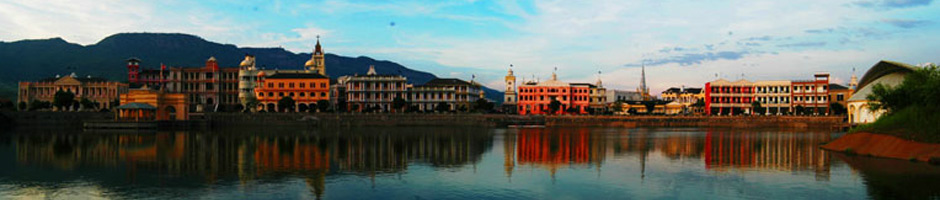
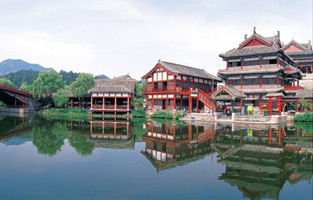
Village lights up as Asia's Hollywood It used to be a small rural village, but today Hengdian has evolved into Asia's version of Hollywood. The village, in Dongyang city in East China's Zhejiang province, has become the largest film base in Asia known as "Chinawood". Hengdian World Studios is operated by the privately-owned Hengdian Group. The studio has seen many films and TV shows shot here, including the movie Hero directed by Zhang Yimou and The Forbidden Kingdom with actors Jackie Chan and Jet Li. The studio consists of 28 location bases, including scenes from the Qin Dynasty (221-206 BC) to a modern Hong Kong Street. Even the area of Hengdian village has multiplied 40 times and the average annual income per capita has grown to more than 100 times that of 30 years ago. Every day, the village has more than 20 films shot here and the reason producers choose the village rather than the big cities is simple. In 2003, Zhejiang was designated by China as a cultural reform pilot province and the State Administration of Radio Film and Television also set a film industry park in Hengdian. A film company can save about one third in shooting expenses in Hengdian due to favorable policies such as special tax allowances. Nowadays, hundreds of film companies have registered in Hengdian. New film groups settle here every other day, and with them the tourists follow in greater numbers. |
 Chinese actors Gong Li and Chow Yun-fat in the film Curse of the Golden Flower shot in 2006.
|
China's Hollywood aims at leisure industry Hengdian World Studios, also known as China's Hollywood, aims to build China's "Las Vegas", said a media executive from the Hengdian Group, the studio's operator, on Wednesday. "We have been testing the waters over the past 15 years. The decision of the Central Committee of the CPC to deepen cultural reforms have consolidated our confidence and activated our passion in the cause," said Zeng Yulin, editor-in-chief of a magazine affiliated to the group. "We are planning to build Hengdian into a Chinese version of Las Vegas, which is well-known all over the world for its gambling and leisure industry. We will attract tourists through show biz and provide them with other leisure services," he added. On the basis of filming and tourism, Hengdian will develop into a high-end leisure destination. A plan shows that the group will invest 3 billion yuan ($220 million)in the construction of shooting bases and a tourism theme park, Oriental Morning Post reported. The studios received 8.4 million tourists from home and abroad in 2010 and the figure is set to top 10 million in 2011, Zeng said. The revenue has also jumped from 500 million yuan in 2010 to an expected 800 million yuan in 2011. Since the first film The Opium War was shot in 1996, the town has witnessed 900 films and TV series being shot here, including Hero, The Forbidden Kingdom and The Mummy Ⅲ. |
|
 Chinese actors Jackie Chan (R) and Jet Li in the film The Forbidden Kingdom shot in 2007.
|
||
|
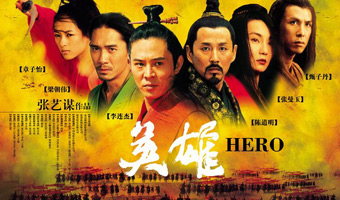 A poster of the film Hero, which stars Chinese actors Jet Li, Maggie Cheung, Zhang Ziyi, and Tony Leung Chiu-Wai, in 2001.
|
|
Film Industry Blueprint |
|
 |
 |
 |
|
Dongyang aims to expand film industry Dongyang city in East China's Zhejiang province, well-known for its private enterprises, is striving to grow its film and tourism industries as the central government encourages the development of the cultural industry. The city's Hengdian Film Industrial Park, which hosts a film base known as China's Hollywood, aims to achieve an annual business revenue of eight billion yuan ($1.26 billion) by 2015, according to the city's five-year plan for the development of the park. To attain the goal, the city hopes to increase the number of enterprises in the park to 600 by 2015 and annually produce about 20 percent of the country's films and teleplays.
|
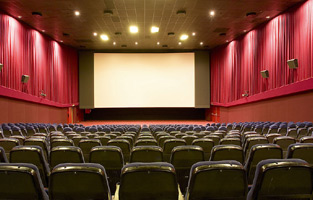
Zhejiang vows to leap in film industry Zhejiang province will accelerate its film & TV development in the 12th Five-Year Plan period (2011-2015), according to a blueprint issued by its TV watchdog on August. The Zhejiang Provincial Radio, Film and Television Bureau pledges in the blueprint to double its revenue of the related industries to 35 billion yuan in 2015 compared with that in 2010. It will build at least 50 cinemas, 300 movie screen and 40,000 seats by then, with a box office of 1.5 billion yuan, twice as much as that in 2010. Meanwhile, construction of infrastructure will be strengthened, too, as it aims to build or expand 10 film & TV industry bases in the province and build Radio & TV centers in 14 cities and counties. |
China gaining clout in film industry With an annual output of over 500 films, China boasts the world's third largest film industry after India and the US. China produced over 520 films in 2010, up from less than 100 annually prior to 2003. Movies screened in China last year raked in 10 billion yuan ($1.57 billion) at the box office, or 10 times more than box office sales in 2002. A survey by Wanda Movie Theater, one of China's largest cinema chains, showed that only 9 percent of city residents watch movies in cinemas, while 70 percent prefer to watch films through the Internet and on DVD. Twenty percent of residents rarely watch movies. This means the 90 percent (of non-cinema-goers) are target customers in the future so the untapped potential is huge. |
|
Policy and Incentives for Culture Industry |
|
China to boost soft power through culture The CPC Central Committee recently approved a decision on promoting the development of the country’s culture industry. As a source of creativity, China's culture industry will play a more critical part in the country's economic and social development. The country should not only provide its people with an ample material life, but also a healthy and rich cultural life. The government will devote more resources to boosting public cultural services and speed up the reform of the culture industry. |
China has established the first State-level investment fund targeting the cultural industry as part of its effort to develop the sector. The China Culture Industrial Investment Fund, launched by the Ministry of Finance and three companies, aims to raise 20 billion yuan ($3.09 billion) in the long term to invest in companies involved in radio and film and news and publishing. The fund is one of an increasing number of investment funds in the sector. Many venture capital and private equity firms are also interested in the cultural sector. |
Bank loan program helps small firms Liu Jinli, a deputy general manager at a film & TV production company in Hengdian Chinese Film Industrial Park, is all smiles as a bank has just approved a 20 million yuan ($3.15m) loan; and he will receive the funds in two days. Liu, like most in his profession, spent a large amount of time worrying about financing, a universal predicament among small and medium-sized film & TV enterprises, as they rarely obtain financial support from banks due to the difficulty in evaluating their intangible assets and valid collateral. |
|
Opinion |
|
 |
 |
 |
|
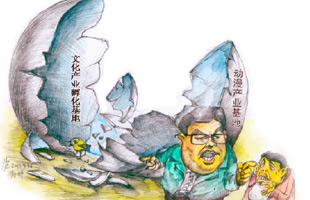
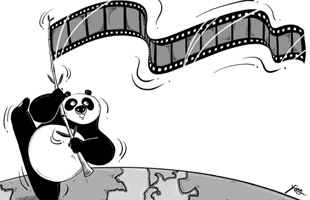
Culture is now treated as an economic sector subject to regulation through State policies and promotion through State entrepreneurship. The value added from the cultural sector reached 1,100 billion yuan ($173 billion) by the end of 2010, with an annual increase of 23.3 percent, which is faster than the growth rate of China's GDP. But while China is the world's largest TV drama and comics producer and the third biggest film producer making more than 500 movies in 2010 - these numbers don't necessarily mean power. Creativity and strength in the country's art and culture are not powerful enough to compete with that of Western goods such as American blockbusters. So boosting indigenous creativity will also boost the country's cultural strength. |
Economic boom leads to cultural revival China's rapid economic development is likely to lead to a revival of its culture, said World Bank chief economist Justin Yifu Lin, echoing a recent resolution by the Chinese authorities to accelerate the country's cultural reform and development. From 1979 to 2010, China maintained an annual GDP growth rate of 9.9 percent and increased its economic size over 20-fold, becoming the world's second largest economy. Lin, also senior vice-president of World Bank, noted that whether China can revive its culture depends on several factors, among which the most crucial is whether Confucianism can support an ever-changing economic base with constant innovation of artifacts and improvements in production force.
|
Action for a growing film industry As China's film industry flourishes, the foundations for the future of the movie business are being laid. Does Beijing have what it takes to be China's Hollywood? As if the rivalry between China's most modern cities needed any more fuel, Shanghai is also a major contender looking to cash in on the country's coming film boom. While Shanghai and Beijing may be the biggest players for the title of the China's Hollywood, there are a few minor players worth a mention. Hengdian is one of many small locations throughout China taking advantage of the growing industry.
|