Mothers plan different future for babies
Updated: 2011-12-13 07:41
By Yu Ran and Yeung Hau-Ming (China Daily)
|
|||||||||||


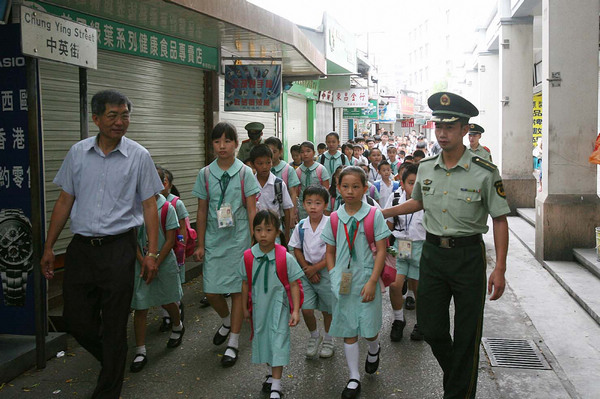
SHANGHAI / HONG KONG - As more mothers from the Chinese mainland have opted to give birth in Hong Kong, the city is expecting to see a peak in children entering its kindergartens and primary schools in the next couple of years.
According to the latest projections from the special administrative region's (SAR) census and statistics department, the number of fresh primary school students (6 years old and above) will rise from 50,400 this year to 66,100 in 2016.
|
 |
|
Students who live in Shenzhen, Guangdong province, are led by police across the border to go to school in Hong Kong near the start of the school year last autumn. [Photo / Xinhua] |
"As more parents look to give their children a Westernized education, going to school in Hong Kong has become one of the shortcuts," said Wang Binhua, a professor at East China Normal University's Institute of Curriculum and Instruction.
Hong Kong's baby boom began in 2003, when the central government made it easier for mainland residents to visit the SAR.
Official figures show there were 88,584 babies born in Hong Kong in 2010, with 40,648 born to mainland mothers, up from about 20,000 in 2005.
"I had my second son in Hong Kong (in 2008) mainly because I had planned to send him to study and live in Hong Kong in the future," said Hang Xiluan, 37.
She and her husband, a businessman, are now looking into moving to the SAR, and are preparing to apply to kindergartens.
"Moving to Hong Kong and leading a new life there seems a great challenge, with a more practical education for my children and better business opportunities for my husband," Hang said.
From the perspectives of native Hong Kong parents, the new arrivals are unlikely to bring benefits to their lives.
Alice Kwan's first daughter will start secondary school next September. She said any child born in the city should have the right to attend its schools.
However, she added that her only concern is that these youngsters will not stay and contribute to the region following their education.
Although the SAR provides 12 years of free education to all children, irrespective of where their parents are from, many mainlanders say they want their offspring to study at primary and secondary schools on the mainland.
"Most mainland parents gave birth in Hong Kong to get their children residency permits, which enable them to travel and study abroad more conveniently," said professor Wang.
Official census figures show that last year 98 percent of mainlanders who had children in the SAR took them back to the mainland, although 28 percent said they planned to return to live in Hong Kong before their children turn 21.
Ni Hong, 44, a white-collar worker in Hong Kong who grew up on the mainland, said her 17-year-old son was educated on the mainland. She wanted him to take the national college entrance examination in the SAR.
"My son was born in Hong Kong in 1994 and stayed until the second year of primary school before I decided to send him back to mainland, so he would speak better Mandarin and learn more traditional Chinese culture," said Ni, who married to a Hong Kong resident in 1992. "I think I made the right decision."
In response to the increase in new arrivals from the mainland, the SAR government in June imposed a reduced quota to restrict the number of mainland mothers giving birth at the city's public hospitals to just 3,400 in 2012, much less than in 2010.
Private hospitals with maternity units have also agreed to cut the places available to pregnant women from other countries and regions next year to 31,000, 7 percent less than in 2010.




Hot Topics
HIV/AIDS, Egypt protest, Thanksgiving, climate change, global economic recovery, home prices, high-speed railways, school bus safety, Libya situation, Weekly photos
Editor's Picks

|
|

|
|

|

|