Charting a course to peace
Updated: 2011-12-31 10:21
By Zhao Shengnan (China Daily)
|
|||||||||


Despite ongoing disputes, China is seeking joint development of the South China Sea to turn a potential flashpoint into an area offering opportunities for friendly cooperation
BEIJING - The South China Sea will continue to be a testing matter next year between China and its neighbors, but hope remains for improvement, experts said.
 |
|
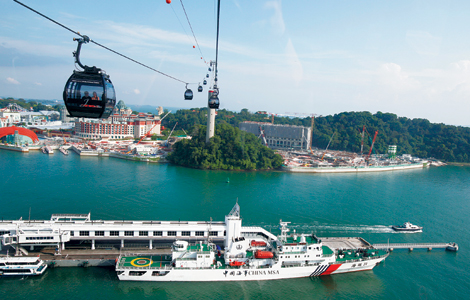
The Haixun 31 maritime patrol vessel, China's largest maritime patrol ship, on its first visit to the Southeast Asian city-state of Singapore, is docked at Singapore Cruise Center on June 21, 2011. [Photo/Agencies] |
China has experienced increased pressure this year regarding sovereignty of the South China Sea, where Malaysia, the Philippines, Brunei and Vietnam hold competing claims.
Although China has clear historical evidence to confirm it rightfully holds sovereignty, Southeast Asian countries, including Vietnam and the Philippines, enlarged their presence in the water area and adopted a tough stance over their disputes with China, said Zhang Tuosheng, a researcher at the China Foundation for International and Strategic Studies.
The interference of the United States further complicated the situation, he said.
Despite its strategic value as a vital commercial shipping route, disputes over sovereignty in the South China Sea had not emerged as a significant problem before it was found to be rich in energy resources in the 1970s, analysts said.
"Several countries have accelerated asserting their interest in the South China Sea. Vietnam has already established many oil platforms there, while China has none south of the Nansha Islands," said Huang Renwei, vice-president of the Shanghai Academy of Social Sciences.
Vietnam produces about 20 million tons of oil annually from the South China Sea, accounting for more than 30 percent of its GDP, Li Jinmin, an expert on South China Sea studies, told the Hong Kong newspaper Wen Wei Po. He added that energy projects in the region has became an economic pillar for Vietnam.
The South China Sea, covering more than 3.5 million square kilometers, is believed to hold oil and natural gas reserves amounting to 17.7 billion tons, making it the world's fourth-largest.
However, the region still holds the promise of being changed from a conflict flashpoint into an area with opportunities for cooperation that can help maintain regional stability.
China has proposed to shelve differences and is seeking joint development of the sea. It signed the Declaration on the Conduct of Parties in the South China Sea (DOC) in 2002 with the Association of Southeast Asian Nations (ASEAN), which led to the agreement of the guidelines for the implementation of the DOC in July.
Signatories agreed to cooperate in maritime protection, search and rescue, as well as transnational crime fighting.
China also proposed to establish a 3-billion-yuan ($477 million) China-ASEAN maritime cooperation fund in November, said Assistant Foreign Minister Le Yucheng earlier this month.
However, peaceful resolution of the issue and cooperation is no easy task for various reasons.
Zhang from the China Foundation for International and Strategic Studies pointed out that claimants of the South China Sea often only cite favorable portions of the United Nations Convention on the Law of the Sea to handle the sea disputes.
In addition, the economic slump over the past three or four years has escalated competition for energy resources and hindered joint development of the South China Sea, he said.
Meanwhile, US efforts to strengthen its economic and security foothold in the Asia-Pacific region, the fastest-growing area in the world, have been widely interpreted as trying to counterbalance China's clout in the region, which has complicated the issue by introducing a new variable to the regional landscape, Zhang said.
Several high-ranking US officials have publicly voiced their determination to interfere in the South China Sea, which only added fuel to the fire, Zhang said.
"Out of security consideration, China's neighboring countries always hedge their bets and join various alliances to counterbalance any power's strength in the region," said Zhu Feng, a professor of international relations at Peking University.
Yet dialogue and cooperation are the most realistic and effective ways to maintain peace and stability in the South China Sea, said Assistant Foreign Minister Liu Zhenmin on Dec 19 at a DOC seminar.
"China sincerely hopes to work with ASEAN countries to make the South China Sea a sea of peace, friendship and cooperation for the benefit of all countries," he said.
Foreign Ministry spokesman Hong Lei said at a news briefing on Friday that China will endeavor to increase cooperation and mutual trust, settle differences and problems and establish stronger ties with its neighbors.


Hot Topics
Kim Jong-il, Mengniu, train crash probe, Vaclav Havel, New Year, coast guard death, Internet security, Mekong River, Strait of Hormuz, economic work conference
Editor's Picks
|

|

|

|

|

|