|
|
|
 |
|
|
|||||||||
Environmental authorities of Guangdong province plan to start releasing PM2.5 readings on Thursday, an early-bird approach to meeting the stricter national air quality requirements.
The State Council announced last week that stricter standards would be adopted in cities, including readings for ozone and concentrations of PM2.5 - particulate matter smaller than 2.5 micrometers in diameter - which is considered more hazardous to health than larger particles.
Guangdong's initial readings will come from 17 monitoring stations in the Pearl River Delta.
Readings at other stations in the delta would be made public by June 5, with those from all stations in the province available in 2014, said Li Qing, director of the provincial environmental protection bureau, at a work conference on Monday.
Given the marked air pollution in the delta, the number of days with air quality that meet the standards in Guangdong will fall 10 to 30 percent after the new standards are adopted, Li said.
Guangdong's announcement came after Premier Wen Jiabao said in his work report on Monday that China will start monitoring PM2.5 in the Beijing-Tianjin-Hebei region, the Yangtze River Delta, the Pearl River Delta and in other key areas, like municipalities directly under the central government, and provincial capital cities this year.
As an economic powerhouse of China, Guangdong faces an uphill task in environmental protection. With a large increase of output from coal-fired power plants last year, sulphur dioxide and nitrogen oxide compound emissions went up, heightening the pressure to fulfill the emission reduction task in the 2011-15 period, according to the provincial environmental protection bureau.
Authorities will tighten clean air legislation this year, strengthening the treatment of emissions from automobiles and coal-fired power plants. They will also phase out obsolete capacities in industries involving furnaces, paper making, printing and dyeing, chemicals, construction materials and cement.
An investment of 100 million yuan ($15.8 million) is needed to enable all 97 national monitoring stations in Guangdong to test the air for PM2.5, in addition to staff recruitment and training.
In Guangzhou, capital of Guangdong province, daily air quality reports in line with the new standards, including PM2.5 readings, will be issued on the websites of the environmental authorities starting Thursday.
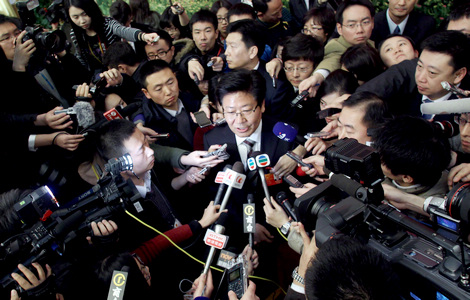
The new standards further emphasize public health guidelines and will serve as reference to the public in arranging their lives and outings, said Yang Liu, deputy director of the city environmental protection bureau, in a statement released Monday night.
He said city authorities will strengthen the control of automobile emissions and industrial pollutants, among other measures.
"The release should help improve air quality but the efforts should not stop here. I hope the government will increase transparency to make the data more convincing and will step up the supervision of the polluters," said a university student in Guangzhou who identified herself only as Huang.
Following Guangdong, the financial center of Shanghai vowed to complete a monitoring network for PM 2.5 in June and focus on cutting emissions from vehicles and power plants - two major sources of the city's pollutants.
The local environment protection department said about 25 percent of the city's PM2.5 comes from car emissions, as a large amount of small pollutants are discharged from diesel-fueled vehicles on the road. The amount increases if the drivers of these vehicles adopt bad driving habits such as frequent sudden acceleration and braking.
Official statistics showed that Shanghai still has more than 200,000 "yellow-label cars" - heavy-polluting vehicles - discharging 20 to 30 times more pollutants than green-label cars.
Another 20 percent of PM2.5 in the city's air comes from the chemical industrial process and industrial boilers and furnaces.
As such, the city plans to phase out 150,000 yellow-label cars by the end of 2014, and raise emission standards for newly registered cars, while providing sufficient approved-quality refined oil.
To fight pollution from thermal power plants, the city proposed cutting emissions by upgrading filtering and denitration facilities.
You may contact the writers at liwenfang@chinadaily.com.cn and wangzhenghua@chinadaily.com.cn
Liang Qianyun in Guangzhou contributed to this story.
Wu Ying, iPad, Jeremy Lin, Valentine's Day, Real Name, Whitney Houston, Syria,Iranian issue, Sanyan tourism, Giving birth in Hong Kong, Cadmium spill, housing policy

|
|

|

|

|

|