|
|
|
 |
|
|
|||||||||
China will establish two or three large rare-earth enterprises by consolidating companies in the sector, said a top industry official on Sunday.
Miao Wei, minister of industry and information technology, said on the sideline of the annual national legislative session that China will retain limits on rare-earth export quotas after the industry rationalization.
|
 |
|
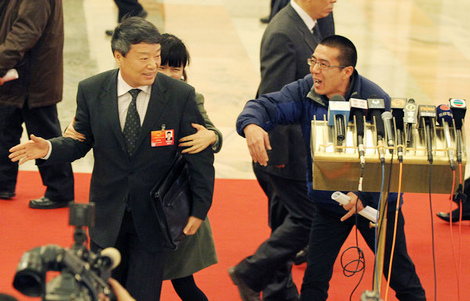
Minister of Industry and Information Technology Miao Wei (center) surrounded by journalists at the Great Hall of the People in Beijing on Sunday during the fourth plenary meeting of the Fifth Session of the 11th National People's Congress. [Jiang Dong / China Daily] |
Miao said the first large rare-earth enterprise had already been created in the Inner Mongolia autonomous region by consolidating 14 related companies under the leadership of Baotou Steel Rare-Earth Hi-Tech Co.
Miao didn't give a timetable for the nationwide restructuring, but a statement issued in February last year said that over a five-year period, China would regulate the industry to ensure "reasonable exploration and orderly production".
Export quotas were introduced to prevent smuggling and illegal exploration in the ill-regulated industry.
Although its rare-earth deposits account for only 35 percent of the world's total, China remains the world's largest rare-earth exporter. It accounts for more than 90 percent of global output of the 17 rare-earth metals, which are used in the electronics, defense and renewable energy industries.
The country said last year it would tighten up regulations on exploration, processing and environmental protection related to rare-earth exports, with officials saying that the move was primarily motivated by environmental concerns and was in compliance with World Trade Organization rules.
According to Miao, after the rationalization, export quotas will be set in accordance with the annual production amount, which is also in line with WTO rules.
Miao said that the rare-earth export quota in 2012 would be the same as in 2011. The full-year quota for 2011 was 30,184 tons, but actual exports amounted to just half of the quota.
Tougher regulations and a halt to illegal exploration meant rare-earth output declined last year and prices rose, leading to a sharp fall in consumption by foreign companies, Miao added.
"It is totally groundless to blame China for not selling or controlling rare-earth exports. The fact is that many foreign firms are cutting their usage," said Miao.
Miao said the industry regrouping will cover firms in more than 10 provinces, adding that the domestic industry's value stands at about 40 billion yuan ($6.35 billion).
Li Yizhong, former minister of industry and information technology, who is now a member of the Chinese People's Political Consultative Conference National Committee, said it's possible that large groups created in the restructuring might consider transnational operations.
In response to China's rare-earth regulations, foreign countries are stepping up new policies to cope.
Japan, the world's biggest importer of rare earths, will provide 5 billion yen ($65 million) in subsidies for projects that reduce the need for the elements as it aims to cut its reliance on imports to meet demand.
The funds will support projects that reduce the consumption of magnetic products that use dysprosium and neodymium, improve recycling and develop new technologies, according to a statement from the Ministry of Economy, Trade and Industry in February.
Apart from rationalizing the upstream segment of the rare-earth industry, it is also the "best time" to develop the downstream end, such as product processing, said Tu Hailing, vice-president of the Chinese Society of Rare Earths.
"For enterprises that made a lot of money from high prices last year, it's time to reinvest in research and development, to avoid falling to a passive market position again when prices decline," Tu said.
Tu suggested the government should also involve venture capital to facilitate a combination of financing and technology, as well as special funds to aid technology upgrades.
Tu was confident that these things would happen soon because "a hard lesson was learned from market volatility last year".
"Only a developed downstream could stabilize market demand and production for the upstream," Tu said.
These changes could be initiated by an "industrial association of rare earths", which will be established soon, he added.
Contact the writers at wujiao@chinadaily.com.cn and weitian@ chinadaily.com.cn
Wu Ying, iPad, Jeremy Lin, Valentine's Day, Real Name, Whitney Houston, Syria,Iranian issue, Sanyan tourism, Giving birth in Hong Kong, Cadmium spill, housing policy

|
|

|
|

|

|