 |
|
|
 |
|
|
|||||||||
A diminishing water table, combined with a growing number of skyscrapers, is causing large areas of China to sink, increasing flood risk and endangering the rail network, according to a survey released recently by the China Geological Survey.
The government has already launched a number of measures to combat the problem and a plan of action was approved by the State Council in February.
Research shows the most vulnerable spots are in the North China Plain, the Yangtze River Delta and the Fenwei Basin, covering a combined total area of 79,000 square kilometers - more than 100 times the size of Singapore.
More than 50 cities in these areas are now at least 20 centimeters lower than they were in the 1970s, the survey said.
The problem is worsening and could spell potential disaster for millions of residents, said Li Tiefeng, head of the group's geological disaster office.
Statistics for Cangzhou in Hebei province, for example, show its average surface level has sunk 2.4 meters since the 1970s, mainly due to the excessive reduction of the water table.
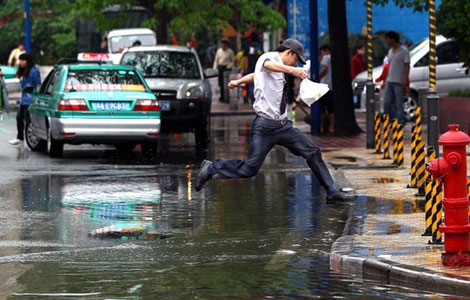
The city's low-lying location has made it vulnerable to urban flooding during rainy seasons since the 1980s.
Unlike Cangzhou, Shanghai is suffering land subsidence due to dense high-rise construction.
In February, a crack about 10 meters long appeared between the 492-meter tall World Financial Center and the under-construction Shanghai Tower with a designed height of 632 meters.
"The frantic building boom has contributed a lot to Shanghai's ground sinking," Li said.
There are about 65 buildings higher than 200 meters in Shanghai, while Tokyo has 45, according to Emporis, one of the world's leading providers of building statistics.
A study released by the China Geological Survey in 2008 showed that total economic losses due to land subsidence reached nearly 333 billion yuan ($53 billion) from 1956 to 2008 in the North China Plain.
The plain covers an area of 140,000 square kilometers, including Beijing and Tianjin.
The situation may become worse with the construction of high-speed rail, Wu Aimin, director of the geological survey and technology department at the China Geological Environment Monitoring Institute, told the Economic Herald.
As China enters a boom period for high-speed rail construction, authorities should monitor subsidence near railways, such as the high-speed rail linking Beijing and Shanghai.
"If the ground sinks, even by a few millimeters, it will threaten the safety of high-speed rail," Wu was quoted as saying.
However, the government is taking measures to tackle the situation with the first national land subsidence control plan from 2011-20 approved by the State Council in February.
It includes a nationwide survey, the establishment of monitoring networks in affected areas and increased control over underground pumping.
A land subsidence research project will be completed by 2015 in key areas such as the North China Plain, the Yangtze River Delta and the Fenwei Basin in Shaanxi and Shanxi provinces, especially areas with high-speed rail, according to the plan.
Han Mukang, a retired professor at Peking University who has studied the issue for decades, said controlling underground water extraction is an urgent task.
Authorities of the affected areas are combating subsidence by recharging groundwater and reducing pumping.
Shanghai Water Authority said that in 2015 the city will reduce extraction to 10 million cubic meters from more than 13 million cubic meters in 2011 and the water table recharge will reach 20 million cubic meters in 2015.
Beijing is also planning to recharge groundwater to avoid further land subsidence when conditions are proper.
wangqian@chinadaily.com.cn
|

|

|

|

|

|


