

 |
|
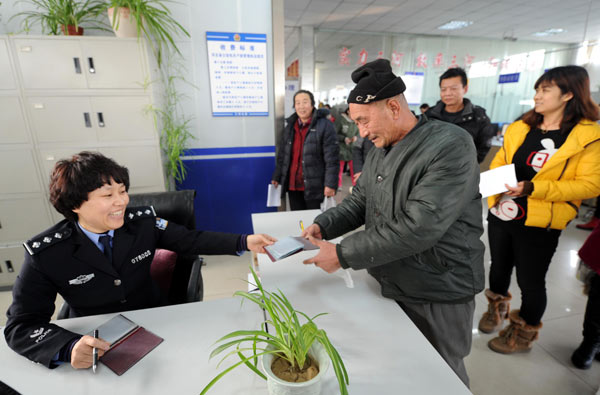
A man's hukou (household registration) is transferred at a government service center in Sanhe, Hebei province. The Ministry of Public Security and 11 other ministries and commissions have drafted reform guidelines aimed at establishing a new system to allow hukou to be transferred based on a person's place of residence and occupation. LI XIAOGUO / XINHUA |
New system would extend pension, education and healthcare services
The Ministry of Public Security and 11 other ministries and commissions have drafted reform guidelines for China's hukou (household registration) system that, if approved by the central government, will take effect immediately and aim to establish a new hukou system by 2020, a senior official said on China Central Television.
Huang Ming, vice-minister of public security, said on Tuesday that the new hukou system will gradually extend pension, education and healthcare services to qualified residents, both urban and rural.
Inequalities brought by the current hukou system have prevented migrants from enjoying equal access to services in cities. This creates a major barrier for the country's urbanization process, Huang said.
Currently, there are 260 million migrant workers who live in cities but do not enjoy the same benefits as those who hold an urban hukou.
The new hukou system will be based on a person's place of residence and job, instead of birthplace, and it will be easier for the people to transfer their hukou, Huang said.
The main task of the upcoming reform is to resolve the problems of those who work in cities but don't have urban hukou, he said, adding that reforms must be based on individual choice. The government should not force residents to change their hukou status, he said.
During the central urbanization work conference last week, the government pledged to make steady moves to promote human-centered urbanization, seeking to balance urban and rural development and to unleash domestic consumer demand.
A statement released after the two-day conference — attended by President Xi Jinping and Premier Li Keqiang — said that urbanization is the road China must follow in its modernization drive, and that it represents one important way of addressing rural problems.
The statement promised to fully remove hukou restrictions in towns and small cities, to gradually ease restrictions in mid-sized cities and to set reasonable conditions for settling in big cities, all while strictly controlling the population of megacities.
The populations of Beijing and Guangzhou have each increased more than 400,000 annually over the past decade, putting tremendous pressure on the environment — for example, by dramatically increasing traffic — Huang told CCTV.
Some local governments have initiated pilot projects in hukou reform in past years.
In June 2010, for instance, the government of Guangdong province introduced a scoring system under which migrant workers would qualify for urban household registration once his scores reach a certain level.
Migrants can earn points based on their educational backgrounds, skill levels, social security records and participation in charitable activities, such as blood donations.
But a change of hukou requires them to give up their plots of farmland back in their hometowns, since only those registered as farmers are entitled to the land, Xinhua News Agency reported.
"The hukou reform will put great pressure on local governments since it will increase public expenses for education, health and pension services," said Yi Peng, a researcher with the China Center for Urban Development under the National Development and Reform Commission.
"The higher cost of public services brought by hukou reform should be jointly paid by the central and local governments, as well as by State-owned enterprises," Yi said.
anbaijie@chinadaily.com.cn
|
|
|
|
|
|
|
|

Copyright 1995 - . All rights reserved. The content (including but not limited to text, photo, multimedia information, etc) published in this site belongs to China Daily Information Co (CDIC). Without written authorization from CDIC, such content shall not be republished or used in any form. Note: Browsers with 1024*768 or higher resolution are suggested for this site.
License for publishing multimedia online 0108263 Registration Number: 20100000002731 














 Op Rana
 Berlin Fang
 Zhu Yuan
 Huang Xiangyang
 Chen Weihua
 Liu Shinan