

 |
|
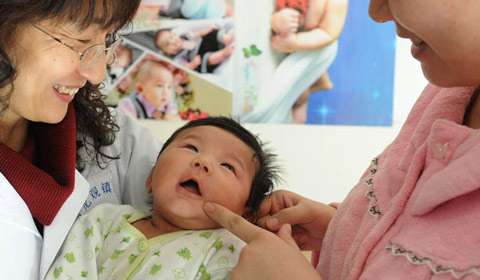
A doctor from the Huilongguan community health service center (left) examines a child. Beijing is planning to transform private hospitals and clinics into community health service center in an effort to provide better primary healthcare. Yan Tong / for China Daily |
Beijing is embracing primary healthcare outside traditional structures, as local governments in Chaoyang and Haidian districts introduce private hospitals and clinics to services long provided by community health centers.
"We are planning to transform a private hospital into a community health service center. It is going to open in 2014, according to the plan," said Yang Hua, deputy head of the health bureau of Chaoyang district.
Two private clinics in Haidian district are also turning themselves into primary-care providers.
"This lessens the burden on the government, as it is not able to set aside as much money and it’s hard to find a piece of land suitable to build a new community health center," said Gui Xiaohai, deputy head of the district’s health bureau. "The government should take most of the responsibility in providing primary care, but other organizations can also complement the service."
Provided by community health service centers across the city, primary care includes the treating of minor diseases, management of chronic diseases, inoculations, tests for pregnant women and young children and generally advocating a healthy lifestyle.
A majority of centers are government-funded. In turn, they give their revenue to the government and rely on government funding to cover costs, including staff salaries.
Other centers are either running on their own or are sponsored by public institutions such as universities or public hospitals.
Compared to government-funded centers, they consume less public money but can provide more targeted services, said Gui.
According to Yang and Gui, of the 91 community health service centers in the two districts, 32 are running outside the government system.
To help these primary-care providers survive and grow, the city’s government pays them more than it pays their government-funded counterparts.
"We want to strike a balance in policy," said Yang.
"For government-funded centers, the government pays 8 yuan ($1.3) for each resident its service covers. For those who don’t depend on the government to cover staff salaries, the figure is 40 yuan per person."
However, Liu Yunjie, director of Liulitun Community Health Service Center in Chaoyang district, said the government’s payments are far from enough to alleviate his center’s financial pressures.
The center was once a hospital sponsored by a State-owned company to provide special healthcare to the company’s staff. It lost the funding from the company in 2002 when the government urged State-owned companies to stop running their own hospitals.
In 2006, the hospital became a community health service center in the neighborhood of Liulitun, responsible for providing primary care to residents in a neighborhood of more than 110,000 people.
With a limited subsidy, the center is working harder than its government-funded counterparts to attract customers and get more government support, Liu said.
On the other hand, it will be difficult to make ends meet if the government doesn’t increase the amount of its subsidy, he said.
"We have to provide many kinds of primary care, so we must develop other services to attract more customers, such as our geriatric ward and rehabilitation center for stroke patients," he said.
"We don’t have as many family doctors as the government has asked for, but we cannot afford to hire more."
"Our staff are under greater pressure but have lower average salaries than those in government-funded health service centers. I’m worried that my staff will leave us for better pay."
Yang, of the Chaoyang health bureau, said he was aware of the problem.
"Community health service centers outside the government system are having a tough time. We are giving them more every year, although the increase is not large," he said. "We will try to find ways to help increase salaries and avoid a talent drain."
wangqingyun@chinadaily.com.cn
|
|
|
|
|
|
|
|

Copyright 1995 - . All rights reserved. The content (including but not limited to text, photo, multimedia information, etc) published in this site belongs to China Daily Information Co (CDIC). Without written authorization from CDIC, such content shall not be republished or used in any form. Note: Browsers with 1024*768 or higher resolution are suggested for this site.
License for publishing multimedia online 0108263 Registration Number: 20100000002731 















 Op Rana
 Berlin Fang
 Zhu Yuan
 Huang Xiangyang
 Chen Weihua
 Liu Shinan