

|
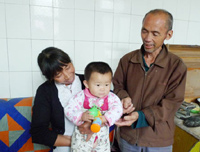
 Obstetric nurses in the Central Hospital of Enshi, Hubei province, take care of newborns at the hospital. Couples in Enshi are allowed to have two children. Li Yuanyuan / for China Daily |
|
|
This is a major change of the decades-long family planning policy in the world's most populous country.
The bi-monthly session of the Standing Committee of the National People's Congress (NPC) passed a resolution on family planning, entrusting provincial congresses and their standing committees to make their own calls on implementation.
"They should amend local family planning regulations, or issue a special act, in time, based on evaluation of local demographic situation and in line with the law on population and family planning as well as this resolution," the document said.
Family planning is written into the Constitution as an essential state strategy and any adjustment requires a resolution by the top legislature.
The changes come against a backdrop of steadily declining birth rates and changing demographics, reducing the working population. The birth rate is relatively low and was showing signs of falling further. The rate has dropped to between 1.5 and 1.6 since the 1990s, which means each Chinese woman of child-bearing age gives birth to 1.5 to 1.6 children, on average.
The working population began to drop in 2012 by 3.45 million annually, and it is likely to fall by 8 million each year after 2023, while the population aged 60 and above will reach 400 million and account for quarter of the population by the early 2030s, up from one seventh now.
The government estimates that since the introduction of the rules in the 1970s, the one-child policy has prevented some 400 million births.
However, thousands of families have lost their only child. Children may be born with congenital problems or has become disabled through illness or accident. These events are not just family tragedies but serious social problems.
Couples, both without siblings, also worry about financial and technical plights when they have to support four aged parents on their own.
Briefing lawmakers on Monday, Li Bin, minister in charge of the commission, warned that if the policy persisted, the birth rate would continue to fall, leading to a sharp drop in population after reaching a peak.
There have always been several exceptions to the rules. A couple could have two children if neither parent had siblings or if either comes from an ethnic minority. Rural couples could apply to have a second child if their first was a daughter.
In debating the new policy, lawmakers emphasized the importance of continuing family planning.
"Easing the one-child policy does not mean an end to family planning," said NPC Standing Committee member Chi Wanchun during the panel discussion.
While it is right to adjust policy to new circumstances, it is equally important to ensure sustainable population growth, Chi said.
"China still has a large population. This has not changed. Many of our economic and social problems are rooted in this reality," said Jiang Fan, an NPC deputy and member of the NPC Agriculture and Rural Affairs Committee. "We cannot risk the population growing out of control."
The State Council expects the policy change to cause only a slight increase in births.
According to the National Health and Family Planning Commission, the new policy is expected to go into force in some provincial regions in the first quarter of 2014.
|
|
|
|
|
|
|
|

Copyright 1995 - . All rights reserved. The content (including but not limited to text, photo, multimedia information, etc) published in this site belongs to China Daily Information Co (CDIC). Without written authorization from CDIC, such content shall not be republished or used in any form. Note: Browsers with 1024*768 or higher resolution are suggested for this site.
License for publishing multimedia online 0108263 Registration Number: 20100000002731 



















 Op Rana
 Berlin Fang
 Zhu Yuan
 Huang Xiangyang
 Chen Weihua
 Liu Shinan