|
 |
| Chinese buzzwords popular on Urban Dictionary? |
But now some people want to replace the term, which describes a pollution-linked particulate, with a lengthy, confusing Chinese equivalent to protect the purity of the Chinese language.
More than three decades into China's reform and opening-up, a growing number of loan words have been absorbed into daily use, ranging from Wi-Fi to GDP, NBA and VIP.
The increased use of foreign words has sparked heated debate about the linguistic purity of the Chinese language.
The discussion was initiated by an editorial last week in People's Daily, the flagship newspaper of the Communist Party of China, which criticized the influx of imported words for harming the purity and health of the Chinese language.
The phenomenon of mixing English words with the Chinese language, though seemingly stemming from laziness, in fact reflects a lack of confidence in the culture, said Du Chuijian, an expert in Confucianism at Capital Normal University in Beijing.
However, the objection to foreign words has triggered dissent from members of the public, who say English abbreviations and acronyms have helped improve efficiency in daily communication.
In response to the alarm over the incursion of foreign words, online users created a handbook on how to maintain the purity of the Chinese language. The handbook has been widely spread throughout Sina Weibo, China's most popular micro-blogging service.
"Excuse me, could you show me the departure lounge for Very Important Persons? Hi dude, tell me the password of the Wireless Fidelity please," said Sina users, citing examples in the handbook of how to speak correctly without the use of English abbreviations.
Rather than viewing foreign words as a threat, some hail the phenomenon as a mark of cosmopolitanism.
The inclusion of foreign words has not only enriched the Chinese language, but also facilitated Chinese people's contact with the outside world, said a commentary run by the Xinhua Daily Telegraph.
"Protecting language purity with a xenophobic mentality is actually a kind of linguistic nationalism," it warned.
It is not the first time such debates have been heard in China. Two years ago, some linguists petitioned for the removal of English words from an authoritative Chinese dictionary and included their Chinese equivalents in the dictionary instead.
In 2010, China Central Television also triggered a backlash when it changed the frequently used "NBA" into meizhilan, short for "American Professional Basketball" in Chinese.
As more foreign words enter the Chinese language, some people have cited the addition of Chinese words to the English language as evidence of language exchange.
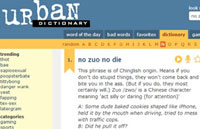
The 2013 Chinese hot phrase "no zuo no die", meaning "if you don't do stupid things, they won't come back to bite you", has been included in the Urban Dictionary, an online dictionary with more than 7.7 million definitions, many for slang, buzzwords, and other words or phrases not found in standard dictionaries.
Other Chinglish words or phrases in the dictionary include "gelivable" (awesome or amazing), "people mountain people sea" (very crowded), "zhuangbility" (boastfulness) and "shability" (foolishness).
Some experts have suggested that the Chinese language is not as influential as English. They have advocated that the government formulate more specific guidelines on the use of borrowed words.
Though the public may choose what they like for daily use, the government still has the obligation to regulate the overuse of borrowed English words in official language, said Gao Jian, a professor from Shanghai International Studies University.
"Language is a very important manifestation of cultural identity and we should protect it from losing its appeal," Gao said.


Copyright 1995 - . All rights reserved. The content (including but not limited to text, photo, multimedia information, etc) published in this site belongs to China Daily Information Co (CDIC). Without written authorization from CDIC, such content shall not be republished or used in any form. Note: Browsers with 1024*768 or higher resolution are suggested for this site.
License for publishing multimedia online 0108263 Registration Number: 130349