Rising tide of parcel deliveries poses possible pollution threat
|
|

China's online shopping platforms have helped to boost the economy, but the waste material from the packages they supply has an environmental downside. Zheng Jinran reports.
Recently, Zhang Yajun received three parcels in one day; the last to arrive contained a feeding bottle for the baby she is expecting soon.
The 29-year-old expectant mother from Shijiazhuang, capital of Hebei province, was surprised to see that the little glass bottle was wrapped in three layers of plastic bubble wrap, making the packaging much larger than the contents.

"It is normal practice for vendors to pack products carefully, but the waste plastic wrappers and cardboard boxes are usually useless, so I just throw them into the trash can," she said.
Given the enormous number of parcels delivered in China every year, coupled with a boom in online shopping platforms, Zhang's story will be familiar to many people.
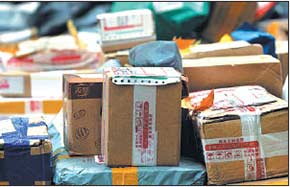
Last year, deliveries from online vendors soared. More than 31 billion parcels were delivered, 31 times higher than in 2006, meaning that 1,000 packages were sent out or received every second of every day, according to the State Post Bureau. For example, the online shopping spree for Singles Day, which falls on Nov 11 every year, generated 1.05 billion parcels.
The upsurge saw China overtake the rest of the world, accounting for 44 percent of the global total of 70 billion parcels.
As a result, the parcel delivery sector generated revenue of 400 billion yuan ($58 billion), according to data released by State Post in January.
However, while the high volume of deliveries is beneficial to the economy, there is an environmental downside because, like Zhang, most recipients throw the packaging straight into the trash can, posing a pollution threat.
That message was under-lined recently at a collection point operated by Cainiao Network, the delivery arm of the internet giant, Alibaba. The point, which serves two universities in Beijing, saw more than 8 kilograms of unwanted packaging in just six hours, after the majority of students who received parcels discarded the wrapping immediately.

"The delivery of billions of parcels has raised energy consumption and poses a huge risk to the environment," said Zhu Lei, deputy director of a research center in Qingdao, Shandong province, which works for the Beijing Institute of Graphic Communication.
Parcels and pollutants
Luan Ning, who sells dried dates and a range of branded items from Australia via WeChat, usually encloses her products in bubble wrap to protect the contents in the event of rough handling, and secures the packages with sticky tape.
"The cost of packaging is rising, but I have to wrap the items well to avoid complaints from customers," she said. For retailers such as Luan, ensuring the success of her business means it is essential to avoid adverse comments online about the service she provides.
The majority of vendors adopt the same approach, resulting in greater use of resources, which is not only wasteful, but also raises costs.
It is estimated that 10 billion cardboard boxes and 8 billion plastic bags were used to wrap the 20.7 billion parcels that were delivered in 2015, while the sticky tape used would circle the equator 425 times, according to a report published by the State Post and Zhu's research center in Qingdao.
The problem is that, compared with the high consumption rate, the recycling rate for packaging materials is extremely low, according to experts and the companies involved.
"Currently, the recycling rate for paper and plastic packaging is no higher than 10 percent, while the overall rate is about 20 percent at most," said Zhu, who participated in the surveys conducted for the report. The situation is different in developed countries, some of which have a 45 percent rate of recycling for paper-based packaging, he added.
Chang Tao, manager of Yingchuang Recycling Co, one of the leading recycling companies in Beijing, said China's current recycling rate is no more than 20 percent, and he estimated that the country will soon produce more than 5 million metric tons of packaging waste every year.
Because a lot of packaging is thrown out as garbage, it ends up in landfill sites, which raises the risk of environmental contamination because most vendors and manufacturers use cheap plastic bags and sticky tape to lower their costs.
However, most plastic packaging is not biodegradable, and the main component, polyvinyl chloride, better known as PVC, can remain unaffected in the soil for 100 to 150 years. Despite the risks, most recycling companies refuse to accept plastic wrapping and cushioning materials.
Even if 100 percent of the paper-based materials used to pack goods was recycled, the growing demand for online goods means that even more paper would need to be produced, That would lead to higher consumption of resources such as wood, and greater use of coal and electricity in the production process, and add
to the risk of environmental pollution, according to a 2013 report by the China Resource Recycling Association.