|
II. Remarkable Improvement in People's Life
Having eliminated poverty and solved basic subsistence problems, the people of all ethnic groups in Xinjiang have now set their eyes on more prosperous lives, along with marked improvement in their standard of living.
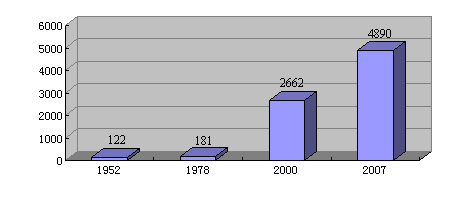
In 2008, the per-capita net income of farmers in Xinjiang was 3,503 yuan, which is 28 times more than that of 1978, and 1.2 times more than that of 2000 when the western development campaign was launched; the per-capita disposable income of urban residents reached 11,432 yuan, which is 35 times more than that of 1978, and double that of 2001. The per-capita deposited savings of urban and rural residents averaged 14 yuan in 1955, 52 yuan in 1978, 4,913 yuan in 2000, and 11,972 yuan in 2008. Per-capita consumption was 122 yuan in 1952, 181 yuan in 1978, 2,662 yuan in 2000, and 4,890 yuan in 2007.
Fig. 2 Per-capita Deposited Savings of Xinjiang Residents (Unit: yuan)
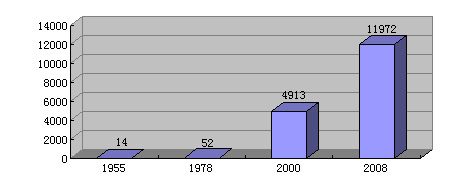
Fig. 3 Per-capita Consumption of Xinjiang Residents (Unit: yuan)
The residents' income increases have become more diversified. In the countryside, besides conventional crops such as grain and cotton, fruit trees have become a new source of earnings for farmers and herders, bringing in 340 yuan per capita in 2008. In places that had developed fruit growing earlier, earnings from selling fruit accounted for more than 40% of the total income of farmers and herders. Another way to increase earnings is seeking jobs elsewhere, particularly in eastern China. In 2008, more than 1.5 million farmers and herders found jobs outside Xinjiang, bringing back an additional 150 yuan per person for all rural residents. The development of tourism has promoted the production and sales of tourist products with distinctive features of minority ethnic groups, and the growth of local handicrafts, directly or indirectly producing hundreds of thousands of jobs, and thus increasing household incomes.
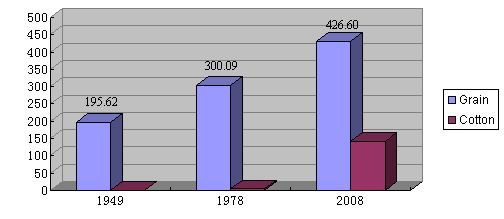
The consumption levels of rural and urban residents have steadily risen. Average per-capita amount of grain rose from 195.62 kg in 1949 to 300.09 kg in 1978, and further to 426.60 kg in 2008; average per-capita amount of cotton rose from 1.18 kg in 1949 to 4.46 kg in 1978, reaching 141.52 kg in 2008; and average per-capita amount of meat was 11.68 kg in 1949, 7.83 kg in 1978, and increased to 53.85 kg in 2008.
Fig 4. Average Per-capita Amount of Grain and Cotton (Unit: kg)
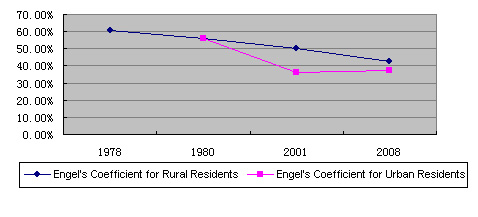
The consumption structure has changed. The Engel's Coefficient (the proportion of food consumption) for rural residents was 60.8% in 1978, 50.0% in 2001, and 42.5% in 2008; while for urban residents it was 57.3% in 1980, 36.4% in 2001, and 37.3% in 2008.
Family consumption patterns are shifting from everyday items to services, culture, education, travel, healthcare, credit, information, private cars, and luxury housing. The consumption structure is changing from agricultural products like foodstuffs to electronic products for comfort and leisure. Food consumption is shifting from staple foods to non-cereal foods stressing nutritional balance. Clothing consumption is following the trends of readymade garments, latest fashions, brand-names and unique styles. The consumption on home appliances has experienced a shift from bicycles, sewing machines, watches and radios, to color TV sets, refrigerators, washing machines and cameras, as well as personal computers (PCs), video cameras, pianos and gym facilities. Now, cars are also becoming more affordable for an increasing number of families.
Fig. 5 Engel's Coefficient for Xinjiang Residents
The number of home appliances bought by urban and rural families has been steadily rising. In the countryside, in 1990 every 100 house-holds owned 12.58 washing machines, which increased to 20.87 in 2000, and to 38 in 2008; in 1990 every 100 households owned 0.40 refrigerators, which increased to 9.93 in 2000, and to 30.32 in 2008; in 1990 every 100 households owned 1.37 motorcycles, which increased to 18.33 in 2000, and to 50.77 in 2008; and the number of cell phones per 100 households increased from 0.33 in 2000 to 54 in 2008.
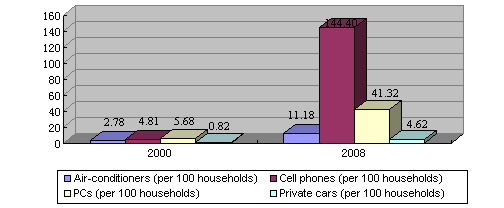
In the cities, every 100 households owned 2.78 air-conditioners in 2000, and 11.18 in 2008; 4.81 cell phones in 2000, and 144.40 in 2008; 5.68 PCs in 2000, and 41.32 in 2008; and 0.82 private cars in 2000, and 4.62 in 2008.
Fig. 6 Consumption on Home Appliances by Rural Households
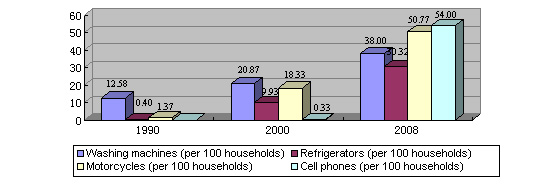
Fig. 7 Consumption on Home Appliances by Urban Households
People's living conditions have seen continuous improvement. A wide range of transportation vehicles available has made travel much easier and faster. In the early days of reform and opening-up in the 1980s, it took nearly one week to travel from Urumqi to Beijing by train, while now it takes only three hours by air. The length of paved road per 10,000 urban residents was 1.6 km in 1978, 4.5 km in 2000, and up to 15.7 km in 2008. The number of buses per 10,000 urban residents was 3.1 in 1978, which increased to 13.2 in 2008.
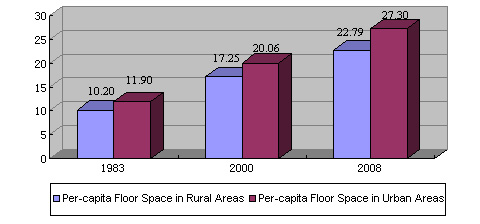
Housing conditions have also greatly improved. Per-capita floor space in the countryside was 10.2 sq m in 1983, 17.25 sq m in 2000, and 22.79 sq m in 2008; while per-capita floor space in cities was 11.9 sq m in 1983, 20.06 sq m in 2000, increasing to 27.3 sq m in 2008.
Presently, 97.86% of the population in cities have access to tap water and the rate is 87.18% in county seats. While 89.33% of people in cities have access to cooking gas, the rate is 66.67% in county seats. In cities and towns the rate of centralized heating is 51.2%, the rate of sewage treatment 68%, and the rate of treatment of domestic waste is 16%. The urban green-coverage is 30.49%, the vegetation-land ratio is 26.19%, and per-capita public green area is 6.94 sq m.
In recent years, reasonably priced clean gas has become available to more than 300,000 households in 23 counties and cities in southern Xinjiang, including Korla, Hotan, Kashi, Artux, Aksu, Moyu, Lop and Shule. The number of household gas users in southern Xinjiang keeps growing by 1,000 every month. The felling and burning of poplar trees for household fuel has become a thing of the past.
Fig. 8 Per-capita Floor Space in Xinjiang (Unit: sq m)
|