Also: How aspirin may help colon cancer patients. And the truth about Tyrannosaurus rex.
VOICE ONE:
This is SCIENCE IN THE NEWS in VOA Special English. I'm Bob Doughty.
VOICE TWO:
And I'm Barbara Klein. This week, we tell about how thin monkeys live longer than fat ones, how aspirin can help colon cancer patients and some new information about Tyrannosaurus rex.
(MUSIC)
VOICE ONE:
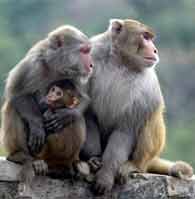
A study of monkeys over a twenty-year period suggests that eating less may extend life and prevent disease. American researchers said they believe their findings could apply to people as well. Their study was published in the journal Science.
Richard Weindruch of the University of Wisconsin in Madison and his team did the research. They tested the effects of calorie restriction in 76 rhesus monkeys over 20 years.
Half of the monkeys were permitted to eat as much as they wanted. The other half ate a controlled diet. They were fed two-thirds of the calories they would otherwise choose to eat. These monkeys were given vitamins and minerals to prevent malnutrition.
VOICE TWO:
The researchers found that 37 percent of the monkeys that ate as much as they wanted had died of causes related to aging after 20 years. In comparison, only 13 percent of the monkeys on restricted diets had died.
On average, rhesus monkeys live about 27 years in captivity, that is, when they live with humans and not in the wild. Mr. Weindruch says researchers do not know why reducing calories increases the length of life. But they believe there is a helpful change in the way the body processes energy in the monkeys that eat fewer calories.
Extended life was not the only observable difference between the two groups. The monkeys that ate less had half the amount of heart disease and cancer. They also had no cases of the disease diabetes. Richard Weindruch explains.
RICHARD WEINDRUCH: "Our data show that there is about a three-fold higher risk of developing a disease of aging in those animals fed the normal diet as opposed to those that have been on caloric restriction since they were adults."
VOICE ONE:
Mr. Weindruch says not only is life extended in the monkeys that eat less, but their quality of life is also improved. He noted another surprising observation in the monkeys on a restricted diet. There was a delay in muscle loss and brain shrinkage that lead to mental problems linked to aging.
In addition, there is also a difference in the appearance of calorie-restricted monkeys and those on a normal diet. The monkeys that ate fewer calories look younger and healthier than fatter monkeys on an unrestricted diet.
VOICE TWO:
The study was paid for by the United States National Institute on Aging. Some critics say more research is needed to prove that calorie restriction extends life in monkeys. Mr. Weindruch says his study is not complete and that his team will continue to observe the remaining monkeys throughout their lives.
Scientists first studied the effects of calorie restriction on aging in the 1930s. Since then, similar studies have shown life-extending effects of reduced diets on rodents, yeast and worms. Scientists are currently studying the effects of restricted diets on people. However, this is more difficult because it is harder to control the diets of people and because they live longer than other animals.
(MUSIC)
VOICE ONE:
People since ancient times have used aspirin-like medicines to fight pain and reduce high body temperature. Modern research has found other uses for aspirin. The drug acts as a blood thinner. It can help blood flow past a blockage in an artery. Blockages can cause heart attacks or strokes. As a result, patients at risk of blockages might be advised by their doctors to take a low-strength aspirin every day. And research continues. A new study has shown that aspirin can improve survival in colon cancer patients.
VOICE TWO:

The study involved about 1300 patients with colorectal cancer. The cancer had not spread to other parts of the body yet. The study compared patients who took 325 milligrams of aspirin at least two times a week with those who did not use aspirin.
The study found that the aspirin users had an almost 30 percent lower risk of dying from their cancer. That was during an average of eleven years after the cancer was discovered.
Andrew Chan of Harvard Medical School and Massachusetts General Hospital led the study. Doctor Chan says the effects appeared especially strong among patients with tumors expressing an enzyme called COX-2. Two-thirds of colorectal cancers produce that chemical. Doctor Chan thinks the aspirin works by blocking it.
The study appeared in the Journal of the American Medical Association. It was an observational study. In a controlled study, some patients would have taken aspirin. Others would have received a placebo -- sugar pills -- for comparison.
VOICE ONE:
Last year, Doctor Chan reported that a long-term study of almost 50 thousand men showed that aspirin can help prevent colon cancer. But the effects required at least six years of regular use. And the greatest risk reductions were in those who took more than 14 aspirins per week.
But the researchers warned that the dangers from such large amounts of aspirin should be carefully considered. Aspirin is a kind of nonsteroidal anti-inflammatory drug, or NSAID. The earlier study found comparable reductions from the use of other NSAIDs, but not from the use of acetaminophen.
All of these drugs have their uses but they also have risks. Aspirin can cause bleeding in the stomach, the intestines and the brain. People who might want to consider taking aspirin as a preventative measure should first talk to a doctor.
(MUSIC)
VOICE TWO:

There is new information about Tyrannosaurus rex, the most widely recognized dinosaur and a favorite among children. Many children's books show T.rex fighting bloody battles with other huge dinosaurs.
But now it seems that T.rex may not have been as fierce as scientists once believed.
"Tyrannosaurus" means "tyrant lizard" and "rex" is Latin for "king." The Tyrannosaurus lived in North America during the late Cretaceous Period. The huge animals died out about 65 million years ago.
T.rex was one of the largest meat-eating dinosaurs that ever lived. It stood four to six meters tall, was about twelve meters long, and weighed up to seven tons. Its huge head was one and a half meters long. It also had sharp, bone-crushing teeth. The animal was believed to be a fierce predator that ate other dinosaurs.
VOICE ONE:
Scientists believed the Tyrannosaurus ate even larger plant-eating dinosaurs. And, they believed T.rex could eat up to 230 kilograms of meat in one bite. But new research suggests that the deadly dinos may not have been as fierce as earlier believed.
Oliver Rauhut is a paleontologist at Ludwig Maximilians University of Munich in Germany. David Hone is a paleontologist at the Institute of Vertebrate Paleontology and Paleoanthropology of China in Beijing.
The two scientists have concluded from fossil records that giant meat-eating dinosaurs like the Tyrannosaurus rex mainly ate young dinosaurs. Fossil records of the stomach contents of the larger dinosaurs suggest they swallowed these young dinosaurs whole.
VOICE TWO:
The scientists say this belief is further supported by the fact that past discoveries from dinosaur areas show they contained large numbers of dinosaur eggs. This should have resulted in a large number of baby dinosaurs. But Mr. Rauhut says fossil records show that this is not the case. He says young dinosaur fossils are extremely rare, a possible sign that many of them had been eaten by attackers.
Mr. Hone says the records suggest that Tyrannosaurus rex was like many other predators. It attacked young, old or sick animals that were not much of a threat.
There are some signs of conflict between T-rex and other large dinosaurs. But, Mr. Hone says the records seem to suggest that those were few. The scientists say they hope more fossils will be found that support their beliefs.
(MUSIC)
VOICE ONE:
This SCIENCE IN THE NEWS was written by Caty Weaver, June Simms and Brianna Blake who was also the producer. I'm Bob Doughty.
VOICE TWO:
And I'm Barbara Klein. For transcripts, MP3s and podcasts of our shows, go to our Web site, voaspecialenglish.com. Listen again next week for more news about science in Special English on the Voice of America.
Tyrannosaurus rex: large carnivorous bipedal dinosaur having enormous teeth with knifelike serrations 暴龍,又名霸王龍
colon cancer: a malignant tumor of the colon; early symptom is bloody stools 結腸癌
rhesus: a brownish monkey of India, used extensively in biological and medical research (北印度產的)恒河猴
rodent: any of various mammals of the order Rodentia, such as a mouse, rat, squirrel, or beaver, characterized by large incisors adapted for gnawing or nibbling 嚙齒目動物
yeast: any of various unicellular fungi of the genus Saccharomyces, reproducing by budding and from ascospores and capable of fermenting carbohydrates 酵母菌
colorectal cancer: also called colon cancer or bowel cancer, includes cancerous growths in the colon, rectum and appendix 結腸癌
enzyme: any of numerous proteins or conjugated proteins produced by living organisms and functioning as biochemical catalysts 酵
placebo: originally, a placebo was a substance that a well-meaning doctor would give to a patient, telling him that it was a powerful drug (e.g., a painkiller), when in fact it was nothing more than a sugar pill 安慰劑;寬心丸
nonsteroidal anti-inflammatory drug: an anti-inflammatory drug that does not contain steroids 非甾體類抗炎藥
acetaminophen: a crystalline compound used in medicine to relieve pain and reduce fever 醋氨酚
Cretaceous Period: from 135 million to 63 million years ago; end of the age of reptiles; appearance of modern insects and flowering plants 白堊紀
die out:滅絕
paleontologist:古生物學家
meat-eating dinosaur:食肉恐龍
Related stories:
Monkey off the back
日本公園為胖猴子減肥
驚訝用語:I'll be a monkey's uncle!
Brass Monkey
(Source: VOA 英語點津編輯)




