
中國網站品牌欄目(頻道)

STEVE EMBER: I'm Steve Ember.
FAITH LAPIDUS: And I'm Faith Lapidus with EXPLORATIONS in VOA Special English. While washing your hands have you ever wondered what materials are in a bar of soap and why it cleans? Today we answer that question with a visit to a soap maker at her home in Falls Church, Virginia near Washington.
Mary Kearns creates soaps that contain inventive combinations of herbs and essential oils. She uses organic and fairly traded ingredients. And she takes great care to operate her Herban Lifestyle business in a way that is environmentally friendly.
(MUSIC)
STEVE EMBER: At the ArtSpring store in Silver Spring, Maryland, visitors can buy products made by local artists and artisans. They might notice some soaps wrapped in colorful paper. This is one of several places where Mary Kearns sells her Herban Lifestyle soaps and other body products.
MARY KEARNS: "People love natural soaps. I love seeing people's reactions when they pick up a bar and smell it and get a smile on their face."
FAITH LAPIDUS: One way to learn more about soap-making is to watch Mary Kearns at work. She shows us the ingredients she will use. They include water into which she has dissolved lye, or sodium hydroxide. She warns that working with lye can be dangerous because it burns the skin. She makes sure to wear special protective glasses and gloves when making soap.
Oil is the other important ingredient in soap. Different oils give a soap different properties. For example, olive oil makes a harder soap, while coconut oil makes a soap that produces suds.

MARY KEARNS: "I use organic coconut oil. Actually, all organic oils. And the palm kernel oil is organic and sustainably harvested."
FAITH LAPIDUS: Once the ingredients have been gathered and measured, it is time to start mixing them together.
MARY KEARNS: "Pretty basic ingredients. Three kinds of oils, water, lye. And then I mix it together. This is where the magical part happens."
STEVE EMBER: First, she adds the water and lye solution little by little to a large pot of heated oil. Then, she uses an electric blender to mix the oils with the lye and water.
(SOUND)
When the soap has reached "trace" it means the liquid soap has come to a point where it will not separate back into oil and water. She then adds exact measurements of herbs or flowers and essential oils.
She adds the dried herbs and flowers for looks and texture. The essential oils give the soap its intense smell. Ms. Kearns has many bottles of different kinds of essential oils that she buys from special organic producers.
Smelling the oil she has in the kitchen now is like breathing in an entire field of lavender flowers. This is exactly the kind of soap Ms. Kearns is making right now. She grows some herbs and plants in her garden. She buys the others.
Not all Herban Lifestyle soaps contain essential oils. Some people's skin is too sensitive for essential oils, so Ms. Kearns also makes soaps that have no intense smell.
MARY KEARNS: "About half of my soaps have no added essential oils, it's for people with very sensitive skin who want to avoid essential oils for any reason. And then the other half, I have fun playing with the different scents"
FAITH LAPIDUS: Next, she pours the liquid soap into wooden mold forms. The forms make small rectangular soaps or large bricks of soap. Ms. Kearns puts paper on top of the molds. She lets them sit for a day or two in a warm place so the soap can dry and harden.
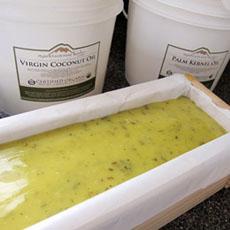
Later, she takes the soap out of the mold and places it in a storage area to cure or dry for four to six weeks. This curing process permits water to evaporate from the soap. The soap soon becomes firmer which helps it last longer.
(MUSIC)
STEVE EMBER: Understanding soap-making also requires a short chemistry and history lesson. Soap is made from a chemical reaction called saponification. During saponification, an alkali base such as sodium hydroxide reacts with a fat. This forms a small amount of alcohol called glycerol and a metal salt of fatty acids, or soap. Soap cleans because its molecules attach to nonpolar molecules like oil and polar molecules like water.
One end of the soap molecule is attracted to oil and keeps away water, while the other end attaches itself to water and repels oil. This special quality of the soap molecule allows it to suspend oils, which attract dirt. Water can then wash away the soap and the dirt.
FAITH LAPIDUS: No one knows exactly when humans first developed soap. Archeologists have found containers filled with a material similar to soap while studying the ancient cultures of Babylon and Egypt.
One story says that soap got its name from Mount Sapo, a place where ancient Romans used to sacrifice animals to their gods. Rainwater washed melted animal fat and wood ashes down the mountain into a river where women were washing clothes. The women found that the ashes and fat combination made their clothes much cleaner. The story may not be true. But it is likely that the discovery of how to make soap may have been accidental.
STEVE EMBER: Soap businesses began to appear in England, France, and Italy during the Middle Ages. By the 12th century, soap- making centers had developed in cities such as Marseilles, France and Savona, Italy. Later, Bristol, England also became an important city for soap production. Two scientists helped modernize soap production. The French chemist Nicolas Leblanc discovered how to make soda ash from salt in the late 18th century. As a result, soda, a main material in soap, became easier to make.
But this process also released large amounts of deadly hydrochloric acid gas. The Belgian chemist Ernest Solvay later developed a better method of soda ash production in the 1860s.
(MUSIC)
FAITH LAPIDUS: About 12 years ago, Mary Kearns bought a kit for making body care products at home. She discovered that she really enjoyed making soaps. She would sometimes sell them at her local farmer's market. But it was her main career in psychology that took up most of her time.
MARY KEARNS: "Well, I have an undergraduate degree in art and then a doctorate in applied developmental psychology. And my specialty has been on health, so health psychology. What motivates people to take care of themselves or not take care of themselves. What are people's attitudes and behaviors around wellness."
STEVE EMBER: A few years ago, Mary Kearns returned to her love of soap-making and established her Herban Lifestyle business. She says she uses both her undergraduate and graduate training for her business. She has also studied the medicinal properties of herbs and plants.
FAITH LAPIDUS: Herban Lifestyle soaps are influenced by the natural colors and smells of the plant world. Mary Kearns points to a large collection of dried plants and herbs that go into making her soaps.
MARY KEARNS: "It's amazing the variety of colors, textures and scents that are just in natural plants. You don't even need to use artificial colors. The rainbow is there."
STEVE EMBER: One soap she makes is called "If They Bathed at Woodstock". It contains hemp oil as well as the smell of orange and patchouli. "It's a Sunshiney Soap" has a bright and pleasing smell. It contains calendula flowers and tangerine essential oils.
She also has soaps that are very popular with men. Her "MAN Beer Soap" is made from palm, olive and coconut oil. And, it has one unusual ingredient -- beer. Ms. Kearns says beer is soothing to the skin and keeps it soft.
FAITH LAPIDUS: Many Herban Lifestyle soaps come wrapped in colored paper. Ms. Kearns chooses papers made from recycled materials, often with colors made from soy ink. One line of soaps has a very unusual wrapping. Her fuzzy soaps look like balls of wool, and they are, sort of. These soaps are tightly wrapped in brightly colored wool. As the soap dissolves, the wool slowly shrinks around the soap. Ms. Kearns says the wool serves several aims. It acts like a washcloth, helps remove dead skin cells and makes the soap last longer.
STEVE EMBER: Herban Lifestyle produces about 3,,000 bars of soap every year. The soaps are sold on the company's website, and on other websites including Etsy and Ebay's socially responsible store called World of Good.
Mary Kearns also sells her products at craft fairs and at stores in Washington, DC, Maryland, Virginia and California. At eight dollars a soap, these products cost more than commercially produced soaps. But she says more and more people are willing to pay more for natural, hand-made products.
MARY KEARNS: "It's in the last ten or 15 years that people are going back to the artisan style soaps in a big way."
FAITH LAPIDUS: We asked Mary Kearns for her advice when shopping for a bar of soap. She said to look for ingredients that you would eat, other than lye, of course. She says to look for pure oils and avoid unnatural fragrances, which can contain harsh chemicals.
(MUSIC)
STEVE EMBER: This program was written and produced by Dana Demange. I'm Steve Ember.
FAITH LAPIDUS: And I'm Faith Lapidus. You can see pictures of soap-making on our Web site, voaspecialenglish.com. Join us again next week for EXPLORATIONS in VOA Special English.
suds: a mass of very small bubbles that forms on top of water that has soap in it 肥皂泡沫
glycerol: a colorless, sweet, viscous liquid formed as a byproduct in soap manufacture. It is used as an emollient and laxative, and for making explosives and antifreeze 甘油
patchouli: the strongly scented shrub of the mint family from which this oil is obtained 廣藿香
calendula: 金盞花屬的植物
Hand washing by birth attendants, mothers saves lives
Staying healthy by washing your hands
(來源:VOA 編輯:崔旭燕)
 |
 |
 |
 |
 |
 |


 主站蜘蛛池模板:
亚洲不卡av不卡一区二区|
亚洲午夜久久久久久久久久|
在线观看肉片av网站免费|
久久99精品久久久久久9|
久久99国产精品久久99软件|
国产激情文学亚洲区综合|
狠狠躁夜夜躁人人爽天天古典|
最新日韩精品视频在线|
午夜国产精品福利一二|
日本亚洲欧洲无免费码在线|
国产不卡在线一区二区|
日本韩国一区二区精品|
高清偷拍一区二区三区|
亚洲免费成人av一区|
亚洲欧美日本久久网站|
牛鞭伸入女人下身的真视频|
国产一区二区三区精品片|
亚洲av永久无码精品网站|
国产偷国产偷亚洲清高动态图|
国产成人精品亚洲高清在线|
福利一区二区不卡国产|
日本无码欧美一区精品久久|
香蕉久久国产精品免|
国产av一区二区三区久久|
99久久婷婷国产综合精品|
欧美日本精品一本二本三区|
国产一区二区不卡精品视频|
无套内谢少妇毛片aaaa片免费|
视频专区熟女人妻第二页|
久热这里只有精品12|
亚在线观看免费视频入口|
国产午夜在线观看视频|
国产精品免费激情视频|
国产精品人妇一区二区三区
|
自拍偷拍一区二区三区四|
中文字幕无码免费久久99|
免费国产高清在线精品一区|
亚洲高清免费在线观看|
日韩精品一区二区三区影院|
国产成人精品人人|
日韩一区二区三区在线视频|
主站蜘蛛池模板:
亚洲不卡av不卡一区二区|
亚洲午夜久久久久久久久久|
在线观看肉片av网站免费|
久久99精品久久久久久9|
久久99国产精品久久99软件|
国产激情文学亚洲区综合|
狠狠躁夜夜躁人人爽天天古典|
最新日韩精品视频在线|
午夜国产精品福利一二|
日本亚洲欧洲无免费码在线|
国产不卡在线一区二区|
日本韩国一区二区精品|
高清偷拍一区二区三区|
亚洲免费成人av一区|
亚洲欧美日本久久网站|
牛鞭伸入女人下身的真视频|
国产一区二区三区精品片|
亚洲av永久无码精品网站|
国产偷国产偷亚洲清高动态图|
国产成人精品亚洲高清在线|
福利一区二区不卡国产|
日本无码欧美一区精品久久|
香蕉久久国产精品免|
国产av一区二区三区久久|
99久久婷婷国产综合精品|
欧美日本精品一本二本三区|
国产一区二区不卡精品视频|
无套内谢少妇毛片aaaa片免费|
视频专区熟女人妻第二页|
久热这里只有精品12|
亚在线观看免费视频入口|
国产午夜在线观看视频|
国产精品免费激情视频|
国产精品人妇一区二区三区
|
自拍偷拍一区二区三区四|
中文字幕无码免费久久99|
免费国产高清在线精品一区|
亚洲高清免费在线观看|
日韩精品一区二区三区影院|
国产成人精品人人|
日韩一区二区三区在线视频|