
中國網(wǎng)站品牌欄目(頻道)

STEVE EMBER: Welcome to THE MAKING OF A NATION – American history in VOA Special English. I'm Steve Ember.
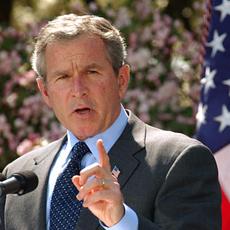
GEORGE W. BUSH: "America, at its best, matches a commitment to principle with a concern for civility."
In recent weeks we talked about the terrorist attacks of September 11th, 2001, and the wars in Afghanistan and Iraq. This week in our series, we look at domestic policy during the first term of President George W. Bush.
(MUSIC)
Bush, the Republican nominee, defeated Vice President Al Gore, the Democratic candidate, in the presidential election of 2000.
A dispute over the ballot count in Florida delayed the declaration of a winner and only added to political divisions in the country. The results in Florida were extremely close. Five weeks passed as courts considered the issues. Finally, a conservative majority on the United States Supreme Court settled the matter. George Bush was to be president.
(MUSIC: "Hail to the Chief")
Bush gave his inaugural speech on January 20th, 2001.
GEORGE W. BUSH: "With a simple oath, we affirm old traditions, and make new beginnings. As I begin, I thank President Clinton for his service to our nation. [Applause] And I thank Vice President Gore for a contest conducted with spirit, and ended with grace."
The new president spoke of American ideals.
GEORGE W. BUSH: "The grandest of these ideals is an unfolding American promise: that everyone belongs, that everyone deserves a chance, that no insignificant person was ever born."
And he called on Americans to care for and respect each other.
GEORGE W. BUSH: "Today we affirm a new commitment to live out our nation's promise through civility, courage, compassion and character. America, at its best, matches a commitment to principle with a concern for civility. A civil society demands from each of us goodwill and respect, fair dealing and forgiveness."
(MUSIC)
Soon after his inauguration, President Bush established the White House Office of Faith-Based and Community Initiatives. The goal was to fight problems like homelessness and drug abuse with the help of social agencies connected to religious groups.
Critics argued that this could violate the separation of religion and government under the United States Constitution. But the president said the agencies would provide shelter and food, not bibles.
(MUSIC)
President Bush took several actions on the environment during his first term, two of which brought strong protests from environmentalists.
In March 2001, he made the decision to reject the Kyoto Protocol. That international treaty sought reductions in the release of carbon dioxide and other industrial gases blamed for trapping heat in the atmosphere. Negotiators approved the treaty in Kyoto, Japan, at the end of 1997 to show their concern about climate change.
Vice President Gore later signed the Kyoto Protocol for the United States. But President Bill Clinton never sent it to the Senate for its required approval. The treaty faced enough opposition in the Senate that it might have been defeated.
President Bush decided to "unsign" the treaty. He said he did not want to put the United States at a competitive disadvantage with big developing countries like China and India. Those countries would not have been required to cut the large amounts of greenhouse gases they were producing. Bush said the agreement was unfair and would harm American industry at a time when the economy was weakening.
Critics said the president's decision would harm the environment and set a bad example for the world.
Another environmental issue concerned exploring for oil and natural gas. The president supported a measure to allow drilling in a wildlife refuge in the state of Alaska. He said doing so would reduce American dependence on foreign oil. Opponents argued that it would destroy wildlife in some of America's most beautiful natural surroundings. In the end, the environmentalists won -- Congress did not approve the drilling.
(MUSIC)
One of President Bush's major domestic goals was improving America's public education system. In January 2002, he signed legislation passed by Congress called the No Child Left Behind Act.
GEORGE W. BUSH: "We owe the children of America a good education. And today begins a new era, a new time in public education in our country. As of this hour, America's schools will be on a new path of reform, and a new path of results."
(MUSIC)
The law increased the role of the federal government in an area where Americans have traditionally defended local control -- public education. No Child Left Behind had several goals: To help poor and minority students improve their performance. To provide choices for parents with students in low-performing schools. And to increase money for schools in low-income areas.
The law required all students in grades three through eight to be tested every year in reading and math. It held schools responsible for showing that all students were making progress, based on standards chosen by the states themselves. No Child Left Behind had many supporters. But critics said the expectations were unreasonable and that teachers might just teach to the test.
(MUSIC)
Another major piece of legislation dealt with health care for older Americans. President Bush wanted to extend Medicare, the nation's health insurance program for people 65 and older.
GEORGE W. BUSH: "For nearly four decades, Medicare has been the binding commitment of a caring society. We must renew that commitment by providing our seniors with the preventative care and new medicines that are transforming health care in our country.
"We must protect seniors from high medical costs that can rob them of their savings. And we must place patients and their doctors at the center of every health care decision. My goal is to give seniors more choices and better benefits under Medicare, including a long-awaited prescription drug benefit."
In 2003 he signed a law to help forty million older Americans pay for their medicine.
On another issue, he banned federal funding for research on any new stem cells taken from human embryos. But he agreed to allow the first federal spending on research on existing lines of embryonic stem cells. Such cells interest some medical researchers because they can grow into different kinds of cells. But opponents object, for moral and religious reasons, to destroying embryos for the purpose of harvesting stem cells.
(MUSIC)
George Bush promised to cut taxes for Americans. In 2001, he signed a bill passed by Congress calling for more than one trillion dollars in tax reductions over time. The president said the economy would improve if people had more money to spend.
In 2003, Congress passed 350 billion dollars in additional tax reductions. That was less than half of what the president had proposed.
In 2002, President Bush signed a law that increased punishments for financial dishonesty by companies. The new law also established an independent group to oversee the accounting industry.
(MUSIC)
The action came after several major companies failed, including, in 2001, Enron. Enron had grown into America's leading energy company.
REPORTER CHRIS BURY: "In the canyons of downtown Houston, home to the country's energy giants, a sense of gloom surrounds this one. Only months ago, it was the mightiest of them all. [Phone rings] Now Enron answers the phone with this recorded message."
ENRON PHONE MESSAGE: "On December 2nd, Enron filed under the Chaper 11 of the Bankruptcy Code, thus commencing proceedings to stabilize our financial situation."
It was at that time the largest bankruptcy in American history. Ten thousand people lost their jobs. Some Enron investors lost all their money in the failure. Former employees lost the retirement payments they needed to live on. Some top Enron officials were found to have used dishonest accounting methods to hide financial problems from investors.
Enron's troubles also involved two large banks, Chase and CitiGroup, and a big financial company, Merrill Lynch.
CARL LEVIN: "Enron couldn't have engaged in the deceptions it did without the help of a major financial institution. Merrill Lynch assisted Enron in cooking its books, by pretending to purchase an existing Enron asset, when it was really engaged in a loan."
Senator Carl Levin led a hearing into accounting and consulting practices and how they benefited Enron. Those actions included inflating the value of the company's stock.
The collapse of Enron was followed by a series of other corporate failures linked to dishonest accounting methods.
(MUSIC)
November 2nd, 2004, was Election Day. Four years earlier, George W. Bush had been elected in one of the closest races in American history. Now he would have another chance to test his popularity with the American people.
The 2004 election will be our story next week.
(MUSIC)
You can find our series online with transcripts, MP3s, podcasts and pictures at voaspecialenglish.com. You can also follow us on Facebook and Twitter at VOA Learning English. I'm Steve Ember, inviting you to join us again next week for THE MAKING OF A NATION -- American history in VOA Special English.
American history: life in the US after the 9/11 attacks
American history: the Civil Rights Movement
American history: Lyndon Johnson becomes president
(來源:VOA 編輯:旭燕)
 |
 |
 |
 |
 |
 |


 主站蜘蛛池模板:
国产一区二区三区禁18|
国模无吗一区二区二区视频|
一二三四中文字幕日韩乱码|
欲色欲色天天天www|
一区二区三区国产不卡|
亚洲精品无码不卡|
最新的精品亚洲一区二区|
极品无码国模国产在线观看|
内射中出无码护士在线|
亚洲精品久久久久久下一站|
午夜爽爽爽男女免费观看影院|
正在播放国产剧情亂倫|
欧美视频在线观看第一页
|
欧洲欧美人成免费全部视频|
尹人香蕉久久99天天拍|
亚洲精品一区二区三区免|
奇米网777狠狠狠俺|
青青草原国产精品啪啪视频|
亚洲欧美成人一区二区在线电影
|
精品亚洲精品日韩精品|
亚洲色大成网站WWW久久|
日产精品高潮呻吟av久久|
精品一卡2卡三卡4卡乱码精品视频|
chinesemature老熟妇中国|
国产蜜臀av在线一区二区|
成人国产精品中文字幕|
国产成人久久蜜一区二区|
www插插插无码免费视频网站|
亚洲av成人一区二区三区|
老司机精品成人无码av|
四虎在线成人免费观看|
久久精品人妻av一区二区|
国产线播放免费人成视频播放
|
日韩成人无码v清免费|
真人无码作爱免费视频|
91精品啪在线观看国产91九色
|
亚洲 制服 丝袜 无码|
色欧美片视频在线观看|
在线a级毛片免费视频|
亚洲男人第一无码av网|
精品无码黑人又粗又大又长|
主站蜘蛛池模板:
国产一区二区三区禁18|
国模无吗一区二区二区视频|
一二三四中文字幕日韩乱码|
欲色欲色天天天www|
一区二区三区国产不卡|
亚洲精品无码不卡|
最新的精品亚洲一区二区|
极品无码国模国产在线观看|
内射中出无码护士在线|
亚洲精品久久久久久下一站|
午夜爽爽爽男女免费观看影院|
正在播放国产剧情亂倫|
欧美视频在线观看第一页
|
欧洲欧美人成免费全部视频|
尹人香蕉久久99天天拍|
亚洲精品一区二区三区免|
奇米网777狠狠狠俺|
青青草原国产精品啪啪视频|
亚洲欧美成人一区二区在线电影
|
精品亚洲精品日韩精品|
亚洲色大成网站WWW久久|
日产精品高潮呻吟av久久|
精品一卡2卡三卡4卡乱码精品视频|
chinesemature老熟妇中国|
国产蜜臀av在线一区二区|
成人国产精品中文字幕|
国产成人久久蜜一区二区|
www插插插无码免费视频网站|
亚洲av成人一区二区三区|
老司机精品成人无码av|
四虎在线成人免费观看|
久久精品人妻av一区二区|
国产线播放免费人成视频播放
|
日韩成人无码v清免费|
真人无码作爱免费视频|
91精品啪在线观看国产91九色
|
亚洲 制服 丝袜 无码|
色欧美片视频在线观看|
在线a级毛片免费视频|
亚洲男人第一无码av网|
精品无码黑人又粗又大又长|