Comments()
  Print
Print  Mail
Mail  Large Medium Small
 |
|
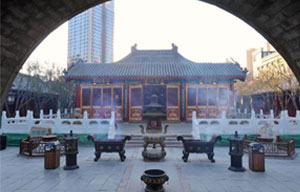
The Confucius Temple in Qufu, Shandong province, attracts a steady flow of tourists every day. Photos by Wang Qian / China Daily |
 |
|
Kong Lingchun, a 76th generation Kong family descendant, owns a souvenir stall along the approach road to Confucius Temple. |
The thinker and his philosophies are as relevant today as they ever were, Chitralekha Basu finds on a visit to his homeplace in Qufu, Shandong province.
Confucius continues to attract and mystify a worldwide audience a good 2,500 years after his aphorisms, compiled in the Analects, were first propagated by his followers. The influence of Confucian wisdom on Chinese thought and lifestyle has been sustained. With 523 Confucius Institutes around the world and 4,359 titles in English on the life and teachings of the great seer on the Amazon database alone, Confucius is one of China's biggest exports to the world. But is Confucius (551-479 BC), who lived in the Spring and Autumn Period (770-476 BC) as popular on home turf? To find out, we went to Qufu, Confucius' hometown in Shandong province.
The buzz was palpable on a weekday afternoon, with hundreds of school children in uniform swarming into the majestic Confucius Temple complex and the regal Kong family residence, mingling with a steady flow of tourists. Footfalls have multiplied - from 2.5 million in 2005 to a whopping 4.3 million in 2011, a 10 percent increase, year-on-year.
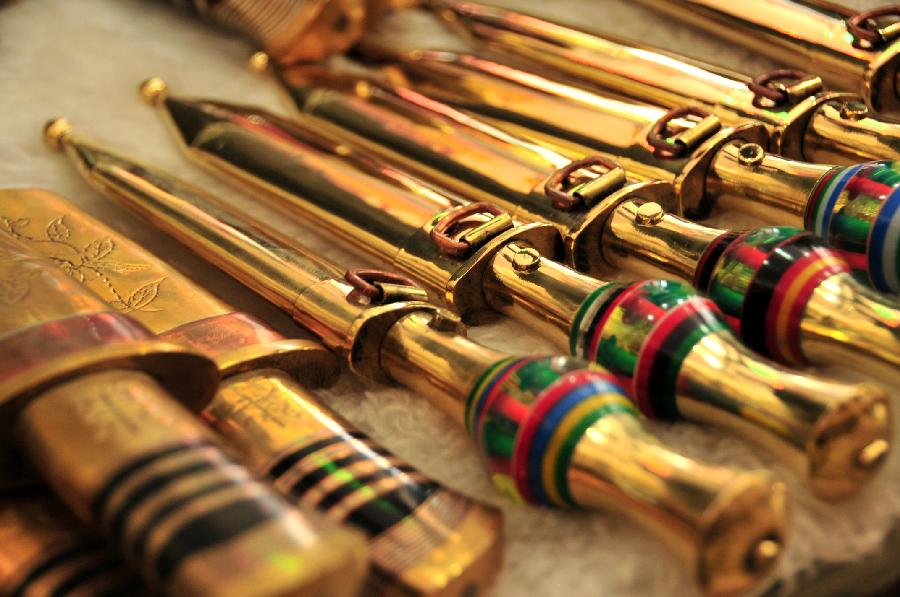
Stalls on either side of the approach road to Confucius Temple brim with the sage's statuettes, wooden scrolls containing some of his sayings and other souvenirs - including a quaint abridged version of the Analects sporting a red cover, often placed strategically right next to Chairman Mao Zedong's Little Red Book.
But does Qufu really care for the teachings of its most illustrious son?
The answer is a resounding yes, according to Liu Xubing, administrator of the local Confucius Institute. "About 70,000-80,000 young people visit the temple complex in Qufu every year as part of orientation programs. They are exposed to Confucian values, inspired to respect each other, make a greater contribution to society and often get a sense of direction as to how to lead their lives," Liu says.
Some of these young men and women take part in a coming-of-age ritual in their 18th year. "Dressed in Han robes and elaborate headgear, they make a pledge about observing filial piety, being industrious, making a contribution to society and to the country," informs Han Fengju, deputy director of Qufu Cultural Relics and Tourism Bureau. "The graduation ceremony is held to enhance young people's awareness of Confucian culture and pay a tribute to the sage."
Confucian scholars from different universities in China preside over the event.
The writer Zhang Wei, whom we meet in Jinan a few days later, however, claims there has been an erosion in Confucian values as China's fast-track economic development continues.
"The friendly relationship among people has been destroyed, and so has the moral fabric," he tells us, regretting that "only a tiny part of Confucius' core teachings is followed by people in their daily lives. We live in a time when Confucianism is extremely ravaged."
But Qufu's young people appear to have struck a fine balance between Confucian ideals and the materialistic drive and vaulting ambition that Chinese youngsters are often associated with.
Kong Lingchun, a 76th generation Kong family descendant, owns a souvenir stall along the approach road to Confucius Temple. She sells about 20 wooden scrolls a day at a modest profit of 2 yuan. "But profit is not my primary concern," Kong says. "This store is my window on the world."
"I treat the tourists here as guests of Qufu and look upon them as friends," says Kong, citing Confucius' saying: "It's always a pleasure to greet a friend from afar." "When business is sluggish, I grab a book by Confucius and start reading."
"Indeed, it's our moral responsibility to help visitors to these premises," pipes up Han Xue and Zhang Xiaoya, sprightly teenagers whizzing by on a bike. Han cites the Confucian tenet, "Treat others the way you would like yourself to be treated".
Both Qufu locals, they say they visit the temple complex often, for its serene ambience and also to meet new people. "I want to be a restaurant boss and run it in the Confucian way," Han says, her kohl-lined eyes glinting.
She might have a worthy example in Kong Xiangling, a member of the 75th generation of the Kongs and owner of the Tianxiang Fish Restaurant. A genial entrepreneur in her mid-50s, she talks nineteen-to-the-dozen, disarming us completely.
"We abide by common Confucian maxims, such as, be honest, be hardworking, don't cheat, don't overcharge your clients. I am very serious about taking good care of my 35 employees and their families, just as I would of my own children. I take care of sick employees, covering their hospital fees, and lend them money in times of need.
"I follow the idea of sharing one's profits. In the last 10 years I have sponsored 10 college students and donated money to charitable organizations.
"The restaurant waste is taken to a cattle farm to be recycled as fodder, following Confucius' idea of caring for the nature and protecting it against environmental damage.
"I believe in considering other people's opinions. Each time we introduce a new dish I call all my employees and ask for suggestions.
"I am a woman of contemporary times, and I'm glad to be able to earn the money to provide for my family. Business keeps me busy, but family is the priority," says Kong, suddenly ready to go. She has to run back home to cook lunch for her husband and mother-in-law who has always lived with her, she says.
"But hey, don't give me too much publicity, that's against Confucian principles," she says, before darting out.
It's not as if Confucius is accepted without question by the residents of his native town. Xun Yuanyuan, a young mother and tour guide, often goes to public lectures held at Shi Li hall. "I do not always agree with his teachings, his views on women, for example."
Confucius once famously said, "Women and people of low birth are hard to handle, if you let them get close, they presume and if you keep them at a distance, they resent it."
Xun does understand, however, that the remark was made in a certain context. Confucius was annoyed with the fact that Duke Ding of the Lu state was distracted by the 80 pretty female musicians offered to him as a battle strategy by his rival, the head of Qi state. It was a comment of anguish and exasperation at the lack of integrity of the duke.
As Liu, of Confucius Institute, explains, "Women and common people would often be bracketed together in ancient times as they, it was felt, had to be protected by the ruler, leader or family head. Had Confucius been an utter misogynist he would probably have taken up the subject more than once but we have just this one mention, and that was out of pure concern for women's well-being."
Confucius' influence, he says, could only grow in the future, given that "Confucianism is part of the mainstream of Chinese traditional culture and Chinese culture is in the throes of prosperity, its influence growing in the world".
Also, Confucianism will survive, Liu says, because of its adaptability. "It works in different time frames and cultural contexts, depending on how it is interpreted, and lends itself to manifold interpretations.
"Confucianism allows different disparate cultural elements to work together. For instance, scholars are engaged in developing specialized need-based programs premised on Confucian thought for state officials and entrepreneurs."
"Confucianism is not a religion, but a tradition, a way of life. It has played a spiritual role in China traditionally. Since the Tang Dynasty (AD 618-907), we have had a temple and school dedicated to Confucius' teachings in almost every county," Liu says.
Li Bin, who came all the way from Shenyang, capital of Liaoning province, to visit the hometown of the philosopher whose teachings he has read since childhood, agrees. "We're Chinese, we follow Confucian principles as a matter of habit without having to making a conscious effort."



Copyright 1995 - 2010 . All rights reserved. The content (including but not limited to text, photo, multimedia information, etc) published in this site belongs to China Daily Information Co (CDIC). Without written authorization from CDIC, such content shall not be republished or used in any form. Note: Browsers with 1024*768 or higher resolution are suggested for this site.
License for publishing multimedia online 0108263 Registration Number: 20100000002731