Comments
  Print
Print  Mail
Mail  Large Medium Small
|
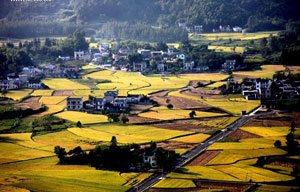
Since 2003, 20 million drought-enduring plants, including (clockwise from top left) Echinops sphaerocephalus, Poacyngrn hendersonii and Calligonum rubicundum, have been planted along the road. Photos by Hou Yiguo / for Chind Daily |
In AD 366, a Buddhist monk had a vision on the outskirts of Dunhuang, a bustling area on the Silk Road.
Thousands of golden lights conjured up an image of a thousand Buddhas. The vision inspired him to build a cave.
This, according to legend, was the beginning of the Mogao Grottoes of Dunhuang. Now the world-famous site has 753 caves and 45,000 square meters of fresco paintings.
A scientific explanation for the vision may be that the monk saw the mica, or minerals, in a nearby sand mountain reflecting light.
The caves and paintings have had a precarious existence, battling the sands of erosion blown from that mountain.
The threat was not removed until six green belts, using different methods, were established to block the sand's threat.
"The problems brought by sand have been completely tackled," said Qu Jianjun, director of the Dunhuang Gobi Desert Research Station.
The sand mountain sits to the west of the Mogao Grottoes. An easterly wind used to whip up sands from the mountain into grottoes.
The station is under the Cold and Arid Regions Environmental and Engineering Research Institute of the Chinese Academy of Sciences.
Qu had his own vision of how the belts could save the artwork and he designed the belts in 1995. Each year, they have been enhanced.
In the 1940s the floor of the Mogao Grottoes was half-buried in sand.
According to the Dunhuang Academy in Gansu province, every year until the 1980s, the academy hauled away 3,000 to 4,000 cubic meters of sand.
In the late 1980s, scientists put nets around the mountain to block the sand, but this was not wholly effective.
"The six-belt system is designed to block different forms of sand; nets for the mobile dunes, a plant belt for finer sand, and a chemical belt on the cliff to prevent dust entering the caves," Qu said.
The six belts were completed in 2010, and since then the sand threat has been under control.
"Now tourists can enjoy the Mogao Grottoes without worrying about the sand but in the 1980s they would have to wear hats and protective coverings," said Wang Wanfu, deputy director of the Conservation Institute of Dunhuang Academy.
"The Mogao Grottoes are an irreplaceable part of China's Silk Road heritage. Protecting them should be a national priority," said Richard Stone, international news editor of Science magazine. Stone visited the Dunhuang Gobi Desert Research Station in 2008, and was impressed by the work scientists were doing there.
"When I visited in August 2008, it was evident that the nylon windbreak fence installed about the caves had helped cut down wind-driven sand. Another innovative idea is the belts of gravel mulch laid to impede sand flow," he said.
However, expert opinion differs on whether the environment should be green around the grottoes.
Zhang Guobin, an assistant researcher at the Dunhuang Academy, told media organizations in an earlier report that the elaborate belt network is not enough.
However, Qu believes the artificial protection is protecting the grottoes far better than a totally green belt.
"The frescoes existed for millennia because they were kept in a dry environment that allowed a breeze. But planting trees so close to the caves and watering them will change the humidity, and destroy the paintings," Qu said.
Qu suggested that the trees be replaced by plants that do not need irrigation.
Related:
Ten things NOT to do in the Mogao Grottos
|
|
|
| Holding onto history | Gansu's great Silk Road secrets |


 Ballet Don Quixote rehearsed in Beijing
 Explore Africa: Go Down art zone
 Ancient sounds, modern music
 Little amateurs perform Peking Opera in Tianjin


Copyright 1995 - . All rights reserved. The content (including but not limited to text, photo, multimedia information, etc) published in this site belongs to China Daily Information Co (CDIC). Without written authorization from CDIC, such content shall not be republished or used in any form. Note: Browsers with 1024*768 or higher resolution are suggested for this site.
License for publishing multimedia online 0108263 Registration Number: 20100000002731