Sights
Labrang Monastery: a magnet for pilgrims (Gannan)
Updated: 2013-11-02( chinadaily.com.cn )
 |
|
Monks pose for a photo on Feb 22, 2013, in front of a thangka - a Tibetan scroll painting - during a Tibetan Buddhism festival at the Labrang Monastery in Gansu province. The monastery, which was founded in 1709, is a major venue for Buddhist ceremonies. [Photo/China News Service] |
 |
|
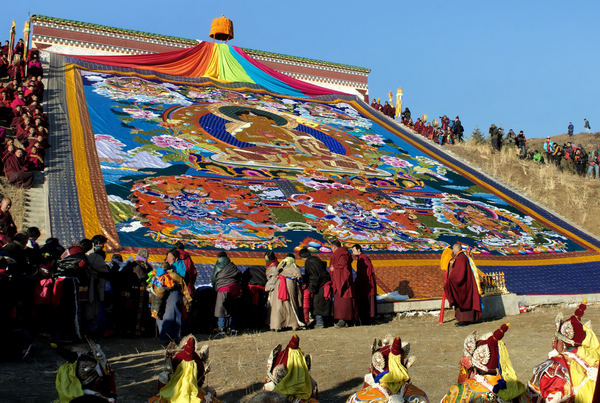
Monks and visitors pray around the portrait of a Budda on a huge tangka during a Tibetan Buddhism festival at the Labrang Monastery in Gansu province, Feb 22, 2013. [Photo/China News Service] |
In the first lunar month of every year, the Labrang Monastery in southern Gansu province is a magnet for Tibetan pilgrims from the Tibetan-populated areas in the country. The grand lamasery is the site where the spectacular Summons Ceremony of the First Lunar Month on the Tibetan calendar is staged every year from the 3rd day of the month (which falls on February 14 this year) to the 17th (February 28).
Located in Xiahe county in the Gannan Tibet autonomous prefecture, the Labrang Monastery was built in 1704 and has developed into one of the six major lamaseries of the Gelugpa, or Yellow, Sect of Tibetan Buddhism, the others being Ganden, Sera and Drepund monasteries in the Lhasa area, Tashilhungpo Monastery in Xigaze in the Tibet Autonomous Region and Ta'er Monastery in Huanzhong, Qinghai province.
Also the top college of Tibetan Buddhism in Northwest China, the monastery holds seven large-scale summons ceremonies a year, of which the Summons Ceremony in the First Lunar Month is the largest.
Summons ceremony
The present summons ceremony, which began in the middle of the 18th century, is based on a ceremony held in 1409 by Tsongkhapa (1357-1419), founder of the Gelugpa Sect.
It includes a series of religious activities attended by both Tibetan monks and pilgrims, such as the Free Captive Animals Festival held on the 8th day of the first Tibetan lunar month, the Sunbathing Buddha Festival on the 13th day of the month and the Cham dance on the 14th day. In addition to this, all the monks of the monastery will gather in the Grand Sutra Hall to recite Buddhist scriptures six times a day, every day during the period.
The Sunbathing Buddha Festival has always been the biggest draw. This year more than 50,000 pilgrims and tourists from home and abroad attended the festival. On the morning of February 23, a "thangka" (sacred painting on cloth) of Buddha measuring over 30 metres by 20 metres was unfurled on the hillside across the Daxia River from the monastery.
The event was accompanied by processions and prayer assemblies.
The Cham dance, on the 14th, was performed by 35 masked dancers, with Yama, the lord of death, playing the leading role, and there was an evening display of butter lanterns and sculptures on the 15th.
Besides pilgrims, nomads who stream into town from the grasslands in their best festival costumes are also a spectacular sight for tourists from the outside world.
While enjoying the fantastic religious ambience and colourful nomads in their traditional clothes, visitors should also note the many majestic examples of the mixture of Tibetan and Han palace architecture in the Labrang Monastery.
Grand architecture
Covering more than 86 hectares and about 3.5 kilometres in circumference, the monastery has six Buddhist institutes (the Institute of Esoteric Buddhism, Higher and Lower Institutes of Theology, the Institute of Medicine, Institute of Astrology and Institute of Law).
Each of them has a chanting hall, several temple halls, 18 residences for "the Living Buddhas," 18 Buddhist Lhakangs (living quarters for monks), and a sutra printing house.
The prayer hall is the principal part of a lamasery, where monks study, hold meetings and chant scriptures.
The largest, the palatial Grand Prayer Hall belongs to the College of Esoteric Buddhism.
In 1985, the hall was burnt down by fire. The central government provided 12 million yuan (US$1.45 million) for its reconstruction. After reconstruction in 1990, the hall was expanded to cover about one hectare.
The hall, of wood and clay structure, has the roof supported by 140 giant pillars. It is large enough to accommodate 3,000 monks. The elegantly decorated hall houses portraits of Buddha on its walls and has built-in Buddha shrines and book cases. Fine "thangka" paintings hang from the pillars.
The chanting halls feature white dagobas erected in the northeast and northwest. The chanting halls are all located in the northwestern part of the monastery compound and the other five chanting halls are set around the Grand Chanting Hall in a shape similar to a crescent moon.
The Hall of Maitreya Buddha is representative of the monastery's temple halls and features a strong Nepalese flavour. It houses a 10-metre-high gilded statue of Maitreya Buddha created by Nepalese artisans.
The monastery was founded by E'angzongzhe (1648-1712), the first generation living Buddha, in 1709. At its height, the monastery housed about 4,000 monks in its 90 halls, with 31 residential and academic buildings, and more than 500 scripture-reading rooms.
But many buildings were destroyed during the "cultural revolution" (1966-76). In the 1990s, most of them have been rebuilt or renovated. Right now there are about 1,200 monks, coming mostly from Qinghai, Gansu, Sichuan provinces and the Inner Mongolian Autonomous Region.
Treasure house
Besides being a spectacular collection of monastic buildings, the Labrang Monastery is also a treasure house.
Art treasures are everywhere. Stunning frescoes and tapestries, incredible carpentry, painted Tibetan furniture, white Tibetan scarfs, stupas (the cone-shaped jewel-encrusted burial chambers where the bones of Tibetan religious and political leaders are placed) resplendent with jewels. Most enchanting of all are the different kinds of Buddha statues and "thangkas."
From the peaceful Sakyamuni (the Present Buddha) and Maitreya (the Future Buddha) covered with huge turquoise medallions and gold ornaments to ferocious nandikesvaras, joyful Buddhas tangled up in multi-armed embraces, from the gilt Tsongkhapa to the bronze statue of Jamuyang I, from just 1 inch high to 10 metres tall, more than 10,000 statues of Buddha made of gold, silver, copper, aluminum, ivory, sandalwood, jade, crystal and clay build up a mystical Buddhist world in the flickering light of yak-butter lamps.
The Labrang Monastery has a collection of close to 10,000 "thangka" paintings by Tibetan folk artists in Qinghai province.
The Labrang Monastery also has one of the richest collections of Buddhist scriptures in the world, boasting about 65,000 of them in 18,200 volumes. These scriptures fall into a dozen categories, including philosophy, collected works, medicine, sabda (grammar and composition), history, biography and craftsmanship. Also included are two volumes of Pattra-leaf sutras, and some 70,000 wood blocks for printing scriptures.
The Labrang Monastery is built in an attractive setting, with the Daxia River winding by to the south and rolling mountains to the south and north.
About 14 kilometres up the valley from the monastery, the Sanke Grasslands is a great place for hiking or horse-riding, with a limpid lake and snow-capped mountains on all sides.
On the rolling pastures, Tibetan nomads graze their yak herds.
News