Sights
Grottos of Bingling Temple (Linxia)
Updated: 2013-11-02( chinaculture.org )
The Grottoes of the Bingling Temple are 50 kilometres to the southwest of Yongjing County, Gansu Province, and are located in Jishi Mountain at the northern bank of the Yellow River.
Bingling means one hundred thousand Buddha in the Tibetan language. The grottoes are in two two temples, upper and lower, and are distributed on the cliff that is 2 kilometres long from north to south, borders on the Yellow River and is strategically located and difficult to access. The grottoes started to be carved in the first year (420) during the Jianhong reign of the Western Qin Period. There is an ink preface of that time found in the No.169 grotto, which is the earliest preface found in the all the grottoes by far. Hereafter, through the dynasties of the Northern Wei (386-534), Northern Zhou (557-581), Sui (581-618), Tang (618-907), Yuan (1271-1368) and Ming (1368-1644), t new grottoes of different levels were built during every dynasty. Now, there are altogether 34 grottoes, 149 shrines, 694 big or small stone statues, 82 mud statues, and frescoes that cover more than 900 square metres in the Bingling Temple. The biggest statue is 27 metres high, and the smallest one is only over 20 centimetres. About two thirds of them are the works of the Tang Dynasty (618-907). In addition, there is another square stone pagoda, and four mud pagodas.
No.169 and No.172 grottoes are the biggest ones in the Bingling Temple, which are more than 40 metres high. It is recorded in Commentary on the Waterways, written by Li Daoyuan, that: there are two grottoes on the cliffs beside the river. One is the Tangshu Grotto, which is 45 zhang (a unit of length, about three and one third meters) high. One kilometre west from the Tangshu Grotto is the other one called the Shiliang Grotto, 100 zhang high, 20 zhang wide and 30 zhang long. And there are 5 ancient books hidden in the grottos. The two grottoes were chiselled in the steep cliff that is 60~70 metres above the ground. Along the zigzag path leading to the cliff, people can reach the two grottoes. No. 169 Grotto, chiselled in the West Qin Period, has many figures of Buddha with graceful appearance and well-balanced proposition, including Amitabha, Avalokitesvara (Bodhisattva of infinite compassion and mercy), Mahsthmaprpta Bodhisattva and the giant Standing Buddha in the middle of the north wall. The giant Standing Buddha in the south wall of the grotto looks handsome, with simple and smooth lines of his clothes. Moreover, the skin under the clothes can be vaguely seen. No.171 Shrine houses Maitreya (Laughing Buddha) of 27 metres high built in the Tang Dynasty (618-907). It is difficult to build such a huge statue without superb skills.
The frescos in the Bingling Temple, which are preserved till now, despite of the small quantities, veritably reflect the social situation, music and dancing, arts of ornamenting and architecture in the Period of Sixteen States (304-439) in northwest China. That is why the frescos in the Bingling Temple are of great value. From the frescoes in No.169 Grotto, which were painted in the first year during the Jianhong reign of the West Qin Period, we can find the images of female attendants similar to those in Admonitions of Instructress to Court Ladies, drawn by Gu Kaizhi, a famous artist in the Eastern Jin Dynasty (317-420). The frescoes use strong lines to portray the images of those women who dressed in splendid attire, with shawls and ribbons, and thick hair worn in a bun. There are other two paintings of Wei Mojie, one describing the appearance of an ill hermit Vimalakirti, who is lying in bed, with his hands grasping the sides of the bed and his mouth opening to argue; the other one describing the posture when Vimalakirti is standing at the side of Sakyamuni in attendance.
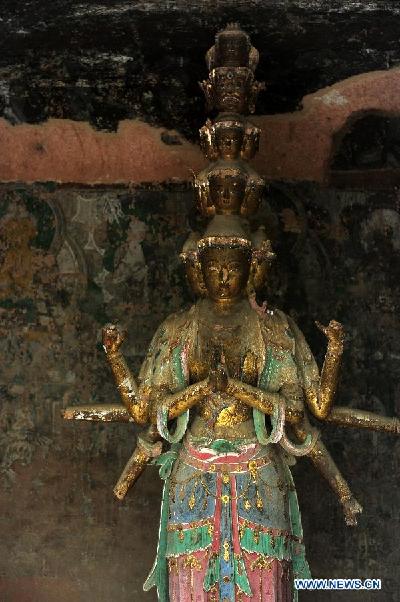
The number of extant frescoes of the Sui (581-618) and Tang (618-907) dynasties is quite small due to the reprinting and rebuilding of the frescoes by the Secret Sect since the Yuan (1271-1368) and Ming (1368-1644) dynasties. Most frescos of the Sui Dynasty are mainly about the Attending Bodhisattvas, which are painted on the north and south wall of the No.8 Grotto, with vivid postures and distinctive expressions. The frescoes of the Yuan and Ming dynasties that have special features includes the paintings on Buddhist stories of the Yuan Dynasty on the upper floor of the west wall in No.3 Grotto, eight-hand Bodhisattva of the Yuan Dynasty on the south wall in No.3 Grotto, eight-hand Bodhisattva of the Ming Dynasty on the south wall in No.168 Grotto and plank paintings of the Ming Dynasty in the wooden attic in No.172 Grotto. Although these frescos are about the Secret Sect of the Buddhism, the painting techniques still inherit the traditions of the Tang and Song dynasties, which employ smooth and tight strokes, and thick colour for ornaments. In 1964, a stone dam of 20 metres high, 2 metres wide and 350 metres long was built in front of the grottoes to protect the whole grotto group of the lower temple. Today, we can reach the front of the grottos directly from the Liujiaxia Reservoir by yachts.
UNESCO to review Bingling Temple Grottoes
 |
|
Photo taken on July 17, 2013 shows the exterior view of the Bingling Temple Grottoes in Yongjing county, northwest China's Gansu province. Listed as part of the ancient Silk Road for the World Heritage candidate, the grottoes will be reviewed by experts from UN Educational, Scientific and Cultural Organization after renovation of a giant Buddha statue dating back more than 1,000 years to the Tang Dynasty was completed lately. Bingling Temple Grottoes, filled with Buddhist statues, stupas and murals, were a work in progress between the 4th and 10th centuries.[Photo/Xinhua] |
 |
|
Buddhists figurines are on display at the Bingling Temple Grottoes in Yongjing county, northwest China's Gansu province, July 17, 2013. Listed as part of the ancient Silk Road for the World Heritage candidate, the grottoes will be reviewed by experts from UN Educational, Scientific and Cultural Organization after renovation of a giant Buddha statue dating back more than 1,000 years to the Tang Dynasty was completed lately. Bingling Temple Grottoes, filled with Buddhist statues, stupas and murals, were a work in progress between the 4th and 10th centuries.[Photo/Xinhua] |
 |
|
Buddhist statues are on display at the Bingling Temple Grottoes in Yongjing county, northwest China's Gansu province, July 17, 2013. Listed as part of the ancient Silk Road for the World Heritage candidate, the grottoes will be reviewed by experts from UN Educational, Scientific and Cultural Organization after renovation of a giant Buddha statue dating back more than 1,000 years to the Tang Dynasty was completed lately. Bingling Temple Grottoes, filled with Buddhist statues, stupas and murals, were a work in progress between the 4th and 10th centuries.[Photo/Xinhua] |
 |
|
A piece of mural is seen at the Bingling Temple Grottoes in Yongjing county, northwest China's Gansu province, July 17, 2013. Listed as part of the ancient Silk Road for the World Heritage candidate, the grottoes will be reviewed by experts from UN Educational, Scientific and Cultural Organization after renovation of a giant Buddha statue dating back more than 1,000 years to the Tang Dynasty was completed lately. Bingling Temple Grottoes, filled with Buddhist statues, stupas and murals, were a work in progress between the 4th and 10th centuries.[Photo/Xinhua] |
 |
|
A Buddhist statue is seen at the Bingling Temple Grottoes in Yongjing county, northwest China's Gansu province, July 17, 2013. Listed as part of the ancient Silk Road for the World Heritage candidate, the grottoes will be reviewed by experts from UN Educational, Scientific and Cultural Organization after renovation of a giant Buddha statue dating back more than 1,000 years to the Tang Dynasty was completed lately. Bingling Temple Grottoes, filled with Buddhist statues, stupas and murals, were a work in progress between the 4th and 10th centuries. |
 |
|
Buddhist statues are seen at the Bingling Temple Grottoes in Yongjing county, northwest China's Gansu province, July 17, 2013. Listed as part of the ancient Silk Road for the World Heritage candidate, the grottoes will be reviewed by experts from UN Educational, Scientific and Cultural Organization after renovation of a giant Buddha statue dating back more than 1,000 years to the Tang Dynasty was completed lately. Bingling Temple Grottoes, filled with Buddhist statues, stupas and murals, were a work in progress between the 4th and 10th centuries.[Photo/Xinhua] |
 |
|
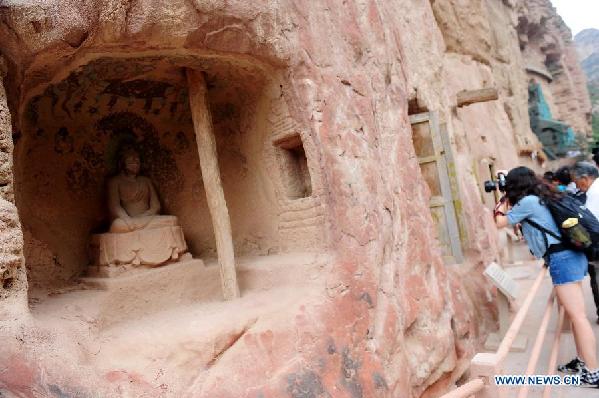
Tourists visit the Bingling Temple Grottoes in Yongjing county, northwest China's Gansu province, July 17, 2013. Listed as part of the ancient Silk Road for the World Heritage candidate, the grottoes will be reviewed by experts from UN Educational, Scientific and Cultural Organization after renovation of a giant Buddha statue dating back more than 1,000 years to the Tang Dynasty was completed lately. Bingling Temple Grottoes, filled with Buddhist statues, stupas and murals, were a work in progress between the 4th and 10th centuries.[Photo/Xinhua] |
 |
|
Tourists visit the Bingling Temple Grottoes in Yongjing county, northwest China's Gansu province, July 17, 2013. Listed as part of the ancient Silk Road for the World Heritage candidate, the grottoes will be reviewed by experts from UN Educational, Scientific and Cultural Organization after renovation of a giant Buddha statue dating back more than 1,000 years to the Tang Dynasty was completed lately. Bingling Temple Grottoes, filled with Buddhist statues, stupas and murals, were a work in progress between the 4th and 10th centuries.[Photo/Xinhua] |
 |
|
A tourist visits the Bingling Temple Grottoes in Yongjing county, northwest China's Gansu province, July 17, 2013. Listed as part of the ancient Silk Road for the World Heritage candidate, the grottoes will be reviewed by experts from UN Educational, Scientific and Cultural Organization after renovation of a giant Buddha statue dating back more than 1,000 years to the Tang Dynasty was completed lately. Bingling Temple Grottoes, filled with Buddhist statues, stupas and murals, were a work in progress between the 4th and 10th centuries.[Photo/Xinhua] |
News