

Look how far beach soccer drifted
By Yang Feiyue ( China Daily Europe )
Updated: 2016-11-13
|
|||||||||


|
Beach soccer is expected to take off in China, since the first Asian Football Confederation Beach Soccer Championship was held in Erdos and four more will come in future. Photos Provided to China Daily |
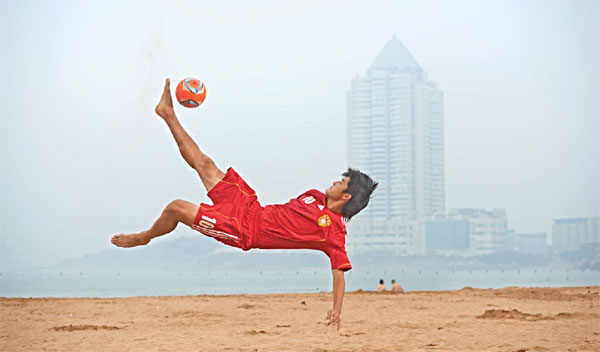
In China, the world's most popular sport has packed up its gear and headed to the beach for some summertime fun. No longer is the game largely confined to green pitches, many of them the centerpiece of giant football stadiums, during the colder months, but is now played on the likes of the golden sands of Copacabana Beach in Brazil.
But if you are going to give an old game a new twist, why restrict it to one of the world's leading football nations? And why stop at beaches?
In Erdos, Inner Mongolia autonomous region in August - with the nearest coastal beach 800 kilometers away - barefoot players were kicking a ball around on sand as pumping music blared out of a sound system.
"It's true that beach soccer was originally played on beaches by the sea, but that does not mean it needs to be limited to them," says Xiao Yang, general manager of Cherry Sports Co of Beijing, which brought the tournament played in Erdos - the Asian Football Confederation Beach Soccer Championship - to China.
Those watching in Erdos were treated to a spectacle of acrobatics, deft footwork, overhead kicks, diving headers and long-range goal shots at the goal.
The performers are a new breed. They take to the grainy field in teams of five for 36 minutes - three 12-minute periods. The pace is different from a regular game, where teams of 11 play two periods of 45 minutes.
The sandy playing area in the beach game is compact - 900-1,000 square meters compared with about 7,000 square meters in the regular game. That means games are fast-paced and favor high scores.
In the first beach championship in Erdos, eight Asian countries were represented. Iran won, with China placing sixth. Others taking part included Bahrain, Japan, Lebanon, Oman, Thailand and Vietnam.
Four more such championships are scheduled in China over the next four years, and organizers hope they will help the game gain a foothold.
The tournament in August was the first event of its kind in China. It was sanctioned by football's world governing body, FIFA, and supported by the Asian Football Confederation.
"FIFA has given priority to the development of beach soccer and five-a-side football, so they have great prospects," Xiao says.
"We reckon the Erdos championship will be a tremendous fillip to beach soccer in China."
Two attractions of the beach game are that the field's soft surface results in the ball often having what may seem like quirky trajectories compared with what happens in the regular game, and the ball tends to stay aloft a lot more as players deploy skills such as heading, he says.
Erdos was chosen because of its sand culture and its focus on football development. The city is home to China's first desert vacation resort, Xiangshawan, which sits at the easternmost point of the country's seventh-biggest desert, the Kubuqi, and where locals are no strangers to sand-based recreational games. In addition, the local government is on a drive to popularize football as part of a plan that Inner Mongolia adopted last year to turn itself into a mecca for the sport over the next 35 years.
Xiao noted that other noncoastal cities with suitable river and lake venues have shown interest in holding the beach event next year. Cities that have expressed interest include Guangzhou and Shenzhen in Guangdong province; Haikou, Hainan province; Qingdao, Shandong province; and Shanghai.
20 years old
Beach soccer is not totally new, having been around for at least 20 years. It is played in 130 countries and has more than 250 million fans.
"Probably fewer than 100 Chinese beach soccer players have played in international games," says Ling Wuhui, chief coach of China's beach soccer team.
Most are not specialized in beach soccer and only get together for training before matches, Ling says.
At the moment about the only place in the country apart from Erdos where there is any beach soccer activity to speak of is Zhoushan, Zhejiang province, where it is taught in schools. But moves are afoot to broaden the game's reach.
"We are looking at our strategy for developing beach soccer throughout China and working to bring in coaches, referees and events to improve it," says Lin Xiaohua, an executive committee member of the Chinese Football Association.
China has many coastal regions and many western deserts, and there are many venues that could be made suitable to host beach soccer, Lin says.
The game calls for sand of a color that does not hinder visibility, and the surface needs to be carefully checked for dangerous stones or coarse particles. Beach soccer sand also generally needs to be highly permeable so that it can be used in various weather conditions.
A beach soccer ball is different from the one used in the regular game, with its surface finished in such that wet sand or mud will not stick too easily.
Recognized sport
Beach soccer officially became a FIFA-recognized sport 11 years ago, and China put together a team the following year. The Chinese team was runner-up at the 2012 Asian Beach Games in Haiyang, Shandong province. The following year in Haiyang, it beat the United Arab Emirates in the final of the Asian Beach Soccer Cup. Now the team is in the process of recruiting new players to replace those who have retired.
Beach soccer traces its beginnings, unsurprisingly, to Brazil, and it was on Copacabana Beach in Rio de Janeiro that the first FIFA-sanctioned Beach Soccer World Cup was staged in 2005. The competition returned to Brazil for the following two years and then went to Marseille, France, in 2008; to Dubai in 2009; Ravenna, Italy, in 2011; Tahiti in 2013; and Espinho, Portugal, last year. It is now held every two years.
Lively music, the antics of crowd-stirring cheer squads and interactive activities for fans have turned the game into a beach carnival, a true blend of sport and entertainment.
"The threshold for playing beach soccer is very low," says Alex Soriano, director for Asia with Beach Soccer Worldwide, a company based in Barcelona, Spain, that was a pioneer of the sport and is FIFA's official promotion sponsor for the sport.
"In addition to areas near the sea, many inland countries in Europe have set up beach soccer fields, and tourists and locals can play anytime without football boots."
Soriano says beach soccer could benefit the round-ball game all over China.
Though the game is played at high intensity, there are generally considered to be fewer physical risks than in the regular game because cleated shoes are not worn and sand reduces the impact on joints as players run, jump, turn and abruptly stop.
Less stringent demands for field conditions also make it easier for beach soccer to be located on campuses and to include other amenities.
The sport is still in its early stages of development in Asia, where it has enjoyed popularity particularly in the Middle East region. Japan in northern Asia and Thailand farther south have now begun to show keen interest.
Teams from those countries are increasingly taking part in international competitions to compete with teams from Europe and Latin America, Soriano says:
"Although Iran and Japan are now taking the lead in Asia, they still have much work to do to compete with their counterparts in Europe and South America."
Xiao says he hopes the game will eventually not just be a competition but a leisure time activity of choice for many.
He sees watching beach soccer in Erdos as being just one part of an interesting itinerary for tourists. They can also savor local mutton, beef and Mongolian milk tea, take in the magnificent Mausoleum of Genghis Khan and relax at Xiangshawan.
"The Erdos game was just the beginning," Xiao says. "We still have a long way to go."
yangfeiyue@chinadaily.com.cn