 |
|
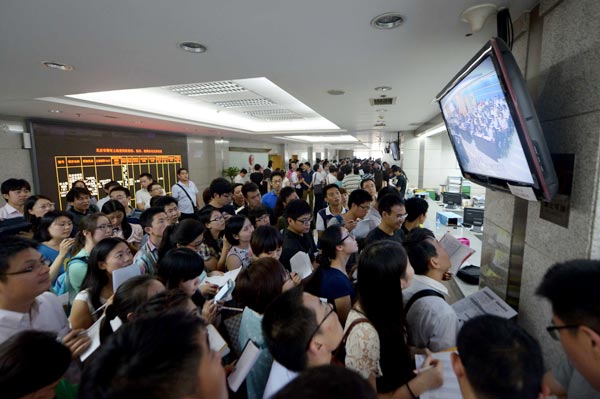
Representatives from property companies check offer prices at a recent land auction in Beijing. The capital city has seen a warm-up in its land market with sales reaching 191 billion yuan ($30.7 billion) this year. Provided to China Daily |
A new Deutsche Bank study says that last year, China's 300 cities faced a 37 percent drop in their land-sale revenues - which is a major setback given that land sales accounted for 35 percent of total local government revenues. Such revenues had risen at an average annual rate of 24 percent from 2009 to 2013.
Moreover, annual consumer and producer inflation dropped to 1.5 percent and minus 3.3 percent in December, owing partly to the sharp decline in world oil prices. China now faces deflation and an inhospitable external economic environment, and its urban centers are struggling with the complex interaction of solvency, liquidity and structural issues.
But some cities are better equipped than others to weather these challenges. China's first- and second-tier cities are very wealthy, benefiting from high property values and the continuous inflow of talent, capital, companies and investment projects. Despite a slowdown in the property market, Beijing's recent land auction concluded with record-breaking prices of about 38,000 yuan ($6,200) per square meter.
Third- and fourth-tier Chinese cities, however, face more challenging balance sheet adjustments, because of falling asset prices, outflows of labor and the need to define new growth models. In the aftermath of the post-2008 debt-fueled infrastructure-investment boom, these cities need to reform how revenue is shared with the central government, increase the transparency and accountability of local budgets, and overhaul the use of municipal-bond and public-private partnership models for local infrastructure projects.
But before such changes can be implemented, these cities must address the overhang of poorly performing projects and loss-making State-owned enterprises (SOEs). In fact, Chinese cities and local enterprises will need even more liquidity than would be required in a classic case of deflation, credit tightening and falling prices, because infrastructure and property investments by local governments and SOEs are still consuming funds. And, given State intervention, interest rates do not adjust quickly enough to allocate resources efficiently.


I’ve lived in China for quite a considerable time including my graduate school years, travelled and worked in a few cities and still choose my destination taking into consideration the density of smog or PM2.5 particulate matter in the region.
Copyright 1995 - . All rights reserved. The content (including but not limited to text, photo, multimedia information, etc) published in this site belongs to China Daily Information Co (CDIC). Without written authorization from CDIC, such content shall not be republished or used in any form. Note: Browsers with 1024*768 or higher resolution are suggested for this site.
License for publishing multimedia online 0108263 Registration Number: 130349