 |
|
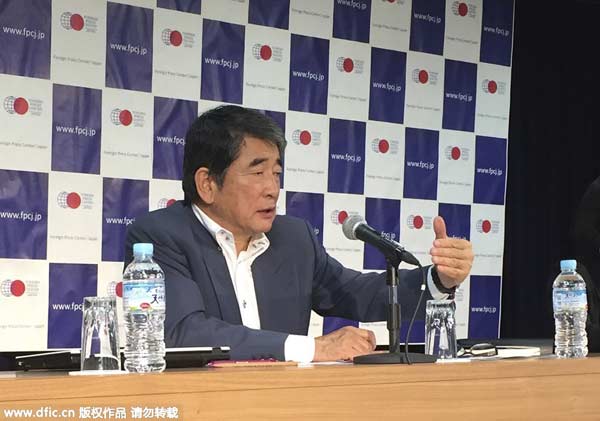
Yukio Okamoto, an outside director of Mitsubishi Materials, speaks to the foreign media in Tokyo Wednesday, July 22, 2015. Okamoto said that the company hopes to apologize to former British, Dutch and Australian World War II POWs, and also reach an amicable solution with Chinese forced laborers, following a landmark apology to American POWs earlier this week. [Photo/IC] |
A long-awaited apology came from Japan, but not from the government. Mitsubishi Materials Corporation, according to reports, has offered "sincere apology" and compensation in a proposed out-of-court settlement to Chinese plaintiffs seeking redress for forced labor during World War II. Just days ago, the company had apologized in Los Angeles for using American prisoners of war as slave laborers, becoming the first Japanese company to do so.
Hopefully, Mitsubishi Materials, one of the world's leading electronic product manufacturers, has set an example for the Japanese government to do some soul-searching on Japan's war atrocities.
Mitsubishi's move is believed to be an attempt to prevent its wartime past from damaging its image overseas and hampering its global operations. But the company's apology comes too late for most of the victims, as less than one-tenth of the Chinese forced laborers are alive, and most of them are in their 80s and 90s. They and the bereaved relatives of other victims of Japanese atrocities demand swift and complete settlement for the company's war crimes.
Japan invaded China in 1937 and ruled parts of the country with brutal force for the next eight years. Chinese historians say nearly 40,000 men were taken to Japan against their will to work in mines and at construction sites. Survivors say living conditions were appalling, and many did not make it back to China. After Japan's defeat in WWII, nearly all the Chinese who survived the ordeal were sent back home without being paid anything.
The Republic of Korea's historians estimate that at least 1.2 million Koreans were forced to work for Japan's war efforts in Japan, China and elsewhere. Roughly 300 Japanese companies still in operation are believed to have used them as "slave laborers".
More evidence of Japan's wartime use of forced labor has emerged in recent years, and lawsuits against the Japanese government and successors to the wartime mining companies have multiplied. But all have been rejected by Japanese courts.
The Japanese government says it will not "intervene" if the accused companies offer compensation. It argues, however, that the San Francisco Peace Treaty, China-Japan Joint Statement and the Korea-Japan Agreement have closed the door on reparation claims by former POWs, "comfort women" (women and girls forced into sexual slavery by the Imperial Japanese Army before and during WWII) and forced laborers, because it owns none of them.
After months of negotiations with the ROK, Japan announced - in English - at the UN Educational, Scientific and Cultural Organization's session in Bonn early this month that a large number of Koreans and other nationals were brought "against their will" and "forced to work" under harsh conditions in the 1940s at some of the industrial sites it has applied for world heritage status.
It was Japan's first acknowledgment of forced labor. But the wording "brought against their will and forced to work" was condensed to "brought to work" in the Japanese version of the announcement. The tricky use of language shows Japan's stance on the issue has not changed.
Mitsubishi rendered its apology and offered compensation even as "aggression" remains debatable for Japanese Prime Minister Shinzo Abe, who is expected to issue a statement on Japan's wartime past on Aug 14 on the 70th anniversary of the end of WWII.
Some members of Abe's advisory panel, which is tasked with providing inputs for his Aug 14 statement, say the word "aggression" is not defined clearly in international laws. Their remark echoes the line Abe took in parliament in 2013.
Telling the truth about and coming to terms with its past will improve Japan's relations with its neighbors and its moral standing in the world. Therefore, Japan must sincerely reflect on the devastation it wreaked on other countries before and during WWII. It owes far more than an apology to the victims of its aggression and atrocities, be they "comfort women" or forced laborers. And it should redress the victims' grievances legally and morally both.
The author is China Daily's Tokyo bureau chief. caihong@chinadaily.com.cn


I’ve lived in China for quite a considerable time including my graduate school years, travelled and worked in a few cities and still choose my destination taking into consideration the density of smog or PM2.5 particulate matter in the region.
Copyright 1995 - . All rights reserved. The content (including but not limited to text, photo, multimedia information, etc) published in this site belongs to China Daily Information Co (CDIC). Without written authorization from CDIC, such content shall not be republished or used in any form. Note: Browsers with 1024*768 or higher resolution are suggested for this site.
License for publishing multimedia online 0108263 Registration Number: 130349