 |
|
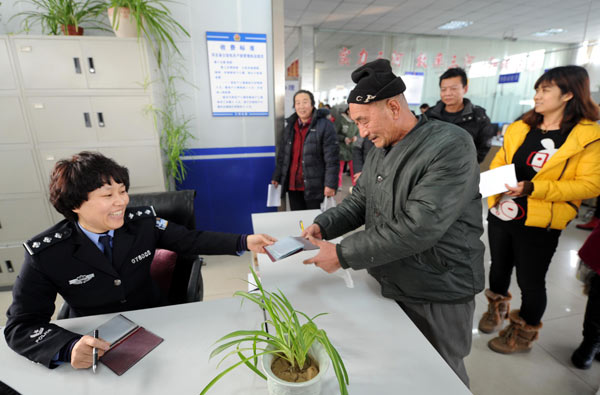
A man's hukou (household registration) is transferred at a government service center in Sanhe, Hebei province. [Photo/Agencies] |
Reform of the hukou, or household registration system, made great progress during the 12th Five-Year Plan (2011-15) period, as over 13 million people were officially admitted as urban residents. However, more still needs to be done as a growing number of people are living in cities without being regarded as residents.

In 2010, 35 percent of Chinese residents had an urban household registration, or hukou, while about 50 percent of the population resided in cities. In 2014, 54.7 percent of the population resided in cities, 36 percent of Chinese residents had an urban hukou.
The top leadership has, via several official documents, made clear its determination to comprehensively reform the hukou system in the coming years.
This will promote the free flow of labor, which in turn will bring huge economic benefits in the coming 13th Five-Year Plan (2016-20) period. Our research suggests that total reform of the household registration system might contribute 2 percentage points to the country's economic growth as it significantly expands the labor market by allowing and encouraging more rural surplus laborers to reside and work in cities.
Further, as the workers from rural areas work 12 hours longer than their urban counterparts per week on average, that will increase the total factor productivity of society.
More importantly, by allowing the population to flow freely and reside where they choose, the reform will create more jobs through the expansion of the service sector.
In a guiding plan on urbanization, the State Council, or the cabinet, raised the objective of transferring 7.4 percent of the total population, or about 100 million residents, from rural to urban areas. That goal will be impossible to achieve without a total reform of the hukou system.
Therefore, local government decision-makers are advised to pay more attention to the benefits of accelerating hukou reform than the costs.
Since the Third Plenum of the 18th Communist Party of China Central Committee, the top leadership has issued one guiding document after another on hukou reform, signaling their determination to reform the system. Local government leaders should build on this by deepening hukou reform.
The country's economic growth over the past years means the State finances are able to bear the cost of providing equal social security, welfare, and public services to those from rural areas that move to the cities. That means there is the wherewith to propel hukou reform and the leading officials of local governments need to seize the opportunity presented by this alignment of capability and will.
But this leads to the problem of fairly dividing the benefits and costs of hukou reform between the central and local governments. While releasing huge labor potential and bringing enormous economic benefits, the hukou reform also involves certain costs because the State will need to provide additional social services and welfare for the groups that freshly migrate to the cities. Obviously, under the current financial and monetary system, the central government needs to bear a bigger share of cost.
As the end of the 12th Five-Year Plan period approaches and the 13th is about to begin, the old hukou system is increasingly hindering the further development of the nation. This has further highlighted the necessity of reforming it. Both the central and the local levels of governments must bear the urgency of doing so in mind and make clear, unambiguous schedules, so that the Chinese economy will enjoy robust growth force in the 13th Five-Year Plan period.
The author is a researcher on urban-rural development at Shanghai Academy.
Editor's note: The print version on Oct 27, 2015, had by mistake called him "a researcher on urban-rural development at Shanghai Academy of Social Sciences". We regret the error.


I’ve lived in China for quite a considerable time including my graduate school years, travelled and worked in a few cities and still choose my destination taking into consideration the density of smog or PM2.5 particulate matter in the region.
Copyright 1995 - . All rights reserved. The content (including but not limited to text, photo, multimedia information, etc) published in this site belongs to China Daily Information Co (CDIC). Without written authorization from CDIC, such content shall not be republished or used in any form. Note: Browsers with 1024*768 or higher resolution are suggested for this site.
License for publishing multimedia online 0108263 Registration Number: 130349