 |
|
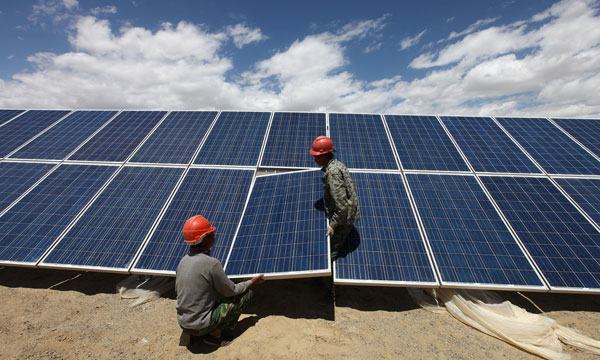
Workers install a solar panel at a photovoltaic power station in Aleteng village, northwest China. Job creation is an example of an economic co-benefit of tackling climate change. Photograph: REX/Imaginechina/REX/Imaginechina |
Paris is hosting the 21st global climate conference, and there are high hopes that negotiators will agree on a carbon-cutting treaty. But adding up the climate effects and costs of carbon-cutting commitments shows that there is something very wrong with this approach.
In a peer-reviewed research paper, I looked at the promises governments have committed to ahead of Paris (their so-called Intended Nationally Determined Contributions) for the years 2016-2030. These are what the global treaty will be based on.
By running this data through internationally recognized climate models, I found that the promises will cut global temperatures by just 0.05 degrees Celsius by 2100.China's contribution would be a 0.014 Creduction by 2100.
I also explored a far more optimistic, much less likely scenario. What if every government not only keeps every Paris promise but also shifts no emissions to other countries and keeps these reductions throughout the rest of the century? In that artificial scenario, temperatures will be reduced by just 0.17 C by 2100(with China contributing 0.048 C).
The United Nations Framework Convention on Climate Change claims "the INDCs have the capability of limiting the forecast temperature rise to around 2.7 C by 2100". This is advocacy, not science. It essentially assumes governments will do relatively little in Paris, but right after 2030 will embark on much more ambitious climate reductions.
Let us get back to reality. What will it cost to cut global temperatures by so little?
We can add up the price tags for the Paris promises submitted by the United States, the European Union, Mexico and China, which account for about 80 percent of pledged reductions.
The US promises to cut greenhouse gas emissions 26-28 percent below 2005 levels by 2025. Data from the peer-reviewed Stanford Energy Modeling Forum shows hitting the target would reduce GDP between $154 billion and $172 billion annually. The EU's promise-to cut emissions 40 percent below 1990 levels by 2030-would reduce GDP by 1.6 percent in 2030, or 287 billion ($305.68 billion) in terms of the value in 2010.Mexico's conditional promise to cut greenhouse gas and black carbon emissions by 40 percent below the current trend line would reach 4.5 percent of GDP by 2030.


I’ve lived in China for quite a considerable time including my graduate school years, travelled and worked in a few cities and still choose my destination taking into consideration the density of smog or PM2.5 particulate matter in the region.
Copyright 1995 - . All rights reserved. The content (including but not limited to text, photo, multimedia information, etc) published in this site belongs to China Daily Information Co (CDIC). Without written authorization from CDIC, such content shall not be republished or used in any form. Note: Browsers with 1024*768 or higher resolution are suggested for this site.
License for publishing multimedia online 0108263 Registration Number: 130349