 |
|
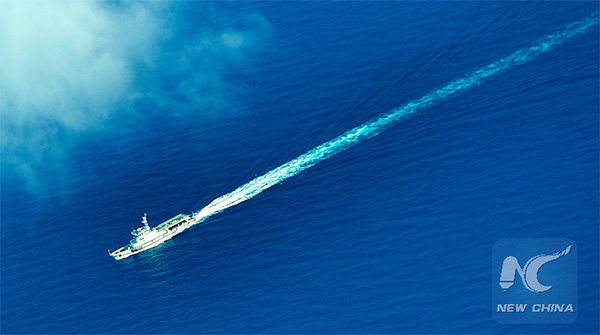
An aerial photo taken on Sept. 25, 2015 from a seaplane of Hainan Maritime Safety Administration shows cruise vessel Haixun 1103 heading to the Yacheng 13-1 drilling rig during a patrol in south China Sea. [Photo/Xinhua] |
The United States claims that it does not take a position on the sovereignty disputes regarding islands in the South China Sea. Its military actions, however, prove otherwise.
In the past several months, the US military has visibly ratcheted up its posture in the South China Sea. By using "freedom of navigation" as a pretext, the US has been directly challenging China's sovereignty and maritime rights and interests in the South China Sea and siding with the Philippines against China. It has moved from behind the scenes to center stage and become deeply involved in the disputes.
The US knows full well that it is impossible to deter China from defending its rights in the South China Sea. By deploying military assets on top of a series of diplomatic and public opinion campaigns, Washington hopes to pressure China into accepting a settlement of the disputes that suits the US. But that is a miscalculated move.
Naturally, the US' actions have been vehemently criticized by the Chinese government. They not only go against the Declaration on the Conduct of Parties in the South China Sea, an agreement signed by China and all the members of the Association of Southeast Asian Nations, but also the dual-track approach advocated by China. (Namely, the handling of disputes through direct negotiations by the countries concerned and the joint efforts of China and ASEAN to maintain peace and stability in the South China Sea.)
Despite all the media hype about potential military confrontation and armed conflicts in the region, it is unlikely that they are the intended result of the US' actions. For China and the US, the importance of cooperation outweighs competition. While the US would like to hold back China's development by singling out the maritime disputes in the South China Sea and making the South China Sea issue a regional flashpoint, the global dimension and comprehensive nature of China-US relations suggest there is little possibility that the South China Sea issue could dominate the course of the relations.
However, the US is playing a dangerous game. Although its aim is to counter China's growing strength, the US can't afford to see the hawks take over at home and risk losing control over tensions in the South China Sea. China is an indispensable partner for the US in solving key global and regional issues, and cooperation between China and the US serves the fundamental interests of both countries and the need for peace and development in the wider world.
In addition, despite their serious divide on the South China Sea issue, China and the US do share one thing in common. Both advocate a negotiated settlement of the disputes. Moreover, even though frictions do occur from time to time between China and the US, there are bilateral mechanisms to prevent those frictions from spinning out of control. For instance, the Memorandum of Understanding on Rules of Behavior for the Safety of Air and Maritime Encounters, which the two sides announced in 2014, provides a code of conduct for effective and normal communication between the two navies. Up till now, Chinese and US naval vessels have been able to act in a professional and rules-based manner, which is also critical for avoiding miscalculation and accidents as well as keeping the South China Sea stable.
Based on the above analysis, to advance its rebalancing strategy, the US will continue to meddle in the South China Sea issue, using political, diplomatic, military tools and public opinion to challenge China's territorial sovereignty and maritime rights and interests so as to build obstacles to China's development. But it will limit the scale and intensity of such actions so as not to upset the cooperation between the two sides on critical issues. It is also hard to imagine that the US would ever take a high risk and pay a heavy price in the interests of another country.
The author is a senior research fellow at the China Foundation for International Studies.
Courtesy: chinausfocus.com


I’ve lived in China for quite a considerable time including my graduate school years, travelled and worked in a few cities and still choose my destination taking into consideration the density of smog or PM2.5 particulate matter in the region.
Copyright 1995 - . All rights reserved. The content (including but not limited to text, photo, multimedia information, etc) published in this site belongs to China Daily Information Co (CDIC). Without written authorization from CDIC, such content shall not be republished or used in any form. Note: Browsers with 1024*768 or higher resolution are suggested for this site.
License for publishing multimedia online 0108263 Registration Number: 130349