 |
|
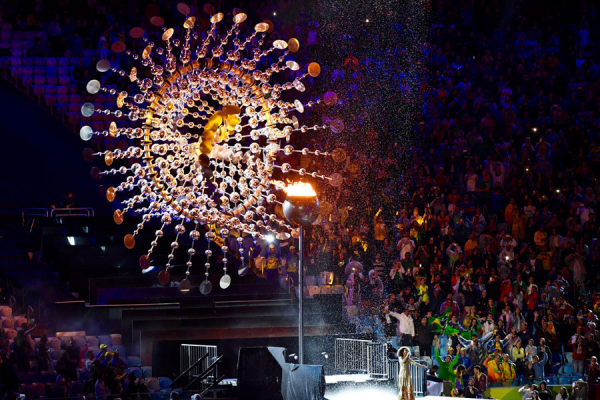
Brazilian singer Mariene de Castro sings as rain extinguishes the Olympic flame during the closing ceremony for Rio Olympics at Maracana stadium in Rio de Janeiro, Brazil, Aug 21, 2016. [Photo by Wei Xiaohao/chinadaily.com.cn] |
The reason why China had an impressive medal tally of 70 at the Rio Olympic Games and India looked pathetic with two can be summed up in three words: attitude to sports.
Even though China was third in the medals table, it might already be discussing why it could not better its tally of 88 medals at London 2012.
In contrast, India is in a euphoric mood, showering its badminton silver medallist P.V. Sindhu and wresting bronze winner Sakshi Malik with insane amounts of money and prestigious state awards. Honors have also been bestowed upon gymnast Dipa Karmakar, who missed the bronze by a whisker, and shooter Jitu Rai, who has won a dozen medals including gold and silver in the past two years but drew a blank in Rio.
China and India are two of the most populous countries and two of the fastest growing major economies, but their similarity ends there. Their views on sports differ dramatically. Indian parents do not take sports seriously. Unlike their Chinese counterparts, Indians consider sports (except perhaps for cricket) a mere pastime, not a profession, and tend to push their children toward money-spinning vocations like medicine, engineering and IT.
In China, however, hundreds of children, barely three or four years old, are trained rigorously to be outstanding athletes. Some may view such regimented life for children as almost brutal, but sports, like any other vocation or field of activity, requires sweat and sacrifice, which Indians are not ready to put in.
Also, compared with China's, India's sports infrastructure and facilities are pathetic. Even while the Rio Olympics was on, NDTV, a leading Indian television news channel, telecast a report on how young children were made to practice swimming in a place in northern India: they were forced to swim in muddy waters infested with snakes and lizards while a nearby government sports facility had been shut down.
Adding to such government apathy are corruption and nepotism, all of which conspire to blot out genuine talent, leading to the selection of subpar candidates for sports competitions like the the Olympics and Commonwealth Games.
And when a rare talent like Budhia Singh emerges, his dreams are snuffed out. In 2006, even before reaching the age of five, Budhia became the world's youngest marathon runner. His coach Biranchi Das was hopeful that he would win India its first athletic gold at the Olympics. But child welfare officials, reportedly jealous of Das' fame, accused him of brutality toward Budhia and stopped him from running. Soon, Das was shot dead. Today, Budhia who is now 14 languishes in a government-run boarding school, and says he cannot even win a school race.
The lesson here is clear. Catch them young-like in China-if you want boys and girls to excel in sports.
Fuelling India's woeful state of affairs in sports is poverty. Many sportsmen hail from very poor families, and lack of government support renders them incapable of competing in international games. They cannot afford to buy nutritious food, let alone find the money to undergo professional training.
Some of India's poorest people belong to indigenous ethnic groups. They have great physique and immense stamina. They are people of the outdoors. And they can be brilliant sportsmen and sportswomen if only they get the right food, remuneration, training and, most importantly, administrative encouragement. But in a nation like India, steeped as it is in divisive religious and caste prejudices, the indigenous groups are placed at the bottom of social hierarchy, and hence shunned.
In short, while China approaches sports with a military-level precision, India is a bundle of bureaucratic bungles and organizational clumsiness laced with amateurism. No wonder even the rare individual brilliance perishes in the face of insurmountable odds. It takes a nation like China to make a champion out of a talent like Budhia.
The author is an Indian writer and movie critic.

 Game of wealth requires strong will power
 Brexit tells world to change path of globalization

Copyright 1995 - . All rights reserved. The content (including but not limited to text, photo, multimedia information, etc) published in this site belongs to China Daily Information Co (CDIC). Without written authorization from CDIC, such content shall not be republished or used in any form. Note: Browsers with 1024*768 or higher resolution are suggested for this site.
License for publishing multimedia online 0108263 Registration Number: 130349